


All blogs
Share
Published on 24 August, 2026
Radiodiagnosis NEET PG Speciality: Course, Eligibility, Seats, Cutoff, Fees & Career Scope
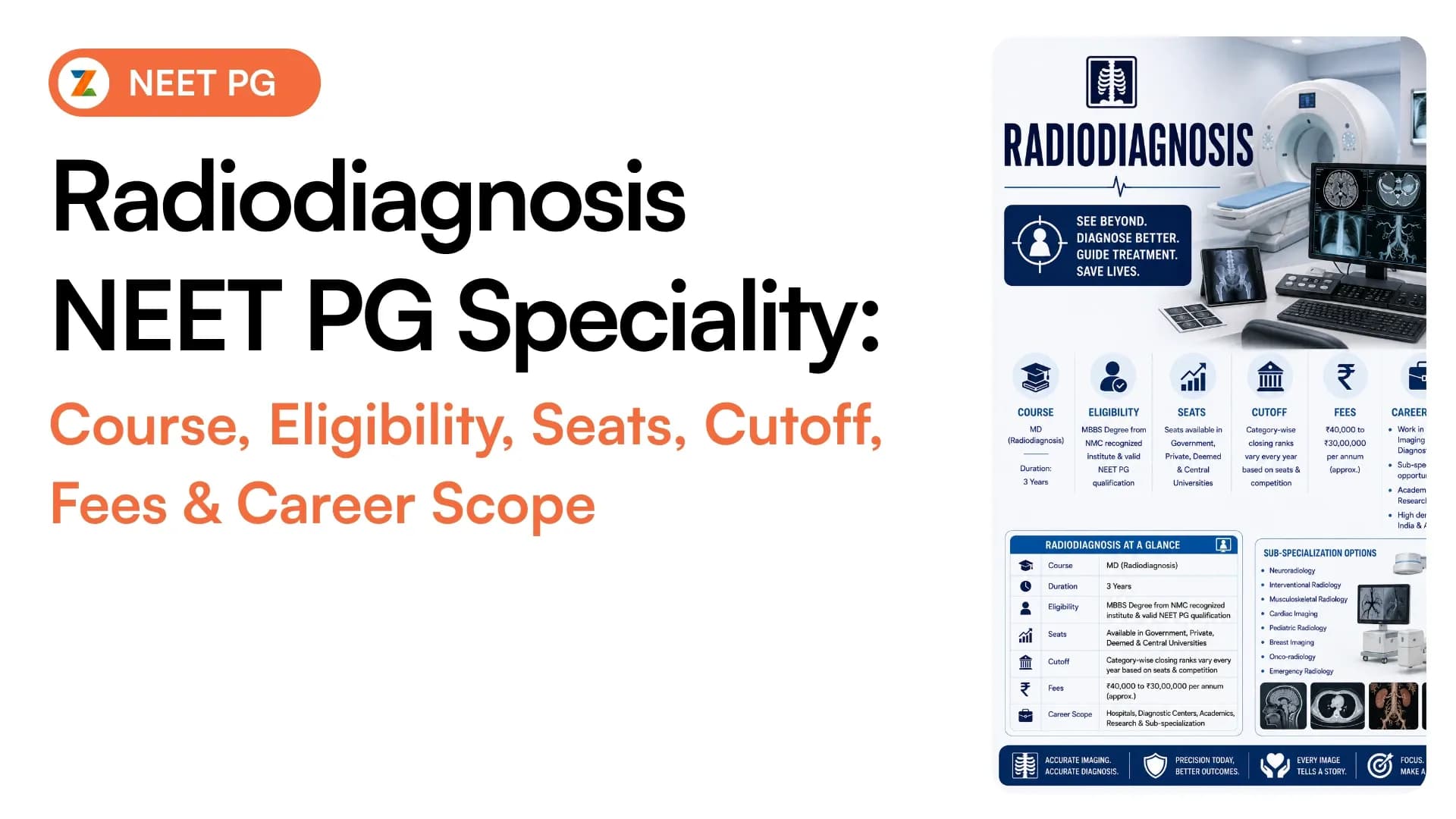
Radiodiagnosis is one of the most sought-after clinical specialities among NEET PG aspirants who are interested in medical imaging, technology, diagnosis and image-guided procedures. Radiologists use imaging modalities such as X-ray, ultrasound, CT and MRI to identify diseases, assess their severity and support treatment decisions. The National Medical Commission (NMC) lists MD in Radiodiagnosis as a postgraduate broad speciality programme. This blog focuses on the 2025 All India Counselling process for the speciality.
For MBBS graduates, the principal postgraduate pathways include MD Radiodiagnosis and DNB Radio Diagnosis. Both provide structured postgraduate training, although the institutions, training environment and counselling pathways can differ. DNB Radio Diagnosis is a three-year post-MBBS programme through NEET PG.
Radiodiagnosis is particularly attractive for aspirants who enjoy anatomy, image interpretation, technology and multidisciplinary clinical decision-making. However, the speciality also demands strong diagnostic reasoning, attention to detail and the ability to work accurately under pressure.
What is Radiodiagnosis?
Radiodiagnosis is a medical speciality concerned primarily with diagnosing diseases and abnormalities using medical imaging. A radiologist interprets images, correlates imaging findings with clinical information and communicates findings to the treating team.
The speciality covers conventional and advanced imaging techniques. The NMC's competency-based curriculum aims to train postgraduate students in conventional and modern radiology and imaging techniques, along with the basic knowledge required across radiology subspecialities.
Major imaging modalities include:
X-ray: Used extensively for chest, bone and emergency imaging.
Ultrasound: Used for abdominal, pelvic, obstetric, vascular and many other applications.
CT scan: Provides cross-sectional images and is widely used in trauma, emergencies, oncology and vascular imaging.
MRI: Offers detailed soft-tissue imaging and is important in neurological, musculoskeletal, abdominal and pelvic imaging.
Mammography: Used primarily for breast imaging and screening.
Fluoroscopy: Provides real-time X-ray imaging for selected diagnostic and procedural applications.
NEET PG Course Options in Radiodiagnosis (MD/MS/DNB)
There are three major postgraduate pathways in Radiodiagnosis:
Branch | Course | Availability |
|---|---|---|
Radiodiagnosis | MD | Yes |
DNB | Yes | |
PG Diploma | Yes | |
MS | No |
Radiodiagnosis Eligibility Criteria
To pursue MD Radiodiagnosis or Post-MBBS DNB Radio Diagnosis through NEET PG, candidates generally need to meet the NEET PG eligibility requirements.
The basic requirements include:
A recognised MBBS degree or provisional MBBS pass certificate.
Permanent or provisional registration with the appropriate medical regulator.
Completion of the required one-year internship, or completion by the prescribed cutoff date for the relevant admission session.
Qualification in NEET PG.
Fulfilment of the specific eligibility requirements prescribed in the NEET PG information bulletin and counselling rules.
Radiodiagnosis Course Duration
Radiodiagnosis postgraduate training is typically 3 years for MD and DNB, while the PG Diploma route is 2 years. The duration may vary for specific pathways, so candidates should check the latest NMC and NBEMS regulations for eligibility and course structure.
Course | Duration |
|---|---|
MS Radiodiagnosis | 3 years |
DNB Radiodiagnosis | 3 years |
PG Diploma | 2 years |
Radiodiagnosis Seat Availability
Radiodiagnosis seats are offered through MD, DNB and PG Diploma programmes across medical institutions. The table below shows the available Radiodiagnosis seats based on 2025 All India Counselling.
Institute type | Diploma in Radio Therapy | Diploma in Radio-Diagnosis | Diploma in Radio-Diagnosis-NBE | DNB Radio Diagnosis | DNB Radio Therapy | MD Radio Diagnosis |
|---|---|---|---|---|---|---|
Deemed | - | - | - | - | - | 466 |
Government | 1 | 8 | - | - | - | 534 |
NBE - Government Institute | - | - | 71 | 8 | - | - |
NBE - Private Institute | - | - | 163 | 452 | 164 | - |
NBE - Public Sector Institute | - | - | - | 1 | - | - |
Total Seats | 1 | 8 | 234 | 461 | 164 | 1000 |
Radiodiagnosis Previous Year's Cutoff Trends
Radiodiagnosis is among the most competitive NEET PG specialities, with cutoff ranks varying based on college, category, quota and counselling round. The table below shows the previous year's Radiodiagnosis cutoff trends of All India Counselling.
Speciality | College Type | Closing Ranks |
|---|---|---|
Diploma in Radio Therapy | Government | 35404 |
Diploma in Radio-Diagnosis | Government | 59759 |
Diploma in Radio-Diagnosis-NBE | Government | 152520 |
Diploma in Radio-Diagnosis-NBE | Private | 19638 |
DNB Radio Diagnosis | Government | 15070 |
DNB Radio Diagnosis | Private | 8408 |
DNB Radio Therapy | Private | 30194 |
MD Radio Diagnosis | Deemed | 224521 |
MD Radio Diagnosis | Government | 158994 |
For detailed General Medicine closing ranks across All India Counselling and individual state counselling, refer to ZyNerd’s Allotment Mapping for college-wise and round-wise data.
Radiodiagnosis Fee Range
Radiodiagnosis fees vary significantly across government, private and deemed medical colleges, as well as different admission quotas. The table below shows the 2025 fee range for Radiodiagnosis courses of All India Counselling.
Speciality | College Type | Fee Range |
|---|---|---|
Diploma in Radio Therapy | Government | 123400 |
Diploma in Radio-Diagnosis | Government | 1550-157100 |
Diploma in Radio-Diagnosis-NBE | Government | 125000 |
Diploma in Radio-Diagnosis-NBE | Private | 125000 |
DNB Radio Diagnosis | Government | 125000 |
DNB Radio Diagnosis | Private | 125000 |
DNB Radio Therapy | Private | 125000 |
MD Radio Diagnosis | Government | 1550-2500000 |
MD Radio Diagnosis | Deemed universities | 2600000-17705680 |
Note: The fee range appears broad because it is based on the 2025 All India Counselling data and includes different types of institutions and quotas. Actual fees may vary significantly depending on the college, quota and state, so candidates can check the applicable fee structure before making their choices.
For detailed fee, stipend and bond information across All India Counselling and all state counsellings, refer to ZyNerd’s institute-wise data for updated college and counselling-specific details. Select the college and quota filters to view in-depth fee, stipend and bond details for your preferred options.
What Will You Learn In Radiodiagnosis?
During MD Radiodiagnosis, students develop competencies in diagnostic imaging, image interpretation, patient evaluation and selected image-guided procedures.
The NMC curriculum specifically aims to develop competence in conventional and modern radiology and imaging techniques and familiarity with radiology subspecialities.
Major areas of training include:
1. Conventional radiography
Students learn systematic interpretation of X-rays and identification of normal and abnormal findings.
2. Ultrasound
Training includes abdominal, pelvic, obstetric, vascular and other ultrasound applications.
3. CT imaging
Students learn CT protocols, contrast studies, emergency imaging and interpretation of cross-sectional anatomy.
4. MRI
Training involves MRI principles, protocols and interpretation across neurological, musculoskeletal, abdominal, pelvic and other applications.
5. Emergency radiology
Residents learn to recognise urgent findings in trauma, stroke, acute abdomen, chest emergencies and other clinical situations.
6. Contrast imaging
Students gain experience with contrast-enhanced imaging and learn to consider indications, contraindications and potential adverse reactions.
7. Interventional procedures
Depending on the institution, residents may receive exposure to image-guided procedures.
8. Communication and multidisciplinary practice
Radiologists work closely with surgeons, physicians, oncologists, emergency physicians and other specialists. The curriculum also emphasises interdisciplinary conduct and appropriate documentation.
Top Colleges Offering Radiodiagnosis
The choice of college is important because radiology training is strongly influenced by imaging infrastructure, patient volume, faculty expertise and exposure to different modalities.
Some well-known institutions offering postgraduate radiology training include:
All India Institute of Medical Sciences, New Delhi
Vardhman Mahavir Medical College and Safdarjung Hospital
Maulana Azad Medical College
Seth Gordhandas Sunderdas Medical College
Sanjay Gandhi Postgraduate Institute of Medical Sciences
Institute of Medical Sciences, Banaras Hindu University
University College of Medical Sciences
Madras Medical College
Government Medical College, Thiruvananthapuram
Government Medical College, Kozhikode
Career Opportunities After Radiodiagnosis
After completing MD Radiodiagnosis or DNB Radio Diagnosis, doctors can pursue careers across hospitals, diagnostic centres, academic institutions and specialised imaging practices.
Common career paths include:
Consultant Radiologist
Radiologists can work in government or private hospitals, diagnostic centres and multispeciality healthcare institutions.
Hospital-based Radiologist
Large hospitals offer exposure to emergency radiology, oncology, trauma, inpatient imaging and multidisciplinary clinical care.
Diagnostic Imaging Centres
Radiologists may work in standalone or chain diagnostic centres with high volumes of CT, MRI, ultrasound and X-ray studies.
Academic Career
Doctors interested in teaching and research can pursue academic positions in medical colleges and teaching hospitals.
Interventional Radiology
Doctors interested in image-guided procedures can pursue further specialised training in interventional radiology.
Teleradiology
Digital imaging has created opportunities for remote reporting, allowing qualified radiologists to interpret scans for healthcare facilities in different locations.
Research and Medical Technology
Radiologists may also participate in clinical research, imaging technology development, artificial intelligence applications and medical education.
Super-Specialization / Fellowship Options
Radiology offers several avenues for further specialisation. The exact pathway can involve fellowships, institutional programmes or other recognised advanced training rather than a single universal super-speciality route.
Possible areas include:
Interventional Radiology
Neuroradiology
Musculoskeletal Radiology
Breast Imaging
Abdominal Imaging
Cardiothoracic Imaging
Paediatric Radiology
Foetal Imaging
Oncologic Imaging
Emergency Radiology
Nuclear medicine-related imaging exposure
Advanced MRI and CT imaging
Common Conditions Managed / Procedures Performed
Radiologists are involved in the diagnosis and imaging evaluation of a very broad range of conditions.
Common clinical areas include:
Brain tumours and intracranial lesions
Stroke and cerebrovascular disease
Head and neck disorders
Chest infections and lung disease
Pulmonary nodules and lung cancer
Abdominal and liver diseases
Gallbladder and biliary disorders
Kidney and urinary tract diseases
Gastrointestinal disorders
Bone and joint diseases
Sports injuries
Spinal disorders
Breast diseases
Gynaecological and pelvic conditions
Paediatric conditions
Congenital abnormalities
Trauma and emergency conditions
Cancer staging and treatment assessment
Depending on their training and institution, radiologists may also perform or assist with procedures such as:
Image-guided biopsies
FNAC or aspiration procedures
Drainage procedures
Vascular access procedures
Image-guided injections
Contrast studies
Interventional radiology procedures
The exact procedural exposure depends heavily on the institution and the resident's area of training.
Factors to Consider Before Choosing Radiodiagnosis
Radiodiagnosis can be an excellent speciality, but it should be chosen based on personal aptitude rather than only its perceived demand or earning potential.
1. Interest in anatomy and imaging
A strong interest in anatomy and pattern recognition can make radiology more engaging.
2. Comfort with technology
The speciality involves continuous interaction with advanced imaging equipment and evolving digital technologies.
3. Attention to detail
Small imaging findings can have major clinical implications, so careful observation is essential.
4. Diagnostic responsibility
Radiologists often make important diagnostic contributions that influence subsequent treatment decisions.
5. Work environment
Compared with many procedural clinical specialities, radiology can involve less continuous bedside interaction, although this varies significantly by workplace and role.
6. Emergency workload
Emergency imaging can be demanding, especially in high-volume tertiary hospitals.
7. College infrastructure
When choosing between seats, check:
CT availability
MRI availability
Ultrasound workload
Interventional exposure
Emergency imaging volume
Number of residents
Faculty strength
Reporting workload
Case diversity
Academic activities
Research opportunities
8. Future specialisation
If you are interested in neuroradiology, interventional radiology, breast imaging or another subspeciality, investigate whether the institution provides meaningful exposure in that area.
9. Fees and return on investment
A high-fee private seat should be evaluated carefully against the total cost of education, expected training quality and future career plans.
10. MD versus DNB
Both MD and DNB are recognised postgraduate pathways, but the training environment can differ substantially from one institution to another. Instead of judging only by the qualification title, compare the specific hospital's patient load, imaging infrastructure, faculty, case mix and academic environment.
_11zon.webp)
Frequently Asked Questions
Here are some answers to questions you might be looking for.

Related Blogs
Paediatrics NEET PG Speciality: Course, Eligibility, Seats, Cutoff, Fees and Career Scope
Paediatrics is one of the most sought-after clinical specialities among NEET PG aspirants who enjoy working with children and want to build a career focused on preventive, diagnostic and therapeutic care from infancy through adolescence.
Aug 24, 2026
Ophthalmology NEET PG Speciality: Course, Eligibility, Seats, Cutoff, Fees, Career & Fellowship Options
Ophthalmology is a popular surgical speciality that focuses on the diagnosis, treatment and prevention of disorders affecting the eye, visual system and related structures. For NEET PG aspirants, it offers a combination of clinical medicine, microsurgery, diagnostic procedures and technology-driven treatments.
Aug 24, 2026
NEET PG General Medicine Speciality: Course, Cutoff, Fees, Seats & Career Scope
General Medicine is one of the most popular clinical specialties among NEET PG aspirants who wish to pursue a career in adult patient care, diagnosis and comprehensive disease management. The specialty is also called Internal Medicine.
Aug 23, 2026
Orthopaedics NEET PG Speciality: Courses, Eligibility, Cutoff, Fees & Career Scope
Orthopaedics is one of the most sought-after surgical specialities among NEET PG aspirants who are interested in the diagnosis and treatment of disorders involving the bones, joints, muscles, ligaments, tendons and spine.
Aug 23, 2026
General Surgery NEET PG: Course, Eligibility, Cutoff, Fees, Colleges & Career Scope
General Surgery is one of the most sought-after clinical specialities among NEET PG aspirants who are interested in operative care, emergency medicine, trauma management and hands-on patient treatment.
Aug 23, 2026
Anaesthesiology NEET PG Speciality: Courses, Eligibility, Seats, Cutoff, Fees & Career Scope
Anaesthesiology is a clinical postgraduate speciality that focuses on the safe management of patients before, during and after surgery and other invasive procedures. Anaesthesiologists are responsible for administering anaesthesia, maintaining vital functions, managing pain, supporting critically ill patients and responding to medical emergencies.
Aug 23, 2026