


All blogs
Share
Published on 23 August, 2026
Anaesthesiology NEET PG Speciality: Courses, Eligibility, Seats, Cutoff, Fees & Career Scope
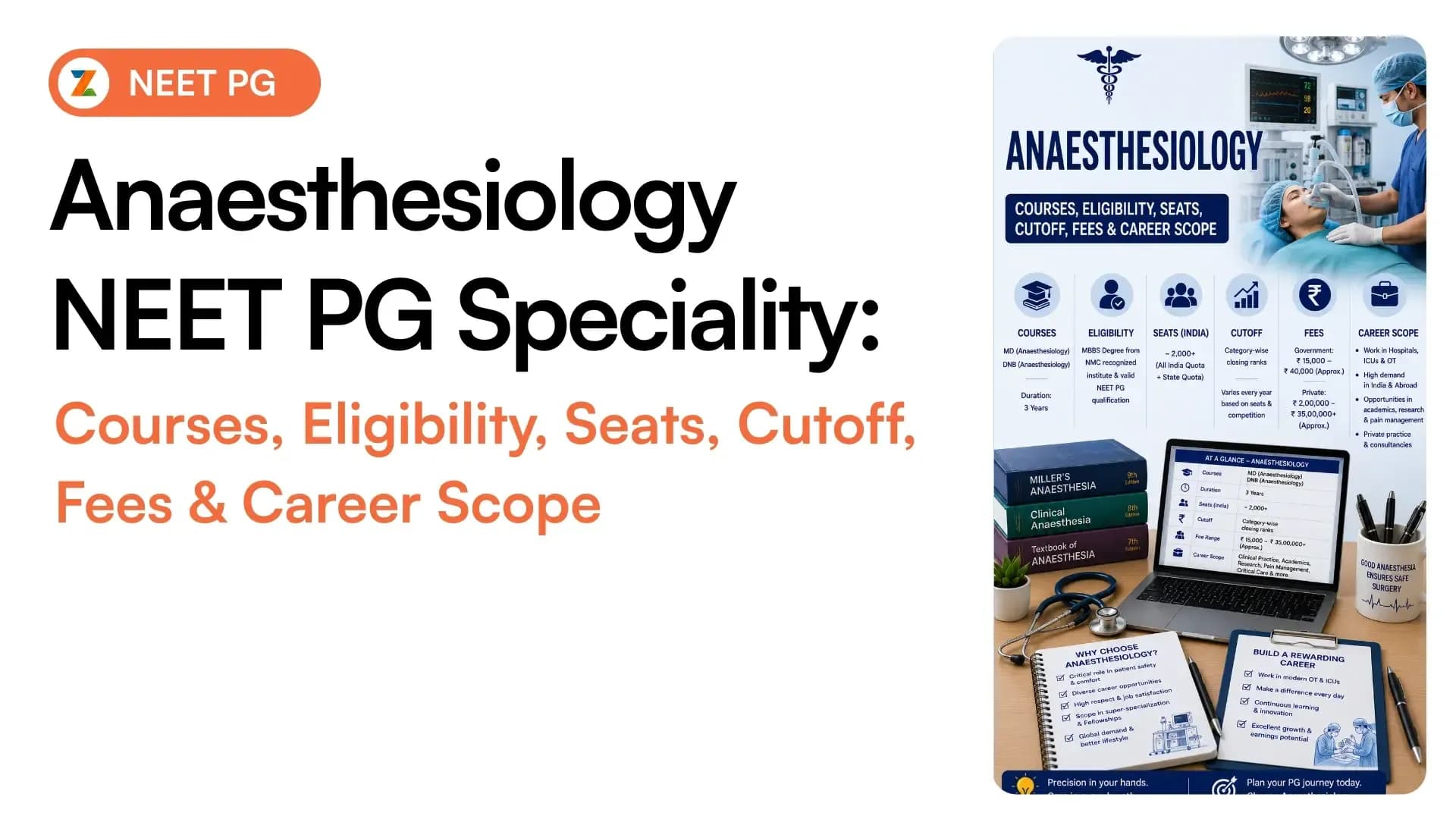
Anaesthesiology is a clinical postgraduate speciality that focuses on the safe management of patients before, during and after surgery and other invasive procedures. Anaesthesiologists are responsible for administering anaesthesia, maintaining vital functions, managing pain, supporting critically ill patients and responding to medical emergencies. This blog focuses on the 2025 All India Counselling process for the speciality.
For NEET PG aspirants, Anaesthesiology is an important clinical speciality because it combines pharmacology, physiology, critical care, emergency medicine and hands-on procedural skills. The speciality also offers career opportunities in operating rooms, intensive care units, trauma centres, pain clinics and academic institutions.
What is Anaesthesiology?
Anaesthesiology is the branch of medicine concerned with anaesthesia, perioperative medicine, resuscitation, critical care and pain management. An anaesthesiologist evaluates a patient's medical condition before a procedure, selects an appropriate anaesthetic technique, monitors the patient throughout the procedure and manages recovery afterwards.
The speciality involves much more than administering anaesthesia. Anaesthesiologists manage the airway, circulation, ventilation, fluids, blood loss, pain and other physiological changes that may occur during surgery. They also play an important role in intensive care, trauma management, emergency medicine and chronic pain services.
The NMC recognises MD in Anaesthesiology as a postgraduate medical qualification and maintains competency-based postgraduate curriculum resources for the speciality.
NEET PG Course Options in Anaesthesiology (MD/MS/DNB)
There are three major postgraduate pathways in Anaesthesiology:
Branch | Course | Availability |
|---|---|---|
Anaesthesiology | MD | Yes |
DNB | Yes | |
PG Diploma | Yes | |
MS | No |
Anaesthesiology Eligibility Criteria
To pursue MD or DNB Anaesthesiology through NEET PG, candidates generally need to meet the eligibility requirements prescribed for NEET PG and postgraduate medical admissions.
The key requirements include:
Candidates must possess a recognised MBBS degree or provisional MBBS pass certificate.
Candidates must have completed or be completing the required one-year internship within the prescribed timeline for the relevant admission session.
Candidates must hold permanent or provisional registration with the appropriate medical regulatory authority.
Candidates must qualify NEET PG and participate in the applicable counselling process.
Admission and reservation requirements are subject to the latest NEET PG information bulletin and counselling rules.
Anaesthesiology Course Duration
MD and DNB in Anaesthesiology are 3-year postgraduate courses pursued after MBBS through NEET PG. PG Diploma in Anaesthesiology is a 2-year course, providing focused training in anaesthesia and perioperative care.
Course | Duration |
|---|---|
MD Anaesthesiology | 3 years |
DNB Anaesthesiology | 3 years |
PG Diploma Anaesthesiology | 2 years |
Anaesthesiology Seat Availability
Anaesthesiology seats are available across colleges through MD and PG Diploma programmes. The table below shows the 2025 seat availability for MD and PG Diploma in Anaesthesiology across government and private institutions.
Institute type | MD Anaesthesiology | DNB Anaesthesiology | Diploma Anaesthesiology - NBE | Diploma Anaesthesiology |
|---|---|---|---|---|
Deemed | 597 | - | - | - |
Government | 1374 | - | - | 32 |
NBE - Government Institute | - | 137 | 155 | - |
NBE - Private Institute | - | 882 | 287 | - |
NBE - Public Sector Institute | - | 21 | - | - |
Total Seats | 1971 | 1040 | 442 | 32 |
Anaesthesiology Previous Year's Cutoff Trends
Anaesthesiology cutoff trends vary based on the institute, category, counselling round and course type. The table below shows the 2025 All India counselling cutoff trends for MD, DNB and PG Diploma in Anaesthesiology.
Speciality | Counselling | College Type | Closing Ranks |
|---|---|---|---|
MD Anaesthesiology | All India | Government | 4233 |
MD Anaesthesiology | All India | Deemed | 1888 |
DNB Anaesthesiology | All India | Government | 405 |
DNB Anaesthesiology | All India | Private | 2678 |
PG Diploma Anaesthesiology | All India | Government | 590 |
For detailed General Medicine closing ranks across All India Counselling and individual state counselling, refer to ZyNerd’s Allotment Mapping for college-wise and round-wise data.
Anaesthesiology Fee Range
The fee for Anaesthesiology varies depending on the course, institution, quota and type of medical college. The table below provides an overview of the fee range for MD, DNB and PG Diploma in Anaesthesiology across different institutions.
Speciality | Academic Year | College Type | Fee Range |
|---|---|---|---|
MD Anaesthesiology | 2025 | Government | 1550-1200000 |
Deemed Universities | 2029500-8453800 | ||
DNB Anaesthesiology | 2025 | Private | 125000 |
Government | 125000 | ||
PG Diploma Anaesthesiology - NBE | 2025 | Government | 125000 |
Private | 125000 | ||
PG Diploma Anaesthesiology | 2025 | Government | 9000-157100 |
Note: The fee range appears broad because it is based on the 2025 All India Counselling data and includes different types of institutions and quotas. Actual fees may vary significantly depending on the college, quota and state, so candidates can check the applicable fee structure before making their choices.
For detailed fee, stipend and bond information across All India Counselling and all state counsellings, refer to ZyNerd’s institute-wise data for updated college and counselling-specific details. Select the college and quota filters to view in-depth fee, stipend and bond details for your preferred options.
What Will You Learn in Anaesthesiology?
MD Anaesthesiology provides comprehensive training in the scientific and clinical aspects of anaesthesia and perioperative care.
Major areas of learning include:
Anaesthetic Pharmacology
Students learn the pharmacology, indications, contraindications and adverse effects of intravenous and inhalational anaesthetic agents, analgesics, muscle relaxants and other drugs used in perioperative care.
Airway Management
Training includes airway assessment and management, endotracheal intubation, supraglottic devices, difficult airway management and emergency airway techniques.
General Anaesthesia
Residents learn how to plan, administer and monitor general anaesthesia for different types of surgical procedures.
Regional Anaesthesia
Training includes spinal, epidural and peripheral nerve block techniques and their applications in surgical and pain management.
Perioperative Medicine
Students learn preoperative assessment, optimisation of patients, intraoperative monitoring and postoperative care.
Critical Care
Anaesthesiology residency provides exposure to ventilated patients, haemodynamic monitoring, sepsis management, resuscitation and other intensive care practices.
Pain Medicine
Residents learn approaches to acute postoperative pain, chronic pain and procedural pain management.
Emergency and Resuscitation
Training includes cardiopulmonary resuscitation, management of shock, trauma and other life-threatening emergencies.
High-yield preparation areas for NEET PG aspirants also commonly include anaesthetic drugs, airway management, ventilation, monitoring, regional anaesthesia, perioperative complications and critical care concepts.
Top Colleges Offering Anaesthesiology
Some well-known institutions offering postgraduate training in Anaesthesiology include:
All India Institute of Medical Sciences (AIIMS), New Delhi
Maulana Azad Medical College (MAMC), New Delhi
Vardhman Mahavir Medical College and Safdarjung Hospital, New Delhi
PGIMER, Chandigarh
Jawaharlal Institute of Postgraduate Medical Education and Research (JIPMER), Puducherry
Institute of Medical Sciences, Banaras Hindu University, Varanasi
Seth GS Medical College and KEM Hospital, Mumbai
Bangalore Medical College and Research Institute, Bengaluru
Madras Medical College, Chennai
Grant Medical College and Sir J.J. Hospital, Mumbai
Government Medical College, Chandigarh
Sanjay Gandhi Postgraduate Institute of Medical Sciences, Lucknow
Career Opportunities After Anaesthesiology
Anaesthesiology offers career opportunities across multiple healthcare settings.
Hospital-Based Anaesthesiologist
Anaesthesiologists can work in government hospitals, private hospitals, multispeciality centres and surgical facilities.
Critical Care
With appropriate training and experience, anaesthesiologists can build careers in intensive care and manage critically ill patients requiring advanced monitoring and organ support.
Pain Medicine
Pain clinics provide opportunities to manage acute and chronic pain using pharmacological, interventional and multidisciplinary approaches.
Trauma and Emergency Care
Anaesthesiologists are frequently involved in trauma resuscitation, emergency airway management and perioperative care of critically ill patients.
Academic Medicine
Doctors interested in teaching can pursue careers as faculty members in medical colleges and training institutions.
Research
Anaesthesiologists can participate in clinical research involving anaesthetic drugs, perioperative medicine, pain, critical care, airway management and patient safety.
Private Practice
Experienced specialists can work with hospitals and surgical centres or establish pain management-focused clinical practices, depending on applicable regulations and local healthcare requirements.
Super-Specialization / Fellowship Options
After MD or DNB Anaesthesiology, doctors can pursue advanced training in several focused areas.
Potential pathways include:
Cardiac Anaesthesia
Neuroanaesthesia
Paediatric Anaesthesia
Transplant Anaesthesia
Critical Care Medicine
Pain Medicine
Obstetric Anaesthesia
Regional Anaesthesia
Trauma and Emergency Care
Common Conditions Managed / Procedures Performed
Anaesthesiologists manage patients across a wide range of clinical situations.
Common Clinical Situations
Acute surgical pain
Postoperative pain
Chronic pain
Respiratory failure
Shock
Sepsis
Trauma
Cardiac emergencies
Difficult airway
Perioperative complications
Critically ill patients requiring mechanical ventilation
Common Procedures and Skills
General anaesthesia
Spinal anaesthesia
Epidural anaesthesia
Peripheral nerve blocks
Endotracheal intubation
Airway assessment and management
Central venous access
Arterial cannulation
Mechanical ventilation
Resuscitation and CPR
Perioperative haemodynamic monitoring
Acute pain management
Critical care procedures
Factors to Consider Before Choosing Anaesthesiology
Before selecting Anaesthesiology in NEET PG counselling, aspirants should consider the following factors:
1. Interest in Physiology and Pharmacology
Anaesthesiology requires a strong understanding of physiology, pharmacology and pathophysiology. Candidates should be comfortable applying these subjects in rapidly changing clinical situations.
2. Comfort With High-Pressure Situations
Anaesthesiologists often work in situations where decisions must be made quickly, particularly during emergencies, trauma and intraoperative complications.
3. Procedural Work
The speciality involves regular hands-on procedures. Candidates who enjoy clinical procedures and technical skills may find Anaesthesiology particularly rewarding.
4. Workload and Lifestyle
The workload can vary considerably between institutions. Emergency duties, night shifts, surgeries and critical care responsibilities should be considered before choosing the speciality.
5. Case Volume and Clinical Exposure
A college with a high surgical workload and diverse departments can provide stronger exposure to different types of anaesthesia.
6. ICU Exposure
Candidates interested in critical care should assess the quality and extent of ICU training available at the institution.
7. Infrastructure
Modern anaesthesia workstations, ventilators, monitoring equipment, simulation facilities and adequate ICU infrastructure can significantly influence training quality.
8. Fees and Financial Commitment
Government seats are generally much more affordable than private or deemed university seats. Candidates should compare the total course cost, hostel expenses and other institutional charges.
9. Bond and Service Conditions
Government institutions in some states may have compulsory service requirements or bonds. These conditions should be checked before accepting a seat.
10. Future Career Goals
Candidates should consider whether they want to work as a general anaesthesiologist, pursue critical care, specialise in pain medicine, enter academics or undertake advanced training in cardiac, neuro, paediatric or transplant anaesthesia.
_11zon.webp)
Frequently Asked Questions
Here are some answers to questions you might be looking for.

Related Blogs
Radiodiagnosis NEET PG Speciality: Course, Eligibility, Seats, Cutoff, Fees & Career Scope
Radiodiagnosis is one of the most sought-after clinical specialities among NEET PG aspirants who are interested in medical imaging, technology, diagnosis and image-guided procedures. Radiologists use imaging modalities such as X-ray, ultrasound, CT and MRI to identify diseases, assess their severity and support treatment decisions.
Aug 24, 2026

Paediatrics NEET PG Speciality: Course, Eligibility, Seats, Cutoff, Fees and Career Scope
Paediatrics is one of the most sought-after clinical specialities among NEET PG aspirants who enjoy working with children and want to build a career focused on preventive, diagnostic and therapeutic care from infancy through adolescence.
Aug 24, 2026

Ophthalmology NEET PG Speciality: Course, Eligibility, Seats, Cutoff, Fees, Career & Fellowship Options
Ophthalmology is a popular surgical speciality that focuses on the diagnosis, treatment and prevention of disorders affecting the eye, visual system and related structures. For NEET PG aspirants, it offers a combination of clinical medicine, microsurgery, diagnostic procedures and technology-driven treatments.
Aug 24, 2026

Orthopaedics NEET PG Speciality: Courses, Eligibility, Cutoff, Fees & Career Scope
Orthopaedics is one of the most sought-after surgical specialities among NEET PG aspirants who are interested in the diagnosis and treatment of disorders involving the bones, joints, muscles, ligaments, tendons and spine.
Aug 23, 2026

NEET PG General Medicine Speciality: Course, Cutoff, Fees, Seats & Career Scope
General Medicine is one of the most popular clinical specialties among NEET PG aspirants who wish to pursue a career in adult patient care, diagnosis and comprehensive disease management. The specialty is also called Internal Medicine.
Aug 23, 2026
Otorhinolaryngology (ENT) NEET PG Speciality: Course, Eligibility, Cutoff, Colleges, Fees & Career Scope
Otorhinolaryngology, commonly known as ENT, is a surgical speciality concerned with the diagnosis and management of disorders affecting the ear, nose, throat, larynx, head and neck. ENT specialists manage conditions ranging from common problems such as tonsillitis, sinusitis and ear infections to complex disorders involving hearing, balance, voice, swallowing and head and neck cancers.
Aug 24, 2026