


All blogs
Share
Published on 23 August, 2026
Orthopaedics NEET PG Speciality: Courses, Eligibility, Cutoff, Fees & Career Scope
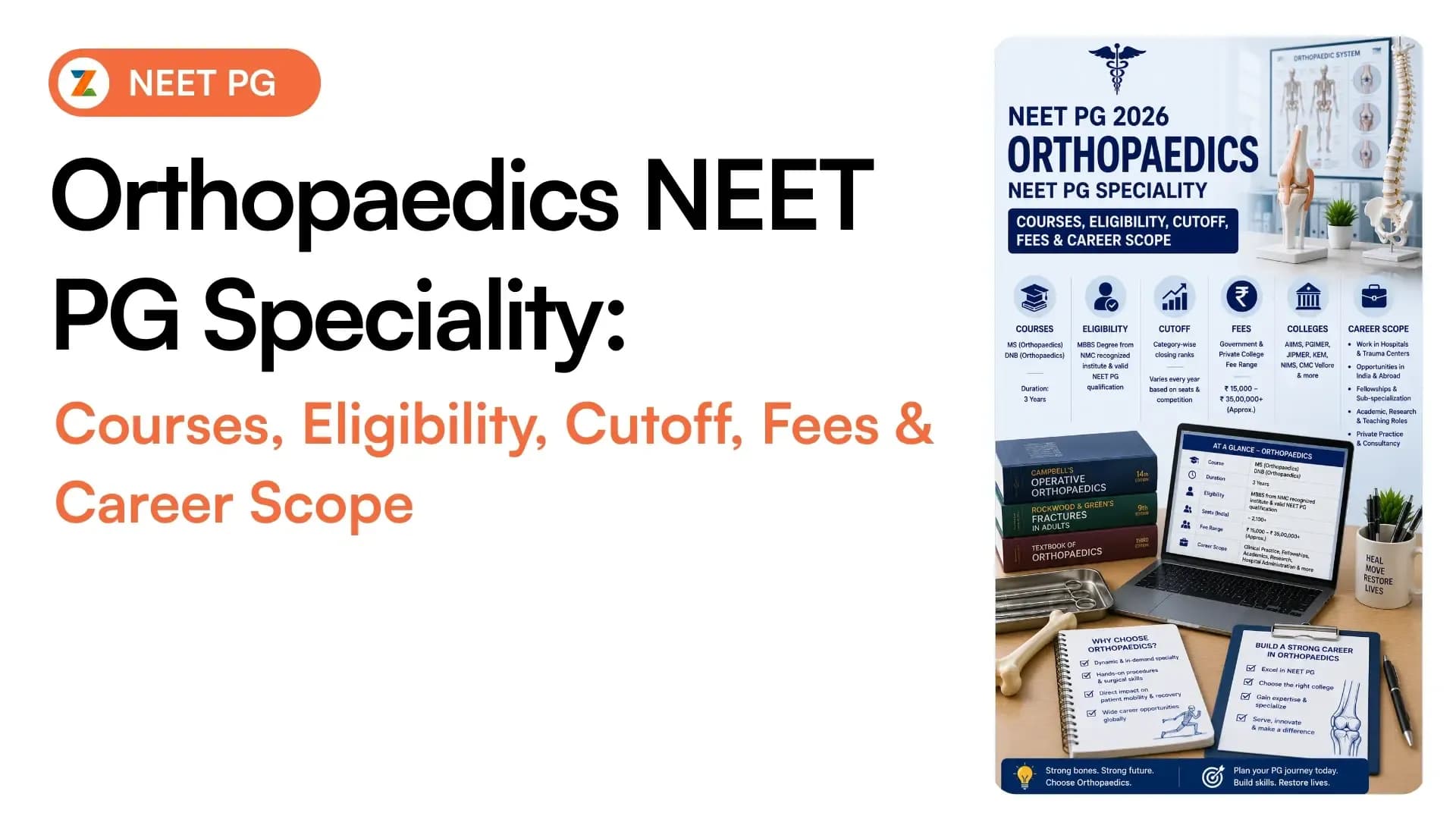
Orthopaedics is one of the most sought-after surgical specialities among NEET PG aspirants who are interested in the diagnosis and treatment of disorders involving the bones, joints, muscles, ligaments, tendons and spine. The speciality combines clinical decision-making with hands-on surgical skills and offers exposure to trauma care, reconstructive procedures, joint replacement, sports injuries and spinal disorders. This blog focuses on the 2025 All India Counselling process for the speciality.
For candidates considering MS Orthopaedics, understanding the course structure, eligibility, counselling process, expected competition, training exposure and career opportunities is essential before making a choice. The National Medical Commission's competency-based curriculum focuses on developing expertise in orthopaedic and trauma care, including fracture management, arthroplasty, arthroscopy and spinal procedures.
What is Orthopaedics?
Orthopaedics is a medical and surgical speciality concerned with the prevention, diagnosis and treatment of conditions affecting the musculoskeletal system. Orthopaedic specialists manage conditions ranging from fractures and sports injuries to arthritis, congenital deformities, spinal disorders, bone tumours and degenerative joint diseases.
During postgraduate training, residents develop skills in evaluating musculoskeletal conditions, managing trauma and performing or assisting in procedures such as fracture fixation, joint replacement, arthroscopy and corrective surgery. The NMC curriculum also includes exposure to complex trauma, limb reconstruction, spinal surgery and musculoskeletal tumours.
NEET PG Course Options in Orthopaedics (MD/MS/DNB)
There are three major postgraduate pathways in Orthopaedics:
Branch | Course | Availability |
|---|---|---|
Orthopaedics | MS | Yes |
DNB | Yes | |
PG Diploma | Yes | |
MD | No |
Eligibility Criteria for Orthopaedics NEET PG
Candidates seeking admission to MS Orthopaedics or DNB Orthopaedics generally need to meet the eligibility requirements prescribed for NEET PG.
Key requirements include:
Candidates must possess an MBBS degree or a recognised provisional MBBS qualification.
Candidates must be registered with the appropriate medical council.
The prescribed internship requirements must be fulfilled by the applicable deadline.
Admission is based on NEET PG rank and the counselling process.
Candidates must satisfy the eligibility and documentation requirements of the respective counselling authority and institution.
Orthopaedics Course Duration
MS Orthopaedics and DNB Orthopaedics are 3-year postgraduate programmes after MBBS, while D.Ortho is generally a 2-year postgraduate diploma offered by select institutions. The course combines clinical training, trauma management, surgical procedures, academic teaching and supervised operative experience.
Course | Duration |
|---|---|
MS Orthopaedics | 3 years |
DNB Orthopaedics | 3 years |
PG Diploma Orthopaedics | 2 years |
Orthopaedics Seat Availability
The table below shows the MS Orthopaedics seats available through NEET PG counselling 2025, covering participating government and private medical colleges.
Institute type | MS Orthopaedics | DNB Orthopaedics | Diploma Orthopaedics |
|---|---|---|---|
Deemed | 468 | - | - |
Government | 701 | - | 11 |
NBE - Government Institute | - | 88 | - |
NBE - Private Institute | - | 571 | - |
NBE - Public Sector Institute | - | 9 | - |
Total Seats | 1169 | 668 | 11 |
Orthopaedics Previous Year's Cutoff Trends
The table below shows the 2025 All India Counselling cutoff trends for MS, DNB and PG Diploma in Orthopaedics, based on the closing ranks across counselling rounds.
Speciality | Counselling | College Type | Closing Ranks |
|---|---|---|---|
MS Orthopaedics | All India | Government | 229954 |
MS Orthopaedics | All India | Deemed | 229242 |
DNB Orthopaedics | All India | Government | 95558 |
DNB Orthopaedics | All India | Private | 40326 |
PG Diploma Orthopaedics | All India | Government | 109400 |
For detailed General Medicine closing ranks across All India Counselling and individual state counselling, refer to ZyNerd’s Allotment Mapping for college-wise and round-wise data.
Orthopaedics Fee Range
The table below shows the 2025 fee range for Orthopaedics courses through All India Counselling, covering MS, DNB and PG Diploma seats across participating institutions. Fees may vary based on the institution, seat type and course, so candidates should verify the applicable fee structure before making their choices.
Speciality | College Type | Fee Range |
|---|---|---|
MS General Surgery | Government | 1550-2000000 |
Deemed Universities | 2574110-17705680 | |
DNB General Surgery | Private | 125000 |
Government | 125000 | |
PG Diploma Orthopaedics | Government | 12000-24000 |
Note: The fee range appears broad because it is based on the 2025 All India Counselling data and includes different types of institutions and quotas. Actual fees may vary significantly depending on the college, quota and state, so candidates can check the applicable fee structure before making their choices.
For detailed fee, stipend and bond information across All India Counselling and all state counsellings, refer to ZyNerd’s institute-wise data for updated college and counselling-specific details. Select the college and quota filters to view in-depth fee, stipend and bond details for your preferred options.
What Will You Learn in MS Orthopaedics?
Orthopaedic postgraduate training covers both non-operative and operative management of musculoskeletal disorders. Major areas include:
Orthopaedic trauma and fracture management
General orthopaedics
Paediatric orthopaedics
Sports medicine
Joint replacement and arthroplasty
Arthroscopy
Spine disorders
Bone and soft-tissue tumours
Orthopaedic infections
Congenital and developmental disorders
Degenerative joint diseases
Limb reconstruction and deformity correction
Rehabilitation and postoperative care
Top Colleges Offering Orthopaedics
Some well-known institutions offering postgraduate training in Orthopaedics include:
All India Institute of Medical Sciences, New Delhi
Postgraduate Institute of Medical Education and Research, Chandigarh
Christian Medical College, Vellore
Jawaharlal Institute of Postgraduate Medical Education and Research, Puducherry
King George's Medical University, Lucknow
Institute of Medical Sciences, Banaras Hindu University, Varanasi
Maulana Azad Medical College, New Delhi
Madras Medical College, Chennai
Grant Medical College and Sir J.J. Group of Hospitals, Mumbai
Government Medical College, Thiruvananthapuram
Career Opportunities After Orthopaedics
An MS Orthopaedics qualification can lead to careers across clinical practice, hospitals, academics and specialised orthopaedic services.
Clinical Practice
Orthopaedic surgeons can work in:
Government hospitals
Private hospitals
Corporate healthcare institutions
Trauma centres
Multispecialty hospitals
Orthopaedic specialty centres
Private clinics
Academic Career
After completing postgraduate training, doctors can pursue teaching and academic positions subject to the prevailing regulatory requirements. Academic careers may also involve clinical research, publications and postgraduate teaching.
Trauma and Emergency Care
Orthopaedic surgeons play an important role in managing fractures, dislocations, polytrauma and other musculoskeletal emergencies. Trauma-heavy hospitals can provide extensive exposure to emergency orthopaedic procedures.
Specialised Orthopaedic Practice
Doctors may develop focused expertise in areas such as joint replacement, sports injuries, spine surgery, paediatric orthopaedics, hand surgery or trauma and reconstruction.
Super-Specialization / Fellowship Options
After MS Orthopaedics, doctors can pursue further training through fellowships or advanced speciality programmes. Depending on the individual's career goals and available programmes, options may include:
Joint replacement and arthroplasty
Spine surgery
Sports medicine and arthroscopy
Trauma and reconstructive orthopaedics
Paediatric orthopaedics
Hand and upper-limb surgery
Foot and ankle surgery
Orthopaedic oncology
Shoulder and elbow surgery
Musculoskeletal trauma
Limb reconstruction
Common Conditions Managed / Procedures Performed
Orthopaedic surgeons manage a broad range of musculoskeletal conditions.
Common Conditions
Fractures and dislocations
Osteoarthritis
Rheumatoid and inflammatory joint disorders
Sports injuries
Ligament and tendon injuries
Spinal disorders
Bone and joint infections
Congenital limb deformities
Developmental hip disorders
Bone and soft-tissue tumours
Degenerative spine conditions
Limb deformities
Nerve compression syndromes
Common Procedures
Closed and open fracture reduction
Internal fixation with plates and screws
Intramedullary nailing
Arthroscopy
Joint replacement
Arthrodesis
Tendon and soft-tissue procedures
External fixation
Deformity correction
Limb lengthening
Spinal decompression and stabilisation
Management of complex trauma
Factors to Consider Before Choosing Orthopaedics
Orthopaedics can be a rewarding choice for students who enjoy surgery, anatomy, procedural work and managing acute clinical problems. However, the speciality also involves demanding residency training and significant physical and mental workload.
Before selecting Orthopaedics, consider:
Interest in Surgical Practice
MS Orthopaedics involves substantial operative and procedural exposure. A genuine interest in surgery is important for long-term satisfaction.
Trauma Exposure
Orthopaedic residents may encounter emergency cases, fractures, polytrauma and complex injuries. Students should be comfortable working in high-pressure clinical environments.
Physical Demands
Orthopaedic procedures can involve long operating hours and physically demanding surgical work. The nature of residency should be considered realistically.
College and Case Load
The quality of postgraduate training depends significantly on patient volume, trauma exposure, faculty, operation numbers, infrastructure and opportunities to perform procedures under supervision.
Future Specialisation
Students interested in spine surgery, arthroplasty, sports medicine, paediatric orthopaedics or trauma should consider whether their preferred college provides adequate exposure in these areas.
Fees and Return on Investment
Government and private institutions can have very different fee structures. Aspirants should evaluate tuition costs alongside training quality, patient load and long-term career prospects.
NEET PG Rank and Counselling Strategy
Orthopaedics is competitive in many institutions. Candidates should prepare a realistic preference list using previous closing ranks, category, quota, seat type, college reputation and current seat availability. MCC's official counselling portal provides updates on PG seat matrices, results and vacancy rounds.
_11zon.webp)
Frequently Asked Questions
Here are some answers to questions you might be looking for.

Related Blogs
Radiodiagnosis NEET PG Speciality: Course, Eligibility, Seats, Cutoff, Fees & Career Scope
Radiodiagnosis is one of the most sought-after clinical specialities among NEET PG aspirants who are interested in medical imaging, technology, diagnosis and image-guided procedures. Radiologists use imaging modalities such as X-ray, ultrasound, CT and MRI to identify diseases, assess their severity and support treatment decisions.
Aug 24, 2026

Paediatrics NEET PG Speciality: Course, Eligibility, Seats, Cutoff, Fees and Career Scope
Paediatrics is one of the most sought-after clinical specialities among NEET PG aspirants who enjoy working with children and want to build a career focused on preventive, diagnostic and therapeutic care from infancy through adolescence.
Aug 24, 2026
Otorhinolaryngology (ENT) NEET PG Speciality: Course, Eligibility, Cutoff, Colleges, Fees & Career Scope
Otorhinolaryngology, commonly known as ENT, is a surgical speciality concerned with the diagnosis and management of disorders affecting the ear, nose, throat, larynx, head and neck. ENT specialists manage conditions ranging from common problems such as tonsillitis, sinusitis and ear infections to complex disorders involving hearing, balance, voice, swallowing and head and neck cancers.
Aug 24, 2026
Ophthalmology NEET PG Speciality: Course, Eligibility, Seats, Cutoff, Fees, Career & Fellowship Options
Ophthalmology is a popular surgical speciality that focuses on the diagnosis, treatment and prevention of disorders affecting the eye, visual system and related structures. For NEET PG aspirants, it offers a combination of clinical medicine, microsurgery, diagnostic procedures and technology-driven treatments.
Aug 24, 2026
Anaesthesiology NEET PG Speciality: Courses, Eligibility, Seats, Cutoff, Fees & Career Scope
Anaesthesiology is a clinical postgraduate speciality that focuses on the safe management of patients before, during and after surgery and other invasive procedures. Anaesthesiologists are responsible for administering anaesthesia, maintaining vital functions, managing pain, supporting critically ill patients and responding to medical emergencies.
Aug 23, 2026
General Surgery NEET PG: Course, Eligibility, Cutoff, Fees, Colleges & Career Scope
General Surgery is one of the most sought-after clinical specialities among NEET PG aspirants who are interested in operative care, emergency medicine, trauma management and hands-on patient treatment.
Aug 23, 2026