


All blogs
Share
Published on 24 August, 2026
Ophthalmology NEET PG Speciality: Course, Eligibility, Seats, Cutoff, Fees, Career & Fellowship Options
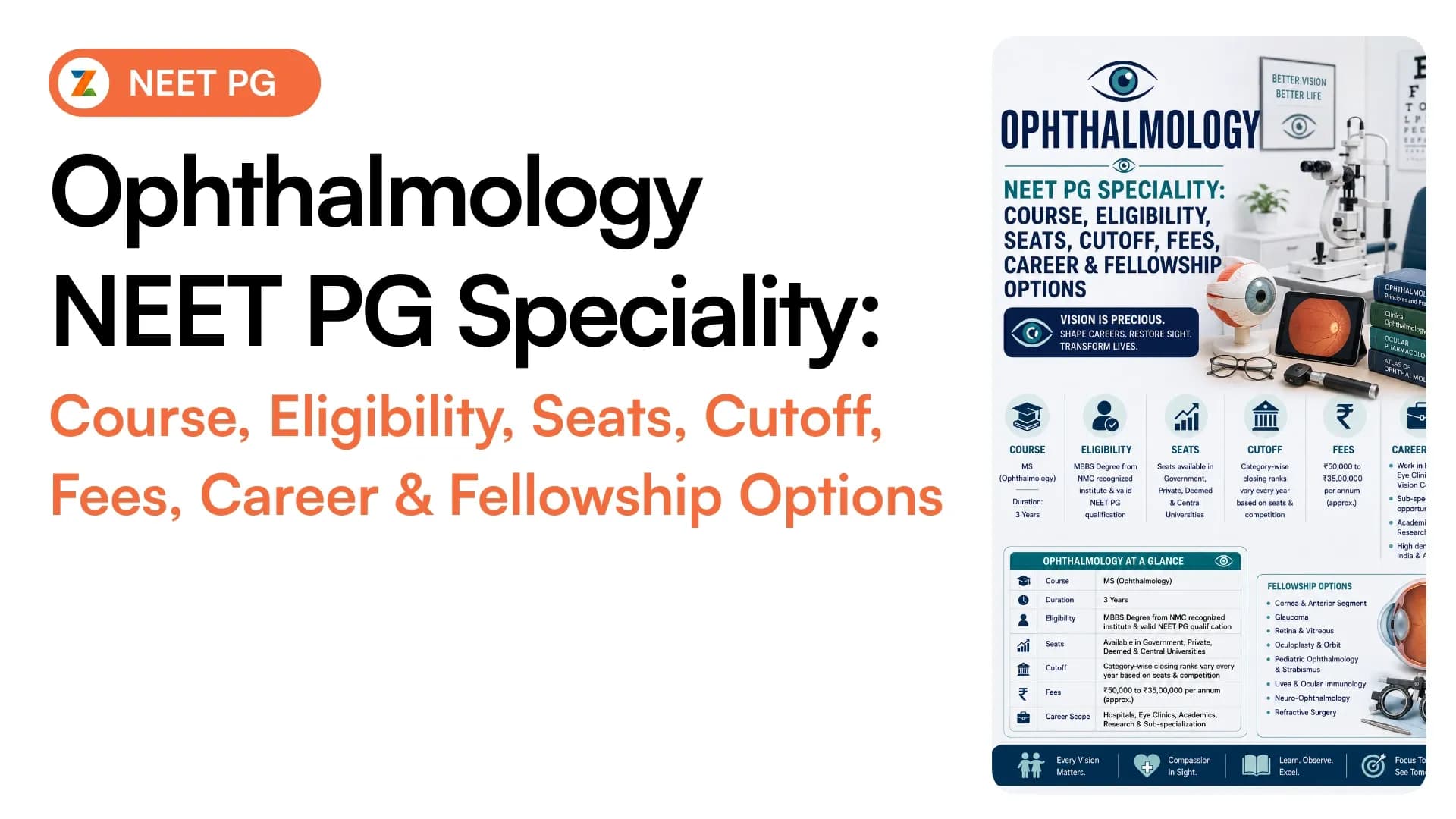
Ophthalmology is a popular surgical speciality that focuses on the diagnosis, treatment and prevention of disorders affecting the eye, visual system and related structures. For NEET PG aspirants, it offers a combination of clinical medicine, microsurgery, diagnostic procedures and technology-driven treatments. This blog focuses on the 2025 All India Counselling process for the speciality.
The speciality covers areas such as cataract, glaucoma, corneal diseases, retinal disorders, uveitis, ocular trauma, squint, neuro-ophthalmology and ocular oncology. Ophthalmology is also considered a relatively high-scoring NEET PG subject because questions frequently test clinical presentations, instruments, images, visual fields, treatment choices and commonly encountered eye disorders.
What is Ophthalmology?
Ophthalmology is the branch of medicine concerned with the anatomy, physiology and diseases of the eye and visual system. An ophthalmologist is trained to diagnose eye conditions, prescribe medical treatment and perform surgical procedures when required.
During postgraduate training, residents develop skills in clinical examination, refraction, slit-lamp examination, fundus evaluation, ocular imaging, emergency management and ophthalmic surgery.
NEET PG Course Options in Ophthalmology (MD/MS/DNB)
There are three major postgraduate pathways in Ophthalmology:
Branch | Course | Availability |
|---|---|---|
Ophthalmology | MS | Yes |
DNB | Yes | |
PG Diploma | Yes | |
MD | No |
Ophthalmology Eligibility Criteria
For admission through NEET PG, candidates generally need to meet the eligibility requirements prescribed by NBEMS for the relevant admission session.
The broad requirements include:
An MBBS degree or provisional MBBS pass certificate recognised under the applicable regulations.
Registration with the appropriate medical council.
Completion of the required one-year internship within the prescribed timeline.
Qualification in NEET PG.
Fulfilment of the eligibility and documentation requirements specified in the NEET PG Information Bulletin.
Ophthalmology Course Duration
MS Ophthalmology and Post MBBS DNB Ophthalmology are 3-year postgraduate programmes after MBBS. A PG Diploma in Ophthalmology is a 2-year programme, offering focused training in clinical and surgical eye care.
Course | Duration |
|---|---|
MS Ophthalmology | 3 years |
DNB Ophthalmology | 3 years |
PG Diploma | 2 years |
Ophthalmology Seat Availability
The table below shows the 2025 All India Counselling seat availability for MS, DNB and PG Diploma in Ophthalmology across participating institutes. Seat numbers may vary by college and counselling round, so candidates should refer to the latest seat matrix while making their choices.
Institute type | MS Ophthalmology | DNB Ophthalmology | Diploma Ophthalmology- NBE | Diploma Ophthalmology |
|---|---|---|---|---|
Deemed | 263 | - | - | 10 |
Government | 551 | - | - | 26 |
NBE - Government Institute | - | 44 | 106 | - |
NBE - Private Institute | - | 360 | 108 | - |
NBE - Public Sector Institute | - | 9 | 4 | - |
Total Seats | 814 | 413 | 218 | 36 |
Ophthalmology Previous Year's Cutoff Trends
The table below shows the 2025 All India Counselling cutoff trends for MS, DNB and PG Diploma in Ophthalmology across participating institutes. Reviewing previous-year closing ranks can help aspirants assess competition and set realistic college preferences during counselling.
Speciality | College Type | Closing Ranks |
|---|---|---|
MS Ophthalmology | Government | 215665 |
MS Ophthalmology | Deemed | 207588 |
DNB Ophthalmology | Government | 88566 |
DNB Ophthalmology | Private | 38599 |
Diploma Ophthalmology- NBE | Government | 188833 |
Diploma Ophthalmology- NBE | Private | 64902 |
Diploma Ophthalmology | Government | 150769 |
Diploma Ophthalmology | Deemed | 105901 |
For detailed General Medicine closing ranks across All India Counselling and individual state counselling, refer to ZyNerd’s Allotment Mapping for college-wise and round-wise data.
Ophthalmology Fee Range
The table below shows the fee range for Ophthalmology across MS, DNB and PG Diploma programmes, covering participating institutes under different quotas. Fees vary by institute and quota, so candidates should check college-specific details before making their counselling choices.
Speciality | College Type | Fee range |
|---|---|---|
MS Ophthalmology | Government | 1550-1500000 |
MS Ophthalmology | Deemed Universities | 2200000-17705680 |
DNB Ophthalmology | Private | 125000 |
DNB Ophthalmology | Government | 125000 |
Diploma Ophthalmology- NBE | Government | 125000 |
Diploma Ophthalmology- NBE | Private | 125000 |
Diploma Ophthalmology | Deemed Universities | 1795000-4454800 |
Diploma Ophthalmology | Government | 12000-54700 |
Note: The fee range appears broad because it is based on the 2025 All India Counselling data and includes different types of institutions and quotas. Actual fees may vary significantly depending on the college, quota and state, so candidates can check the applicable fee structure before making their choices.
For detailed fee, stipend and bond information across All India Counselling and all state counsellings, refer to ZyNerd’s institute-wise data for updated college and counselling-specific details. Select the college and quota filters to view in-depth fee, stipend and bond details for your preferred options.
What Will You Learn In Ophthalmology?
MS/DNB Ophthalmology provides training in both medical and surgical management of eye disorders.
Core areas of learning
Detailed anatomy and physiology of the eye
Ocular examination and clinical diagnosis
Refraction and optics
Slit-lamp examination
Tonometry and glaucoma evaluation
Fundus examination
Visual field assessment
Ocular imaging
Cataract evaluation and surgery
Glaucoma diagnosis and management
Corneal disorders
Retinal diseases
Uveitis
Neuro-ophthalmology
Pediatric ophthalmology
Squint and ocular motility disorders
Oculoplasty and orbital diseases
Ocular trauma
Ocular emergencies
Ophthalmic pharmacology
Laser-based treatments
Research methodology and academic presentation
Top Colleges Offering Ophthalmology
Some well-known institutions for postgraduate Ophthalmology training include:
All India Institute of Medical Sciences (AIIMS), New Delhi
Postgraduate Institute of Medical Education and Research (PGIMER), Chandigarh
Sankara Nethralaya, Chennai
Aravind Eye Hospital and associated academic institutions
Christian Medical College, Vellore
Dr. Rajendra Prasad Centre for Ophthalmic Sciences, AIIMS
Government Medical College and Hospital, Chandigarh
Maulana Azad Medical College, New Delhi
King George's Medical University, Lucknow
Seth GS Medical College and KEM Hospital, Mumbai
Madras Medical College, Chennai
Jawaharlal Institute of Postgraduate Medical Education and Research (JIPMER), Puducherry
Career Opportunities After Ophthalmology
An MS/DNB Ophthalmology graduate can pursue careers in clinical practice, surgery, academics, research and specialised eye-care services.
1. Consultant Ophthalmologist
Ophthalmologists can work in hospitals, eye-care centres, multispeciality hospitals or private clinics.
2. Cataract Surgeon
Cataract surgery is one of the major components of ophthalmic practice. Ophthalmologists can develop expertise in modern cataract surgery and intraocular lens procedures.
3. Glaucoma Specialist
Doctors can focus on diagnosing and managing glaucoma through medication, laser procedures and surgery.
4. Retina Specialist
Retina practice involves conditions such as diabetic retinopathy, retinal vascular disorders, retinal detachment and macular diseases.
5. Cornea and Refractive Specialist
This area includes corneal disorders, keratoplasty and refractive procedures.
6. Pediatric Ophthalmologist
This career path focuses on children's eye disorders, amblyopia, strabismus and congenital conditions.
7. Oculoplasty and Orbital Specialist
This involves diseases and reconstruction of the eyelids, orbit and surrounding structures.
8. Academic Medicine
Ophthalmologists can pursue teaching and research careers in medical colleges and ophthalmic institutes.
9. Private Practice
After gaining adequate clinical and surgical experience, ophthalmologists can establish or join private eye-care practices.
Super-Specialization / Fellowship Options
Ophthalmology offers numerous opportunities for focused subspecialty training after MS/DNB.
Popular fellowship areas include:
Vitreo-retinal surgery
Glaucoma
Cornea and anterior segment
Refractive surgery
Pediatric ophthalmology
Squint and strabismus
Oculoplasty
Orbit and ocular oncology
Neuro-ophthalmology
Uveitis
Ocular pathology
Community ophthalmology
Low-vision rehabilitation
NBEMS also lists Vitreo Retinal Surgery among its FNB programmes, providing a formal fellowship pathway in this area.
Common Conditions Managed / Procedures Performed
Common conditions managed
Cataract
Glaucoma
Diabetic retinopathy
Hypertensive retinopathy
Retinal detachment
Retinal vascular occlusions
Corneal ulcers
Keratoconus
Corneal dystrophies
Uveitis
Conjunctivitis
Dry eye disease
Pterygium
Refractive errors
Amblyopia
Strabismus
Ptosis
Entropion and ectropion
Dacryocystitis
Orbital disorders
Ocular trauma
Retinoblastoma and other ocular tumours
Common procedures and surgeries
Cataract extraction
Phacoemulsification
Intraocular lens implantation
Glaucoma laser procedures
Glaucoma surgeries
Corneal transplantation
Intravitreal injections
Retinal laser procedures
Retinal detachment surgery
Squint surgery
Pterygium surgery
Dacryocystorhinostomy
Eyelid procedures
Oculoplastic surgery
Enucleation and evisceration where indicated
Refractive surgery
Foreign-body removal
Management of ocular trauma
Factors to Consider Before Choosing Ophthalmology
Choosing Ophthalmology should involve more than looking at the closing rank or perceived lifestyle.
1. Interest in microsurgery
Ophthalmology involves delicate procedures and microsurgical techniques. Comfort with precision-based work is important.
2. Surgical exposure
The quality and volume of surgical training can vary significantly between institutions. Candidates should investigate operative exposure before choosing a college.
3. Patient load
High patient volume can provide extensive clinical exposure, particularly in cataract, glaucoma, cornea and retinal disorders.
4. Subspecialty exposure
If you are interested in retina, glaucoma, cornea, pediatric ophthalmology or oculoplasty, check whether the institution has dedicated subspecialty departments or fellowships.
5. Infrastructure
Modern ophthalmic practice relies heavily on diagnostic and surgical technology. Look for facilities such as OCT, visual fields, corneal topography, fundus imaging, lasers and vitreoretinal surgical equipment.
6. Academic environment
Residents interested in teaching or research should consider the institution's academic culture, publications, conferences and research opportunities.
7. Fee and financial considerations
Compare tuition fees, hostel costs, other institutional charges and stipend before selecting a private or deemed institution.
8. Location and future plans
Consider whether you want to practise in a metropolitan area, smaller city or underserved region. Ophthalmology offers opportunities in all these settings.
9. Work style
Ophthalmology can offer a combination of outpatient practice, elective surgery and emergency care. Candidates should consider whether this matches their preferred professional lifestyle.
10. Fellowship plans
If you already have an interest in retina, glaucoma, cornea, pediatric ophthalmology or another subspecialty, choose a residency programme that provides strong exposure in that area.
_11zon.webp)
Frequently Asked Questions
Here are some answers to questions you might be looking for.

Related Blogs
Radiodiagnosis NEET PG Speciality: Course, Eligibility, Seats, Cutoff, Fees & Career Scope
Radiodiagnosis is one of the most sought-after clinical specialities among NEET PG aspirants who are interested in medical imaging, technology, diagnosis and image-guided procedures. Radiologists use imaging modalities such as X-ray, ultrasound, CT and MRI to identify diseases, assess their severity and support treatment decisions.
Aug 24, 2026

Paediatrics NEET PG Speciality: Course, Eligibility, Seats, Cutoff, Fees and Career Scope
Paediatrics is one of the most sought-after clinical specialities among NEET PG aspirants who enjoy working with children and want to build a career focused on preventive, diagnostic and therapeutic care from infancy through adolescence.
Aug 24, 2026
NEET PG General Medicine Speciality: Course, Cutoff, Fees, Seats & Career Scope
General Medicine is one of the most popular clinical specialties among NEET PG aspirants who wish to pursue a career in adult patient care, diagnosis and comprehensive disease management. The specialty is also called Internal Medicine.
Aug 23, 2026
Otorhinolaryngology (ENT) NEET PG Speciality: Course, Eligibility, Cutoff, Colleges, Fees & Career Scope
Otorhinolaryngology, commonly known as ENT, is a surgical speciality concerned with the diagnosis and management of disorders affecting the ear, nose, throat, larynx, head and neck. ENT specialists manage conditions ranging from common problems such as tonsillitis, sinusitis and ear infections to complex disorders involving hearing, balance, voice, swallowing and head and neck cancers.
Aug 24, 2026
Anaesthesiology NEET PG Speciality: Courses, Eligibility, Seats, Cutoff, Fees & Career Scope
Anaesthesiology is a clinical postgraduate speciality that focuses on the safe management of patients before, during and after surgery and other invasive procedures. Anaesthesiologists are responsible for administering anaesthesia, maintaining vital functions, managing pain, supporting critically ill patients and responding to medical emergencies.
Aug 23, 2026
Obstetrics & Gynaecology NEET PG Speciality: Course, Eligibility, Cutoff, Colleges & Career Scope
Obstetrics & Gynaecology, commonly referred to as OBGYN or OBG, is one of the most sought-after clinical specialities after MBBS. The speciality combines obstetrics, which focuses on pregnancy, childbirth and the postpartum period, with gynaecology, which deals with the diagnosis and management of disorders affecting the female reproductive system.
Aug 24, 2026