


All blogs
Share
Published on 23 August, 2026
General Surgery NEET PG: Course, Eligibility, Cutoff, Fees, Colleges & Career Scope
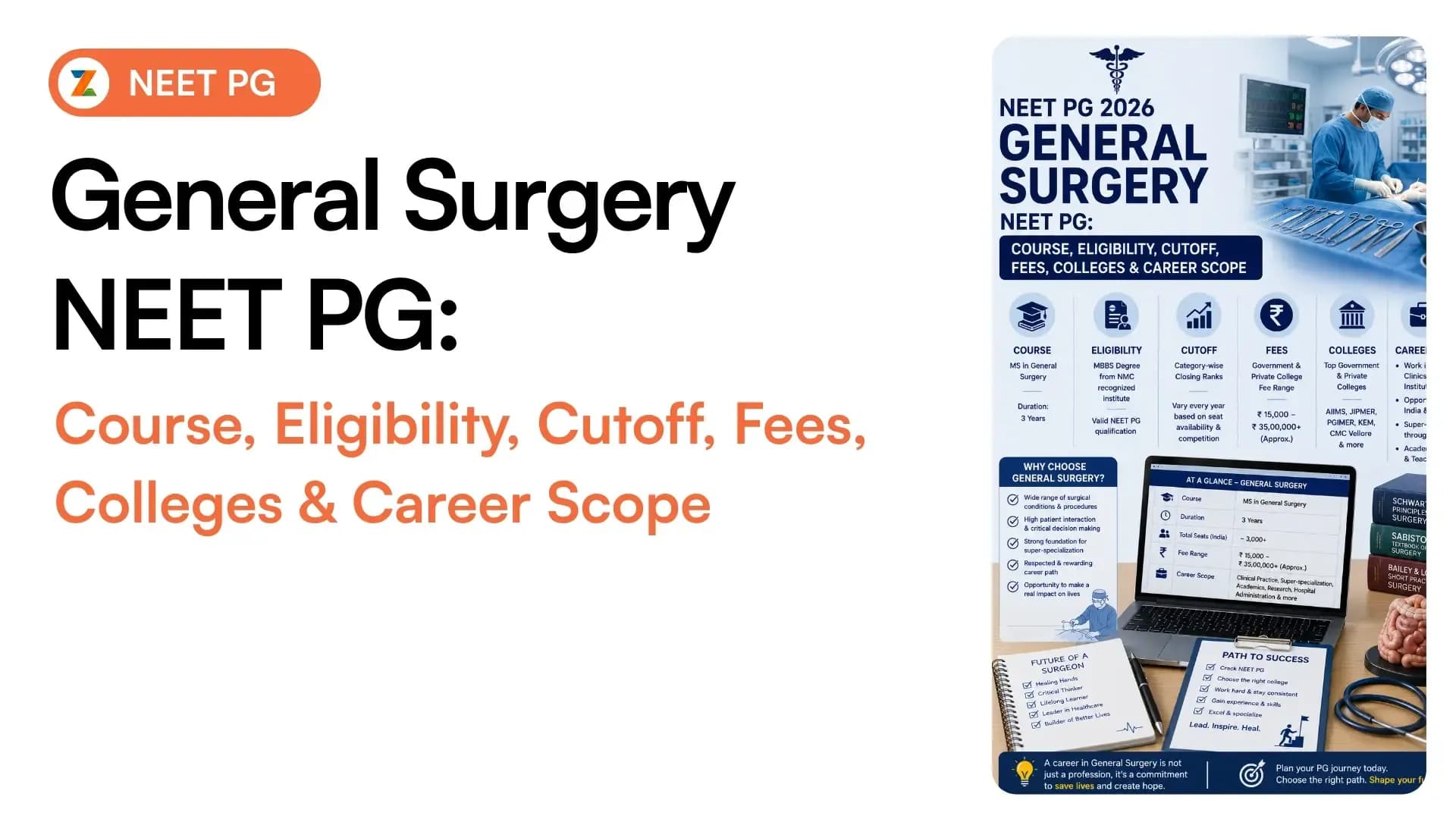
General Surgery is one of the most sought-after clinical specialities among NEET PG aspirants who are interested in operative care, emergency medicine, trauma management and hands-on patient treatment. The postgraduate pathway primarily leads to an MS in General Surgery or DNB in General Surgery, both of which provide structured training in surgical diagnosis, operative procedures and perioperative patient care.This blog focuses on the 2025 All India Counselling process for the speciality.
Admission to most MS and DNB General Surgery programmes is through NEET PG, followed by counselling conducted through the Medical Counselling Committee (MCC) for applicable seats and respective state counselling authorities. The choice of college is particularly important because operative exposure, patient load, faculty strength, infrastructure and access to super-speciality departments can significantly influence residency training.
What is General Surgery?
General Surgery is a broad surgical speciality concerned with the diagnosis and operative management of diseases involving areas such as the gastrointestinal tract, abdomen, breast, thyroid, endocrine system, skin and soft tissues, vascular structures and other surgical conditions.
An MS General Surgery programme is a three-year postgraduate residency that combines classroom learning with extensive clinical and operative training. Residents are exposed to wards, outpatient departments, emergency services, intensive care units and operation theatres. Training commonly includes preoperative assessment, surgical decision-making, postoperative care, trauma management, open surgery and minimally invasive techniques.
General Surgery also serves as an important foundation for several surgical super-specialities. After completing MS or DNB General Surgery, eligible doctors can pursue further training in areas such as surgical oncology, gastrointestinal surgery, urology, paediatric surgery, plastic surgery and other advanced surgical disciplines.
NEET PG Course Options in General Surgery
There are two major postgraduate pathways in General Surgery:
Speciality | Course | Availability |
|---|---|---|
General Surgery | MS | Yes |
DNB | Yes | |
PG Diploma | No | |
MD | No |
General Surgery Eligibility Criteria
Candidates seeking admission to MS General Surgery through NEET PG generally need to fulfil the following requirements:
Hold an MBBS degree or a recognised equivalent qualification from an institution recognised by the appropriate medical authority.
Complete the required one-year compulsory rotating internship by the date prescribed in the applicable NEET PG admission rules.
Possess valid medical registration as required by the National Medical Commission or the concerned State Medical Council.
Qualify NEET PG and meet the applicable qualifying criteria.
Participate in the relevant counselling process and fulfil the eligibility conditions of the chosen institution, state or quota.
NMC regulations specify that candidates entering postgraduate medical courses must possess a recognised MBBS qualification and appropriate medical registration.
General Surgery Course Duration
General Surgery is typically offered as a 3-year MS or DNB postgraduate programme after MBBS and completion of the required internship. The course combines academic learning with clinical training, emergency care and hands-on surgical experience.
Course | Duration |
|---|---|
MS General Surgery | 3 years |
DNB General Surgery | 3 years |
General Surgery in Seat Availability
General Surgery seats are available across government, private, deemed and DNB institutions through NEET PG counselling. The table below shows the MS General Surgery seats in 2025.
Institute type | MS General Surgery | DNB General Surgery |
|---|---|---|
Deemed | 626 | - |
Government | 1249 | - |
NBE - Government Institute | - | 136 |
NBE - Private Institute | - | 421 |
NBE - Public Sector Institute | - | 11 |
Total Seats | 1875 | 568 |
General Surgery in Previous Year's Cutoff Trends
The table below highlights the 2025 NEET PG closing cutoff trends for General Surgery across MS and DNB programmes. It covers All India Counselling cutoffs to help aspirants understand the rank range required for admission.
Speciality | Counselling | College Type | Closing Ranks |
|---|---|---|---|
MS General Surgery | All India | Government | 227639 |
MS General Surgery | All India | Deemed | 220647 |
DNB General Surgery | All India | Government | 95828 |
DNB General Surgery | All India | Private | 33025 |
For detailed General Medicine closing ranks across All India Counselling and individual state counselling, refer to ZyNerd’s Allotment Mapping for college-wise and round-wise data.
General Surgery in Fee Range
General Surgery fees vary significantly across government, private and deemed medical colleges, depending on the type of institution and seat category. The table below highlights the fee range for MS and DNB General Surgery through All India Counselling.
Speciality | College Type | Fee Range |
|---|---|---|
MS General Surgery | Government | 1550-2000000 |
Deemed Universities | 2300000-17705680 | |
DNB General Surgery | Private | 125000 |
Government | 125000 |
Note: The fee range appears broad because it is based on the 2025 All India Counselling data and includes different types of institutions and quotas. Actual fees may vary significantly depending on the college, quota and state, so candidates can check the applicable fee structure before making their choices.
For detailed fee, stipend and bond information across All India Counselling and all state counsellings, refer to ZyNerd’s institute-wise data for updated college and counselling-specific details. Select the college and quota filters to view in-depth fee, stipend and bond details for your preferred options.
What Will You Learn In General Surgery?
MS General Surgery provides broad exposure to surgical sciences and clinical practice. The curriculum is designed to develop both theoretical understanding and practical surgical skills.
Major areas of learning include:
Principles of general surgery
Surgical anatomy and applied physiology
Preoperative evaluation and preparation
Postoperative care and complication management
Surgical infections and wound management
Trauma and emergency surgery
Fluid, electrolyte and acid-base management
Blood transfusion and haemostasis
Gastrointestinal and abdominal surgery
Breast and endocrine surgery
Vascular surgery
Surgical oncology
Paediatric surgical conditions
Plastic and reconstructive principles
Laparoscopic and minimally invasive surgery
Critical care and ICU management
Surgical research and evidence-based practice
Top Colleges Offering General Surgery
Some well-known institutions associated with General Surgery training include:
Government Institutions
All India Institute of Medical Sciences, New Delhi
Maulana Azad Medical College, New Delhi
King George's Medical University, Lucknow
Institute of Medical Sciences, BHU, Varanasi
Bangalore Medical College and Research Institute, Bengaluru
Government medical colleges affiliated with major state health universities
Private Institutions
Kasturba Medical College, Manipal
Dr. D. Y. Patil Medical College, Pune
Amrita School of Medicine, Kochi
Sharda University, Greater Noida
Career Opportunities After General Surgery
An MS or DNB in General Surgery provides multiple career pathways.
1. General Surgeon
Graduates can work as surgeons in government hospitals, private hospitals, multispeciality hospitals and surgical centres.
2. Senior Residency
Many graduates opt for senior residency to gain additional operative exposure, strengthen their academic profile and prepare for further specialisation.
3. Super-Specialisation
General Surgery provides the foundation for several MCh and other advanced surgical training pathways.
4. Academic Career
Doctors interested in teaching and research can pursue academic positions in medical colleges and teaching hospitals, subject to applicable eligibility requirements.
5. Private Practice
After gaining adequate clinical experience and fulfilling applicable regulatory requirements, surgeons can establish or join private surgical practices and hospitals.
6. Trauma and Emergency Surgery
General surgeons can develop careers in trauma centres, emergency departments and hospitals handling high volumes of acute surgical cases.
7. Research and Healthcare
Opportunities are also available in clinical research, medical education, hospital administration and healthcare organisations.
Super-Specialization / Fellowship Options
MS or DNB General Surgery can serve as a foundation for advanced surgical training. Depending on eligibility, entrance requirements and the prevailing regulations, options may include:
MCh Surgical Gastroenterology
MCh Urology
MCh Paediatric Surgery
MCh Plastic Surgery
MCh Cardiothoracic and Vascular Surgery
MCh Neurosurgery
MCh Surgical Oncology
Vascular surgery training
Fellowships in laparoscopic and minimal access surgery
Fellowships in trauma and critical care
Fellowships in breast and endocrine surgery
Fellowships in colorectal surgery
Fellowships in gastrointestinal and hepatobiliary surgery
Common Conditions Managed / Procedures Performed
General surgeons manage a wide range of elective and emergency surgical conditions.
Common Conditions
Acute appendicitis
Gallstones and gallbladder disease
Hernias
Intestinal obstruction
Perforation peritonitis
Abscesses and soft-tissue infections
Haemorrhoids and anal disorders
Fistula and fissure
Breast disorders requiring surgical management
Thyroid and other endocrine surgical conditions
Gastrointestinal diseases requiring surgery
Trauma and abdominal injuries
Benign and malignant surgical conditions
Common Procedures
Appendectomy
Hernia repair
Cholecystectomy
Bowel resection and anastomosis
Incision and drainage of abscesses
Wound debridement
Thyroid surgery
Breast procedures
Haemorrhoidectomy
Laparoscopic procedures
Emergency laparotomy
Chest tube insertion
Tracheostomy
Management of traumatic injuries
Factors to Consider Before Choosing General Surgery
General Surgery can be a rewarding choice, but it requires sustained commitment to clinical work and operative training. Before selecting the branch, NEET PG aspirants should consider:
Interest in Surgical Practice
Candidates should genuinely enjoy clinical examination, procedures, operating-room work and decision-making in acute situations.
Operative Exposure
The number and variety of surgeries performed at a college can significantly affect surgical skill development. Check resident feedback, operative logs and the actual level of hands-on exposure.
Patient Load
A busy hospital can provide exposure to a wide variety of cases, particularly trauma and emergency surgery. However, workload should be assessed alongside teaching quality and resident support.
Infrastructure
OTs, ICUs, emergency facilities, imaging services, blood bank availability and access to advanced surgical equipment are important considerations.
Super-Speciality Exposure
Hospitals with departments such as surgical oncology, urology, neurosurgery, plastic surgery, paediatric surgery and gastroenterology can provide valuable exposure to complex cases.
Workload and Residency Culture
General Surgery residency is demanding. Candidates should understand the duty hours, night duties, emergency workload, leave policy, academic schedule and overall working environment before selecting a college.
Future Plans
Those planning to pursue MCh or fellowship training should consider institutions that provide strong academic exposure, research opportunities and a diverse surgical case mix.
Fees and Financial Considerations
Compare tuition fees, hostel expenses, stipend, bond requirements and other institutional charges before finalising a seat.
_11zon.webp)
Frequently Asked Questions
Here are some answers to questions you might be looking for.

Related Blogs
NEET PG General Medicine Speciality: Course, Cutoff, Fees, Seats & Career Scope
General Medicine is one of the most popular clinical specialties among NEET PG aspirants who wish to pursue a career in adult patient care, diagnosis and comprehensive disease management. The specialty is also called Internal Medicine.
Aug 23, 2026

Paediatrics NEET PG Speciality: Course, Eligibility, Seats, Cutoff, Fees and Career Scope
Paediatrics is one of the most sought-after clinical specialities among NEET PG aspirants who enjoy working with children and want to build a career focused on preventive, diagnostic and therapeutic care from infancy through adolescence.
Aug 24, 2026
Radiodiagnosis NEET PG Speciality: Course, Eligibility, Seats, Cutoff, Fees & Career Scope
Radiodiagnosis is one of the most sought-after clinical specialities among NEET PG aspirants who are interested in medical imaging, technology, diagnosis and image-guided procedures. Radiologists use imaging modalities such as X-ray, ultrasound, CT and MRI to identify diseases, assess their severity and support treatment decisions.
Aug 24, 2026
Otorhinolaryngology (ENT) NEET PG Speciality: Course, Eligibility, Cutoff, Colleges, Fees & Career Scope
Otorhinolaryngology, commonly known as ENT, is a surgical speciality concerned with the diagnosis and management of disorders affecting the ear, nose, throat, larynx, head and neck. ENT specialists manage conditions ranging from common problems such as tonsillitis, sinusitis and ear infections to complex disorders involving hearing, balance, voice, swallowing and head and neck cancers.
Aug 24, 2026
Orthopaedics NEET PG Speciality: Courses, Eligibility, Cutoff, Fees & Career Scope
Orthopaedics is one of the most sought-after surgical specialities among NEET PG aspirants who are interested in the diagnosis and treatment of disorders involving the bones, joints, muscles, ligaments, tendons and spine.
Aug 23, 2026

Psychiatry NEET PG Speciality: Course, Cutoff, Colleges, Career & Scope
Psychiatry is a clinical medical speciality focused on the diagnosis, treatment, prevention and rehabilitation of mental, emotional and behavioural disorders. With increasing awareness of mental health and growing demand for specialist psychiatric care, Psychiatry has become an increasingly sought-after choice among NEET PG aspirants.
Aug 23, 2026