


All blogs
Share
Published on 23 August, 2026
Psychiatry NEET PG Speciality: Course, Cutoff, Colleges, Career & Scope
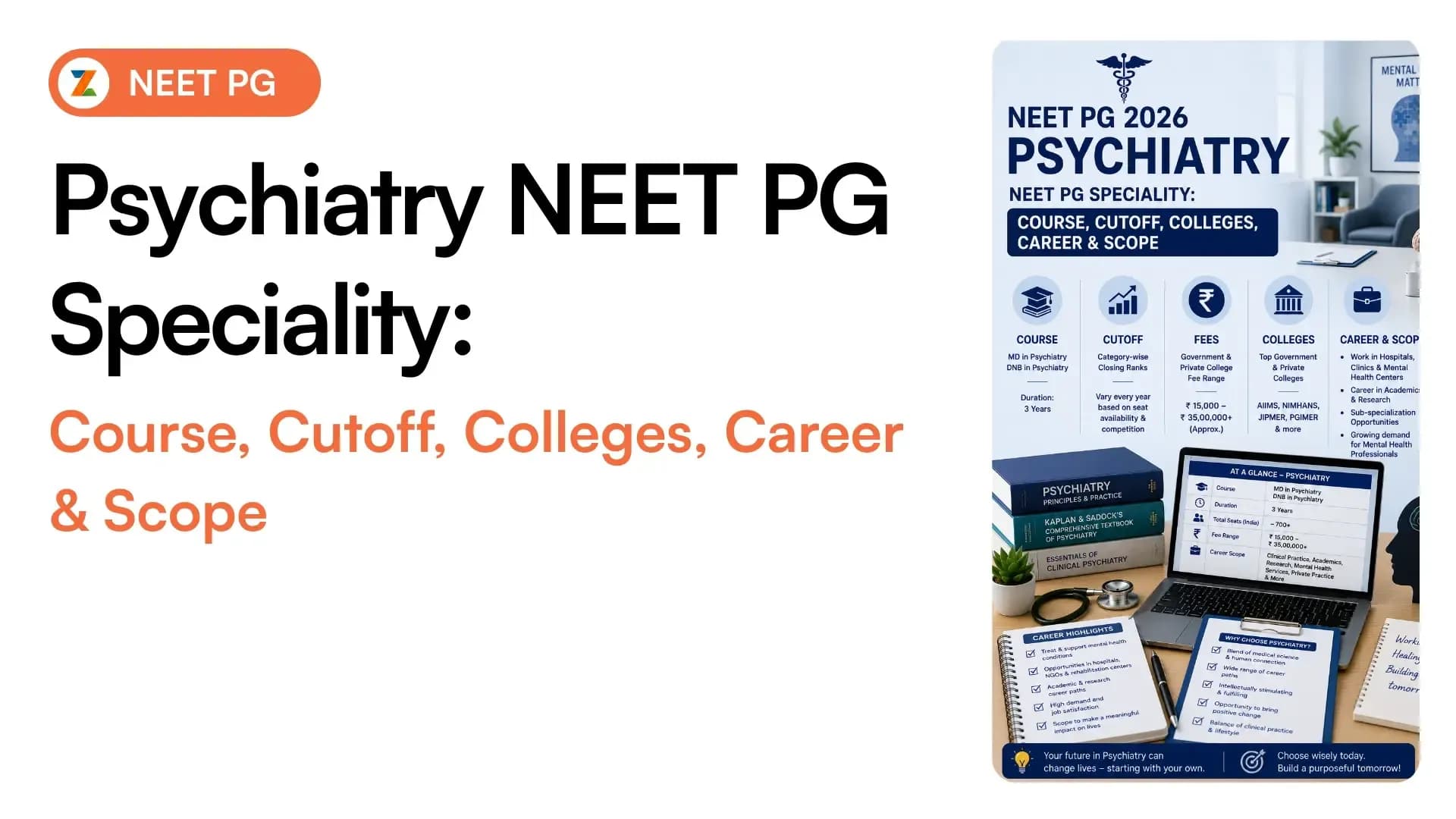
Psychiatry is a clinical medical speciality focused on the diagnosis, treatment, prevention and rehabilitation of mental, emotional and behavioural disorders. With increasing awareness of mental health and growing demand for specialist psychiatric care, Psychiatry has become an increasingly sought-after choice among NEET PG aspirants. This blog focuses on the 2025 All India Counselling process for the speciality.
In India, candidates can pursue MD Psychiatry or DNB Psychiatry after MBBS. Admission to these programmes is primarily through NEET PG, while certain premier institutes such as NIMHANS and AIIMS offer psychiatry programmes through their respective INI-CET pathways. The National Medical Commission (NMC) regulates postgraduate medical education and periodically updates the standards and seat availability for PG courses.
What is Psychiatry?
Psychiatry is the branch of medicine concerned with understanding and managing disorders that affect mood, thoughts, behaviour, cognition and overall functioning. Unlike non-medical mental health disciplines, psychiatrists are medical doctors who can assess physical and psychological factors, prescribe medicines and provide comprehensive psychiatric care.
During postgraduate training, residents gain experience in outpatient and inpatient psychiatry, emergency psychiatric care, psychotherapy, psychopharmacology, addiction medicine, consultation-liaison psychiatry, child and adolescent psychiatry, geriatric psychiatry and community mental health.
NEET PG Course Options in Psychiatry: MD/DNB
There are three major postgraduate pathways in Psychiatry:
Speciality | Course | Availability |
|---|---|---|
Psychiatry | MD | Yes |
DNB | Yes | |
Diploma | Yes | |
MS | No |
Psychiatry Eligibility Criteria
Candidates seeking admission to MD Psychiatry or DNB Psychiatry through NEET PG generally need to meet the following requirements:
Hold an MBBS degree or provisional MBBS pass certificate recognised under the NMC framework.
Possess permanent or provisional registration with the NMC or a State Medical Council.
Complete the required one-year compulsory rotating internship by the cut-off date specified for the respective NEET PG session.
Qualify NEET PG and participate in the relevant counselling process.
Meet any additional eligibility requirements prescribed by the counselling authority or individual institution.
The NEET PG information bulletin specifies recognised MBBS qualification, medical registration and completion of the compulsory internship as key eligibility requirements.
Psychiatry Course Duration
Psychiatry postgraduate courses typically include MD, DNB and PG Diploma programmes, with duration varying by the course and training pathway. The table below highlights the course duration for MD Psychiatry, DNB Psychiatry and PG Diploma in Psychiatry.
Course | Duration |
|---|---|
MD Psychiatry | 3 years |
DNB Psychiatry | 3 years |
PG Diploma Psychiatry | 2 years |
Psychiatry Seat Availability
Psychiatry seats are available across government, private, deemed and DNB institutions through All India Counselling 2025. The table below highlights the MD PG Diploma Psychiatry seats available for government and private institutions.
Institute type | MD Psychiatry | DNB Psychiatry |
|---|---|---|
Deemed | 181 | - |
Government | 347 | - |
NBE - Government Institute | - | 29 |
NBE - Private Institute | - | 14 |
Total Seats | 528 | 43 |
Psychiatry Previous Year's Cutoff Trends
Psychiatry cutoff trends vary by institute, course, category and counselling round, with competition differing across seats. The table below presents the 2025 cutoff trends for Psychiatry through All India Counselling, covering MD, DNB and PG Diploma programmes.
Speciality | Counselling | College Type | Closing Ranks |
|---|---|---|---|
MD Psychiatry | All India | Government | 221754 |
MD Psychiatry | All India | Deemed Universities | 212372 |
DNB Psychiatry | All India | Government | 95529 |
DNB Psychiatry | All India | Private | 26494 |
PG Diploma Psychiatry | All India | Government | 32083 |
PG Diploma Psychiatry | All India | Deemed Universities | 38225 |
For detailed General Medicine closing ranks across All India Counselling and individual state counselling, refer to ZyNerd’s Allotment Mapping for college-wise and round-wise data.
Psychiatry Fee Range
The fee for Psychiatry courses varies significantly based on the institution, course type, quota and category, covering MD, DNB and PG Diploma programmes. The table below highlights the fee range for Psychiatry courses across institutions under All India Counselling 2025.
Speciality | College Type | Fee Range |
MD Psychiatry | Government | 3000-250000 |
Deemed Universities | 1900000-7740000 | |
DNB Psychiatry | Private | 125000 |
Government | 125000 | |
PG Psychiatry | Government | 25000-157100 |
Deemed | 1400000 |
Note: The fee range appears broad because it is based on the 2025 All India Counselling data and includes different types of institutions and quotas. Actual fees may vary significantly depending on the college, quota and state, so candidates can check the applicable fee structure before making their choices.
For detailed fee, stipend and bond information across All India Counselling and all state counsellings, refer to ZyNerd’s institute-wise data for updated college and counselling-specific details. Select the college and quota filters to view in-depth fee, stipend and bond details for your preferred options.
What Will You Learn in Psychiatry?
During MD/DNB Psychiatry training, residents develop competencies in:
Psychiatric history-taking and mental status examination
Diagnosis and classification of psychiatric disorders
Psychopharmacology and rational prescribing
Psychotherapy and counselling techniques
Management of psychiatric emergencies
Suicide risk assessment and crisis intervention
Addiction and substance-use disorder management
Child and adolescent mental health
Geriatric psychiatry
Consultation-liaison psychiatry
Community psychiatry and rehabilitation
Electroconvulsive therapy and other biological treatments
Research methodology and evidence-based psychiatric practice
Communication with patients, families and multidisciplinary healthcare teams
Top Colleges Offering Psychiatry
Some of the well-known institutions where Psychiatry training is available through the NEET PG route include:
Atal Bihari Vajpayee Institute of Medical Sciences and Dr Ram Manohar Lohia Hospital, New Delhi
Government Medical College and Hospital, Chandigarh
Lady Hardinge Medical College, New Delhi
Topiwala National Medical College and BYL Nair Charitable Hospital, Mumbai
Seth GS Medical College and KEM Hospital, Mumbai
B J Medical College, Ahmedabad
Lokmanya Tilak Municipal Medical College and General Hospital, Mumbai
Institute of Medical Sciences, Banaras Hindu University, Varanasi
Central Institute of Psychiatry, Ranchi
King George's Medical University, Lucknow
Sawai Man Singh Medical College, Jaipur
Bangalore Medical College and Research Institute, Bengaluru
Government Medical College, Thiruvananthapuram
Government Medical College, Kozhikode
BJ Government Medical College, Pune
Career Opportunities After Psychiatry
An MD/DNB in Psychiatry provides opportunities across clinical practice, academics, research and public health.
Clinical Practice
Psychiatrists can work in:
Government hospitals
Private hospitals
Mental health institutes
Rehabilitation centres
Addiction treatment centres
Corporate hospitals
Community mental health programmes
Private psychiatric clinics
Academic Careers
Psychiatrists can pursue teaching and academic positions in medical colleges and postgraduate institutions, subject to applicable regulatory and institutional requirements.
Research
Career opportunities are also available in psychiatric research, clinical trials, neuroscience, epidemiology, mental health policy and public health programmes.
Subspecialty Practice
After postgraduate training, psychiatrists can develop focused expertise in areas such as:
Child and adolescent psychiatry
Addiction psychiatry
Geriatric psychiatry
Forensic psychiatry
Neuropsychiatry
Consultation-liaison psychiatry
Women's mental health
Psychotherapy
Psychiatric rehabilitation
The growing focus on mental healthcare has also expanded opportunities in community psychiatry, telepsychiatry, digital mental health and integrated healthcare.
Super-Specialization / Fellowship Options
Psychiatrists can pursue additional specialised training after MD/DNB Psychiatry.
DM Programmes
Institutes such as NIMHANS have offered advanced psychiatry super-speciality training in areas including:
DM Addiction Psychiatry
DM Child and Adolescent Psychiatry
DM Geriatric Psychiatry
DM Forensic Psychiatry
The availability of individual DM programmes and seats can change by admission session. NIMHANS also provides advanced training and research opportunities across multiple areas of mental health and neurosciences.
Fellowship Options
NBEMS also offers fellowship pathways. Its FET 2025 information bulletin lists FNB Addiction Psychiatry, for which MD/DNB Psychiatry is an eligible feeder qualification.
Other institutions may offer postdoctoral fellowships, certificate programmes, observerships and focused clinical training in areas such as child psychiatry, addiction medicine, neuropsychiatry, psychotherapy and psychiatric rehabilitation.
Common Conditions Managed / Procedures Performed
Psychiatrists manage a wide range of mental and behavioural health conditions, including:
Depression and other mood disorders
Bipolar disorder
Schizophrenia and other psychotic disorders
Anxiety disorders
Obsessive-compulsive disorder
Post-traumatic stress disorder
Personality disorders
Substance-use disorders
Alcohol and drug dependence
Child and adolescent psychiatric disorders
Dementia and other neurocognitive disorders
Sleep-related psychiatric conditions
Somatic symptom and related disorders
Eating disorders
Behavioural and emotional disorders
Common clinical interventions and procedures include:
Psychiatric assessment and mental status examination
Psychopharmacological treatment
Individual and supportive psychotherapy
Family and group interventions
Crisis intervention
Suicide risk assessment and management
De-addiction and relapse-prevention programmes
Electroconvulsive therapy (ECT)
Repetitive transcranial magnetic stimulation (rTMS), where available
Psychiatric rehabilitation
Consultation-liaison services
Factors to Consider Before Choosing Psychiatry
Before selecting Psychiatry in NEET PG counselling, aspirants should consider more than just the closing rank.
1. Interest in Mental Health
Psychiatry involves long-term patient relationships, detailed clinical interviews and understanding behavioural and psychological factors. Genuine interest in the speciality is important.
2. Patient Exposure
Check the institute's OPD and inpatient workload. A high-volume department can provide broader exposure to different psychiatric disorders.
3. Emergency and Inpatient Training
Evaluate whether the department offers adequate exposure to psychiatric emergencies, acute psychosis, suicidal behaviour, substance withdrawal and inpatient management.
4. ECT and Other Treatment Facilities
Candidates interested in biological treatments should check the availability and frequency of ECT, rTMS and other specialised services.
5. Subspecialty Exposure
Look for institutes offering dedicated services in child and adolescent psychiatry, addiction psychiatry, geriatric psychiatry, neuropsychiatry and rehabilitation.
6. Academic Environment
Research opportunities, teaching quality, journal clubs, conferences and faculty mentorship can significantly influence postgraduate training.
7. Fees and Financial Commitment
Compare the complete three-year cost, not just tuition fees. Include hostel, examination, university, miscellaneous and other institutional charges.
8. Stipend and Service Bond
Government and private institutions can differ significantly in stipend structure and bond conditions. Verify the latest official rules before joining.
9. Future Career Plans
Candidates interested in private practice, academics, hospital-based psychiatry, addiction medicine, child psychiatry or research may prefer different types of training environments.
10. Work Style
Psychiatry generally involves less operative work than surgical specialities but requires extensive communication, clinical reasoning, patience and continuity of care. Aspirants should assess whether this style of clinical practice suits their long-term career goals.
_11zon.webp)
Frequently Asked Questions
Here are some answers to questions you might be looking for.

Related Blogs

Paediatrics NEET PG Speciality: Course, Eligibility, Seats, Cutoff, Fees and Career Scope
Paediatrics is one of the most sought-after clinical specialities among NEET PG aspirants who enjoy working with children and want to build a career focused on preventive, diagnostic and therapeutic care from infancy through adolescence.
Aug 24, 2026

Obstetrics & Gynaecology NEET PG Speciality: Course, Eligibility, Cutoff, Colleges & Career Scope
Obstetrics & Gynaecology, commonly referred to as OBGYN or OBG, is one of the most sought-after clinical specialities after MBBS. The speciality combines obstetrics, which focuses on pregnancy, childbirth and the postpartum period, with gynaecology, which deals with the diagnosis and management of disorders affecting the female reproductive system.
Aug 24, 2026
Radiodiagnosis NEET PG Speciality: Course, Eligibility, Seats, Cutoff, Fees & Career Scope
Radiodiagnosis is one of the most sought-after clinical specialities among NEET PG aspirants who are interested in medical imaging, technology, diagnosis and image-guided procedures. Radiologists use imaging modalities such as X-ray, ultrasound, CT and MRI to identify diseases, assess their severity and support treatment decisions.
Aug 24, 2026

NEET PG General Medicine Speciality: Course, Cutoff, Fees, Seats & Career Scope
General Medicine is one of the most popular clinical specialties among NEET PG aspirants who wish to pursue a career in adult patient care, diagnosis and comprehensive disease management. The specialty is also called Internal Medicine.
Aug 23, 2026
Otorhinolaryngology (ENT) NEET PG Speciality: Course, Eligibility, Cutoff, Colleges, Fees & Career Scope
Otorhinolaryngology, commonly known as ENT, is a surgical speciality concerned with the diagnosis and management of disorders affecting the ear, nose, throat, larynx, head and neck. ENT specialists manage conditions ranging from common problems such as tonsillitis, sinusitis and ear infections to complex disorders involving hearing, balance, voice, swallowing and head and neck cancers.
Aug 24, 2026
Ophthalmology NEET PG Speciality: Course, Eligibility, Seats, Cutoff, Fees, Career & Fellowship Options
Ophthalmology is a popular surgical speciality that focuses on the diagnosis, treatment and prevention of disorders affecting the eye, visual system and related structures. For NEET PG aspirants, it offers a combination of clinical medicine, microsurgery, diagnostic procedures and technology-driven treatments.
Aug 24, 2026