


All blogs
Share
Published on 17 February, 2026
NEET Dress Code 2026: Complete Guidelines for Candidates, Barred Items, and Exam Day Tips
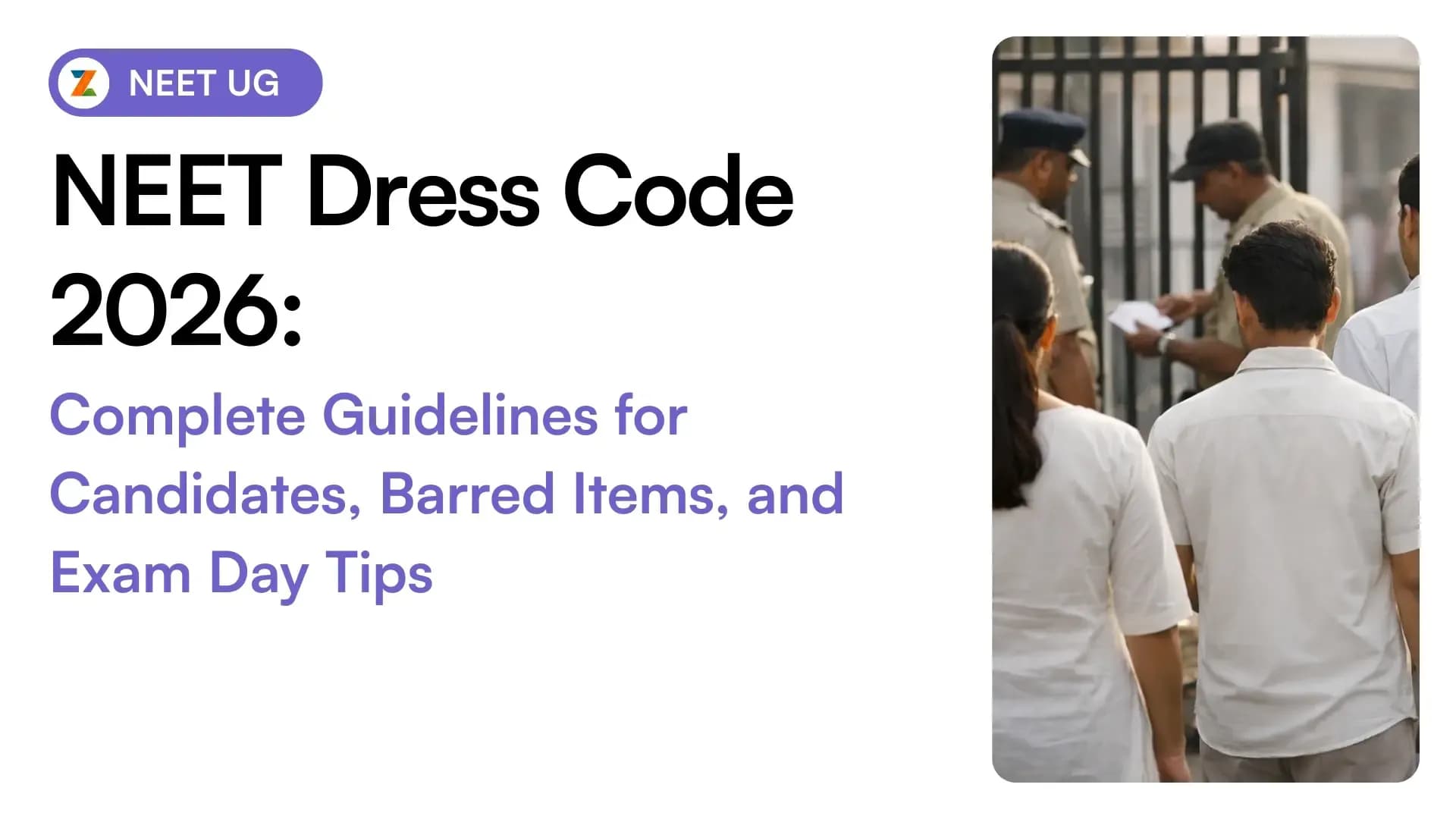
Table of contents
- Biometric Check and Entry Process at the NEET UG Exam Centre
- Quick Summary of NEET Dress Code
- NEET Dress Code for Females 2026
- NEET Dress Code for Males 2026
- Dress Code for Religious Attire in NEET
- Barred Items in NEET Exam Hall
- Items Allowed in NEET Exam Hall
- What Happens If You Violate the NEET Dress Code?
- NEET Exam Day Tips to Avoid Last-Minute Issues
Note: Biometric authentication is a mandatory step for entry at every NEET UG exam centre. Even if technical or fingerprint-related issues occur, candidates will still be allowed to appear for the exam after completing the required verification process by submitting a written undertaking (the format will be provided at the exam centre).
The NEET UG exam, conducted by the National Testing Agency (NTA), is one of India's most competitive and high-stakes medical entrance tests, where lakhs of aspiring doctors vie for limited seats in prestigious institutions. On exam day, every detail matters, from reaching the centre on time to carrying the right documents, but one often-overlooked aspect that can create unnecessary stress or even lead to entry denial is the strict dress code. All candidates will undergo mandatory and thorough security screening at the entrance of the examination centre using high-sensitivity metal detectors before they are allowed to enter.
Biometric Check and Entry Process at the NEET UG Exam Centre
Along with following the NEET UG dress code, candidates must also complete biometric verification at the exam centre before entering the examination hall. This verification is conducted after document checking and security screening to confirm the identity of every candidate appearing for the exam.
NTA has clarified that students who face biometric verification issues at the NEET exam centre will still be permitted to take the examination. Problems such as unclear fingerprints, scanner malfunction, Aadhaar network issues, or medical conditions affecting fingerprint authentication will be handled separately by the exam authorities. In such cases, candidates must submit a written undertaking (the form will be provided at the exam centre).
Candidates are advised to report to the NEET UG exam centre well before the reporting time mentioned on the admit card, as biometric checks may take additional time. Carrying a valid photo ID and following the dress code guidelines properly can help avoid delays during the entry process.
Quick Summary of NEET Dress Code
The NEET dress code requires candidates to wear simple, light-coloured, half-sleeve clothing with minimal accessories to ensure smooth frisking and fair examination conduct. Avoid heavy outfits, metallic items, and prohibited accessories to prevent delays or entry issues.
Wear plain, light-coloured, half-sleeve clothes that are easy to frisk.
Avoid heavy embroidery, big buttons, zips, layers, thick-soled shoes, and jewellery.
Customary religious dress is permitted if declared in the application; such candidates must arrive at least 2 hours before for additional checks.
NEET Dress Code for Females 2026
Female candidates should opt for plain, light-coloured clothes such as half-sleeve tops, kurtis, or simple salwar/trousers with minimal embroidery. Footwear should be simple slippers or sandals with thin soles, and jewellery or heavy accessories must be avoided.
Recommended: light-coloured half-sleeve tops, kurtis, salwar or simple trousers. Keep buttons medium-sized and embroidery minimal.
Footwear: slippers or sandals with thin soles; avoid high heels and boots.
Avoid: heavy jewellery, brooches, flowers, large hair accessories, printed or tight-fitting jeans, leggings or jeggings with prints or heavy designs. Plain denim may be acceptable in some cases, but simple trousers are safer.
NEET Dress Code for Males 2026
Male candidates are advised to wear light-coloured half-sleeve shirts or t-shirts paired with simple trousers. Thick-soled shoes, layered clothing, belts, and accessories are not permitted as per exam security guidelines.
Recommended: light-coloured half-sleeve shirts or t-shirts and simple trousers. Avoid layered clothing.
Footwear: open sandals or slippers with thin soles; avoid shoes with thick soles.
Avoid: full-sleeve shirts, kurtas, track pants, shorts, belts, watches, heavy buttons, zips, and clothes with multiple or concealed pockets. These items can cause extra frisking or denial of entry.
Dress Code for Religious Attire in NEET
Candidates who wear customary, cultural, or religious attire or articles of faith must reach the examination centre at least two hours before the final reporting time. This allows sufficient time for detailed security checks without causing inconvenience while also ensuring the integrity of the examination. If, during screening, any such item is found to potentially conceal a prohibited device, the candidate may be instructed not to carry it into the examination hall.
Candidates who observe specific religious dress, such as a turban, burqa, hijab, or other customary items, may appear in those clothes only if they selected the “customary dress” option in the application. They must report earlier than the standard reporting time to allow for thorough security checks.
Some customary religious items may be allowed subject to inspection. Follow the instructions on your admit card and arrive early when you have declared customary dress.
Barred Items in NEET Exam Hall
The candidates are not allowed to carry the following items to the exam centre:
Electronic Objects
Mobile phones
Smartwatches
Fitness bands
Earphones
Bluetooth devices
Pen drives
Microchips
Electronic pens
Cameras
Accessory Items
Jewellery of any kind
Belts
Caps
Sunglasses
Wallets
Heavy buttons
Brooches
Hair clips and pins
Stationery and Study Material
Pens
Pencils
Papers
Geometry boxes
Log tables
Calculators
Scale
Erasers
Writing pads
Other
Food items
Personal water bottles are not permitted except for documented medical needs such as diabetes.
Items Allowed in NEET Exam Hall
Candidates must carry the following items to the exam hall to ensure smooth running:
Admit card
Valid photo ID
Passport-size photograph
What Happens If You Violate the NEET Dress Code?
If a candidate does not follow the prescribed dress code, they may face delays during frisking or even be denied entry to the examination centre.
Candidates not following the dress code may be denied entry to the exam centre.
In addition, wearing prohibited items can lead to disqualification or misconduct charges in severe cases.
Security staff and NTA guidelines are strict because dress-code checks are a core anti-cheating measure.
If you arrive in customary dress but did not declare it, you may face delays or denial.
NEET Exam Day Tips to Avoid Last-Minute Issues
Plan your outfit a day in advance and carry only essential documents like the admit card and valid ID proof. Arrive early at the centre, follow the dress code strictly, and avoid bringing any barred items to ensure a hassle-free entry.
Read your admit card carefully: it may list the final rules and reporting time.
Choose plain, light-coloured half-sleeve clothing and test the footwear you plan to wear for comfort and thin soles.
Remove all jewellery and metallic items before leaving home. Keep them at home rather than trying to store them at the centre.
If you follow a religious/customary dress, mark that option in the application and reach the centre at least one hour earlier for extra checks. Carry any supporting documents if the admit card requires them.
Keep medical proof handy if you must carry medicines or a small transparent water bottle for a legitimate health reason.
Frequently Asked Questions
Here are some answers to questions you might be looking for.
Related Blogs
NEET SS 2026 Exam: Complete Guide to Exam Date, Eligibility, Syllabus, Pattern & Registration
The National Eligibility-cum-Entrance Test for Super Speciality (NEET SS) is a national-level entrance examination conducted by the National Board of Examinations in Medical Sciences (NBEMS).
Nov 20, 2026
NEET PG 2026 PwD Guidelines: Eligibility, Functional Assessment, Speciality-Wise Criteria & Appeals
The National Medical Commission (NMC) has released new guidelines for NEET PG 2026 PwD candidates. The guidelines explain how PwBD candidates will be assessed for eligibility during counselling and admission.
Oct 9, 2026

NEET PG 2026 Result Statistics: Number of Candidates, Qualified Candidates & Cutoff
The NEET PG 2026 result has been declared by the National Board of Examinations in Medical Sciences (NBEMS) on September 24, 2026. The result includes the candidate's total score and NEET PG 2026 rank. The examination was conducted on August 30, followed by a re-examination in Jaipur on September 5 for candidates affected by a technical disruption.
Sep 30, 2026
NEET SS Syllabus 2026: Subject-Wise Syllabus, DM/MCh Specialities & Exam Pattern
The National Eligibility cum Entrance Test for Super Speciality (NEET SS) is a national-level entrance examination conducted by the National Board of Examinations in Medical Sciences (NBEMS).
Nov 11, 2026

Tamil Nadu NEET PG 2026 Counselling Documents Required: Complete Checklist for All Quotas
Candidates preparing for Tamil Nadu NEET PG 2026 counselling should keep all the required certificates and documents ready before completing the counselling application. The Tamil Nadu Selection Committee, Directorate of Medical Education and Research, Chennai, has notified candidates that counselling for PG MD, MS, Diploma and DNB courses for the 2026-27 session will commence shortly.
Oct 13, 2026
NEET PG 2026 Counselling Seat Matrix: PDF, College-Wise, Course-Wise & Category-Wise Seats
The NEET PG counselling 2026 seat matrix is one of the most important documents for candidates preparing their choice-filling strategy. It shows the postgraduate courses and the number of seats available across medical colleges and institutions for the academic year 2026-27.
Oct 1, 2026