


All blogs
Share
Published on 9 October, 2026
NEET PG 2026 PwD Guidelines: Eligibility, Functional Assessment, Speciality-Wise Criteria & Appeals
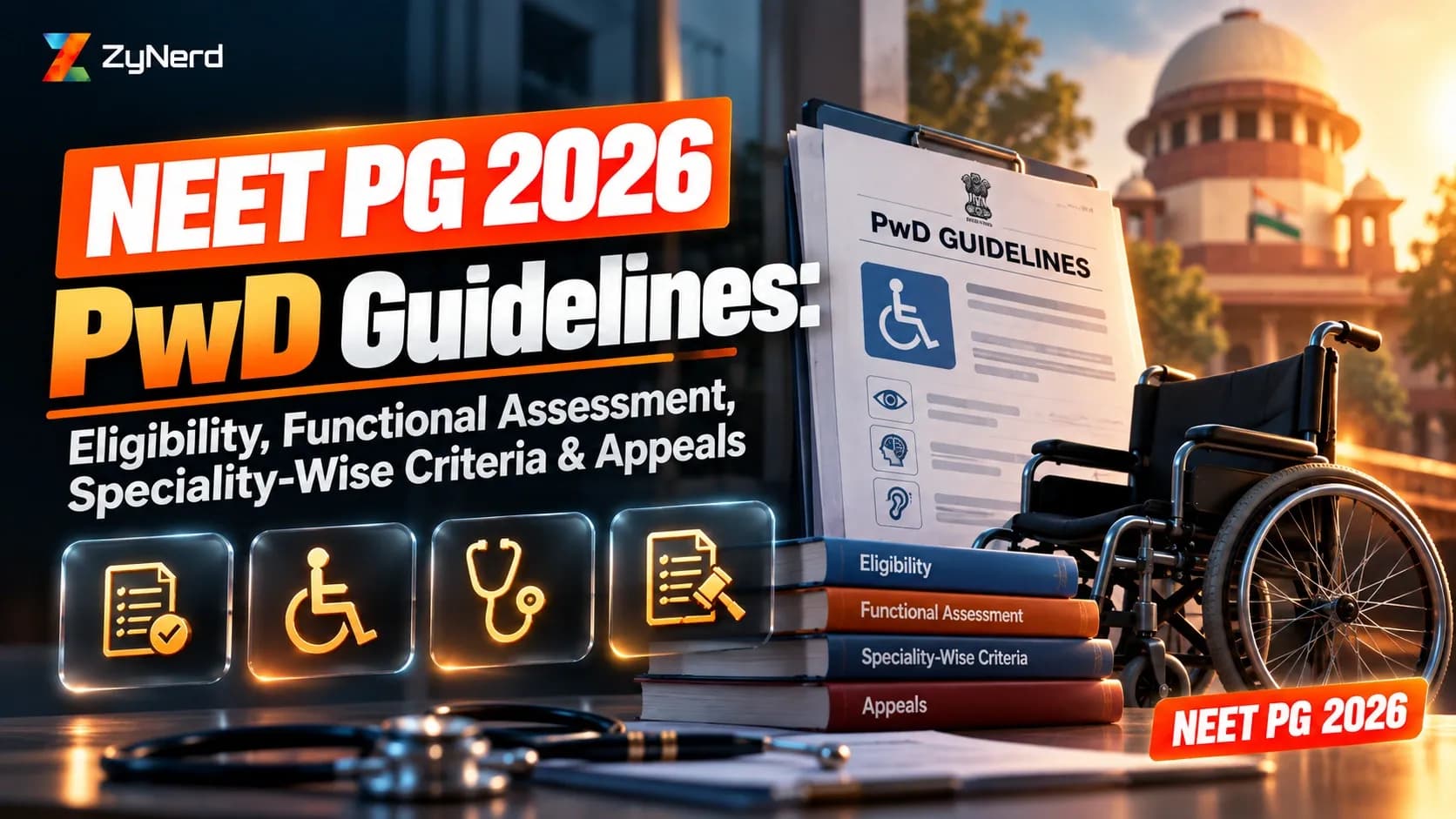
The National Medical Commission (NMC) has released new guidelines for NEET PG 2026 PwD candidates. The guidelines explain how PwBD candidates will be assessed for eligibility during counselling and admission.
The biggest thing to understand is that your disability percentage is not the only factor that decides whether you can take a particular PG specialty. The Medical Assessment Board will also look at your functional abilities and whether you can perform the essential requirements of the course, with reasonable accommodation wherever possible.
In simple terms, having a 40% or higher benchmark disability makes a candidate eligible to claim PwBD reservation, but the final eligibility for a PG course depends on the candidate's ability to meet the functional requirements of that speciality.
The guidelines also cover the role of the UDID Card, functional assessment, reasonable accommodation, Eligibility Certificate, specialty-wise requirements and the appeal process if a candidate is declared ineligible.
Key Highlights for NEET PG 2026 PwD Aspirants
The NMC guidelines introduce several important points for PwBD candidates appearing for NEET PG counselling:
Key Terms | What it means |
|---|---|
Minimum 40% benchmark disability | A candidate seeking reservation under the specified disability category must have benchmark disability of at least 40%. |
Valid UDID Card | A valid UDID Card is required and serves as the primary documentary evidence of the specified disability. |
Functional assessment | The Board independently assesses whether the candidate can acquire and demonstrate essential competencies for the particular PG course. |
Reasonable accommodation | Assistive devices, adaptive equipment, digital accessibility, communication support and other suitable accommodations may be considered. |
Patient safety | Patient safety remains an important consideration, but conclusions must be based on objective clinical and functional evidence. |
Eligibility Certificate | The document issued by the Medical Assessment Board is termed an Eligibility Certificate, reflecting functional assessment rather than disability percentage alone. |
Three possible outcomes |
|
Is 40% Disability Enough for NEET PG PwD Eligibility?
One of the most important points in the NEET PG 2026 PwBD guidelines is that disability percentage and course eligibility are two different things. A candidate needs at least 40% benchmark disability to claim PwBD reservation. However, having 40% disability does not automatically make a candidate eligible for every PG speciality.
The Medical Assessment Board will also check whether the candidate can perform the essential functions required for the particular PG course. This assessment can include things like motor skills, communication, mobility, clinical work, academic participation and the ability to follow instructions.
The Board will also consider whether reasonable accommodation or assistive technology can help the candidate meet these requirements. The guidelines specifically state that a candidate cannot be declared ineligible simply because of their disability category, disability percentage or a general assumption about their condition.
NEET PG 2026 PwD Eligibility for Different Specialties
The functional requirements can vary significantly from one PG specialty to another. A candidate who may be able to meet the requirements of one specialty may need a different assessment for another.
The NMC guidelines broadly divide PG specialties into four groups.
Surgical Specialties
This group includes specialties such as General Surgery, Orthopaedics, Obstetrics and Gynaecology, Ophthalmology, ENT, Anaesthesiology, Emergency Medicine, PM&R and Sports Medicine.
These specialties can require:
Fine motor skills
Bimanual dexterity
Prolonged standing
Operating theatre mobility
Hand-eye coordination
Depth perception
Patient communication
Clinical judgement
Continuity of patient care
Because of these requirements, the functional assessment is particularly important for surgical specialities. For example, the guidelines consider whether a candidate with a locomotor or upper-limb disability can actually demonstrate the required skills, rather than deciding eligibility only from the percentage mentioned on the disability certificate.
Other Clinical Specialties
This category includes specialties such as General Medicine, Dermatology, Paediatrics, Psychiatry, Radio-diagnosis, Radiation Oncology, Respiratory Medicine, Palliative Medicine and Community Medicine, among others.
The assessment can focus on functions such as:
Patient interaction
Clinical examination
Communication
Documentation
Clinical decision-making
Monitoring patients
Performing relevant procedures
Working with the healthcare team
Depending on the candidate's needs, accommodations such as hearing aids, cochlear implants, assistive devices or flexible scheduling may be considered where appropriate.
Pre-Clinical Specialties
The pre-clinical group includes:
Anatomy
Physiology
Biochemistry
Biophysics
Here, the assessment is more focused on activities such as teaching, laboratory demonstrations, microscopy, academic interaction and other course-related responsibilities. The guidelines also mention accommodations such as ramps, adjustable tables, digital microscopy, magnifiers, hearing aids, cochlear implants and other assistive devices, depending on the candidate's functional needs.
Para-Clinical Specialties
The para-clinical group includes:
Pharmacology
Pathology
Microbiology
Forensic Medicine and Toxicology
The functional requirements can include laboratory work, teaching, microscopy, data interpretation, field visits and medico-legal work. Again, the assessment is based on whether the candidate can perform these functions, with suitable accommodation considered wherever possible.
Does the Specialty-Wise List Mean Some Disabilities Are Automatically Rejected?
No. The specialty-wise tables are meant to help assess whether a candidate can meet the essential requirements of a particular course. The final decision is taken after physical verification and functional assessment by the designated Medical Assessment Board during counselling or admission. This means candidates should not assume that their disability automatically rules out a particular specialty without going through the prescribed assessment.
How Are Neurodevelopmental, Psychiatric & Chronic Illnesses Assessed?
The guidelines have separate criteria for some conditions, including Autism Spectrum Disorder (ASD), mental illness, Specific Learning Disorder (SLD), Intellectual Disability (ID) and chronic neurological disorders.
The focus remains on what the candidate can actually do and whether they can safely acquire the competencies required during PG training.
Autism Spectrum Disorder and Mental Illness
For candidates with ASD or mental illness, the Board looks at practical aspects such as:
Ability to communicate and understand information
Ability to follow instructions
Participation in academic and clinical activities
Social and professional interaction
Ability to manage routine responsibilities
Ability to function independently or with reasonable support
A diagnosis or disability percentage by itself should not be treated as an automatic reason for rejection.
The important question is whether the candidate can acquire the required competencies and participate safely in the PG course, with reasonable accommodation where required.
Specific Learning Disorder
For SLD, the assessment looks at whether the candidate can acquire the academic and clinical competencies required for the course.
Accommodations such as extra time, accessible learning material and assistive technology may be considered where they help the candidate demonstrate the required competencies.
Intellectual Disability
For candidates with Intellectual Disability, the Board considers factors such as:
Understanding and following instructions
Communicating needs and safety concerns
Adaptive functioning
Ability to perform relevant tasks
Ability to acquire the required competencies
Ability to work independently or with appropriate support
The focus is therefore on functional ability rather than simply the diagnosis or percentage of disability.
Chronic Neurological Disorders
For chronic neurological conditions, the Board considers whether the condition is stable and controlled and whether the candidate can participate consistently in the PG course. Factors such as the frequency of seizures or relapses, motor and cognitive abilities, treatment-related limitations and the possibility of interruptions to training may be considered.
The guidelines specifically recognise that conditions such as epilepsy, cerebral palsy and neuromuscular disorders can be assessed based on their functional impact and stability.
What Does Reasonable Accommodation Mean for NEET PG Candidates?
Reasonable accommodation essentially means making suitable changes or providing support that helps a PwBD candidate participate in the course without lowering the required academic or clinical standards.
Depending on the candidate and specialty, this could include:
Assistive devices
Adaptive equipment
Hearing aids or cochlear implants
Digital or accessible learning material
Communication support
Modified mobility aids
Adjustable furniture
Digital microscopy or magnification aids
Flexible scheduling where feasible
The accommodation will depend on the candidate's individual needs and the requirements of the particular speciality.
The NMC guidelines make it clear that reasonable accommodation should be considered before a candidate is declared ineligible.
Step-by-Step Checklist for NEET PG 2026 PwBD Candidates
If you are applying under the PwBD category, keep these steps in mind:
1. Check Your Disability Percentage
You should have at least 40% benchmark disability to claim reservation under the PwBD category. However, remember that this is not the final test for specialty eligibility.
2. Keep Your UDID Card Ready
A valid UDID Card is required and serves as the primary documentary evidence of the specified disability. The Medical Assessment Board will verify the details on the UDID Card as part of the assessment.
3. Check Your Functional Ability
Think beyond the disability percentage and look at the actual requirements of the specialty you want. For example, surgical specialties may involve prolonged standing, fine motor skills and bimanual dexterity, while other specialties may have different functional requirements.
4. Fill the Required Self-Certification
PwBD candidates have to submit the prescribed self-certified affidavit declaring their functional abilities. The Medical Assessment Board will verify these details during the assessment.
5. Attend the Medical Assessment
The Board may conduct further clinical examination or functional evaluation if required to understand your abilities and determine whether reasonable accommodation is possible.
6. Check Your Eligibility Certificate
After the assessment, the Board can issue one of three outcomes:
Eligible
Eligible with Reasonable Accommodation
Ineligible
If accommodation is recommended, it should be mentioned in the Eligibility Certificate.
7. Keep Your Assessment Documents Safely
If you are declared eligible with accommodation, make sure you understand what accommodation has been recommended. If you are declared ineligible, carefully check the reasons given in the written decision, especially if you plan to appeal.
What If You Are Declared Ineligible? Appeals & Grievances
If a candidate is declared ineligible, the decision cannot simply be based on their diagnosis or disability percentage.
The Medical Assessment Board must explain what limitation was identified, which competency is affected, what accommodation was considered and why the accommodation was not sufficient.
Can You Appeal the Decision?
Yes.
A candidate who disagrees with the Medical Assessment Board's decision can appeal to the Appellate Authority constituted by the Directorate General of Health Services (DGHS).
The appellate authority can:
Review the Medical Assessment Board's records
Ask for a fresh medical assessment
Seek an additional medical opinion
Conduct further examination where required
Confirm, modify or set aside the original decision
The appeal has to be filed within the time and in the manner notified by MCC.
What Should You Check If You Are Declared Ineligible?
If you receive an ineligibility decision, check whether the order clearly explains:
The functional limitation identified
The PG competency that is affected
The medical or functional evidence considered
The accommodation that was considered
Why the accommodation was considered insufficient
Why the candidate cannot safely acquire or demonstrate the required competency
Frequently Asked Questions
Here are some answers to questions you might be looking for.
Related Blogs
KEA NEET PG Counselling 2026: Registration, Offline Document Verification, Eligibility, Fees & Seat Allotment Rules
Karnataka NEET PG counselling is the state-level counselling process for admission to postgraduate medical courses in Karnataka. The Karnataka Examinations Authority (KEA) conducts centralized counselling for eligible NEET PG candidates for seats in government medical colleges, government quota seats in private and minority medical colleges, and private seats in eligible private institutions and few seats in deemed universities as well.
Aug 27, 2026

Minority Seats in NEET PG Counselling: Linguistic & Religious Minority Eligibility, Colleges & Admission Rules
Minority seats in NEET PG counselling are available in certain medical colleges that have recognised religious or linguistic minority status. These seats are not governed by one uniform national minority-quota rule. The eligibility, documentation, seat distribution and counselling process can differ depending on the state, institution and type of seat.
Sep 10, 2026
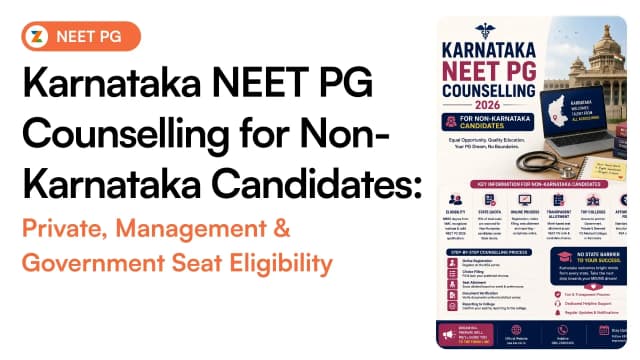
Karnataka NEET PG Counselling for Non-Karnataka Candidates: Private, Management & Government Seat Eligibility
Karnataka is one of the most preferred destinations for NEET PG aspirants from across India, particularly because its counselling includes seats in government colleges, private medical colleges, minority institutions and private universities. For Karnataka NEET PG counselling for non Karnataka candidates, however, the most important point is that eligibility depends on the type of seat being sought.
Sep 2, 2026

Tamil Nadu NEET PG 2026 Counselling Documents Required: Complete Checklist for All Quotas
Candidates preparing for Tamil Nadu NEET PG 2026 counselling should keep all the required certificates and documents ready before completing the counselling application. The Tamil Nadu Selection Committee, Directorate of Medical Education and Research, Chennai, has notified candidates that counselling for PG MD, MS, Diploma and DNB courses for the 2026-27 session will commence shortly.
Oct 13, 2026

NEET PG 2026 Counselling Seat Matrix: PDF, College-Wise, Course-Wise & Category-Wise Seats
The NEET PG counselling 2026 seat matrix is one of the most important documents for candidates preparing their choice-filling strategy. It shows the postgraduate courses and the number of seats available across medical colleges and institutions for the academic year 2026-27.
Oct 1, 2026

NEET PG 2026 Result Statistics: Number of Candidates, Qualified Candidates & Cutoff
The NEET PG 2026 result has been declared by the National Board of Examinations in Medical Sciences (NBEMS) on September 24, 2026. The result includes the candidate's total score and NEET PG 2026 rank. The examination was conducted on August 30, followed by a re-examination in Jaipur on September 5 for candidates affected by a technical disruption.
Sep 30, 2026