


All blogs
Share
Published on 11 November, 2026
NEET SS Syllabus 2026: Subject-Wise Syllabus, DM/MCh Specialities & Exam Pattern
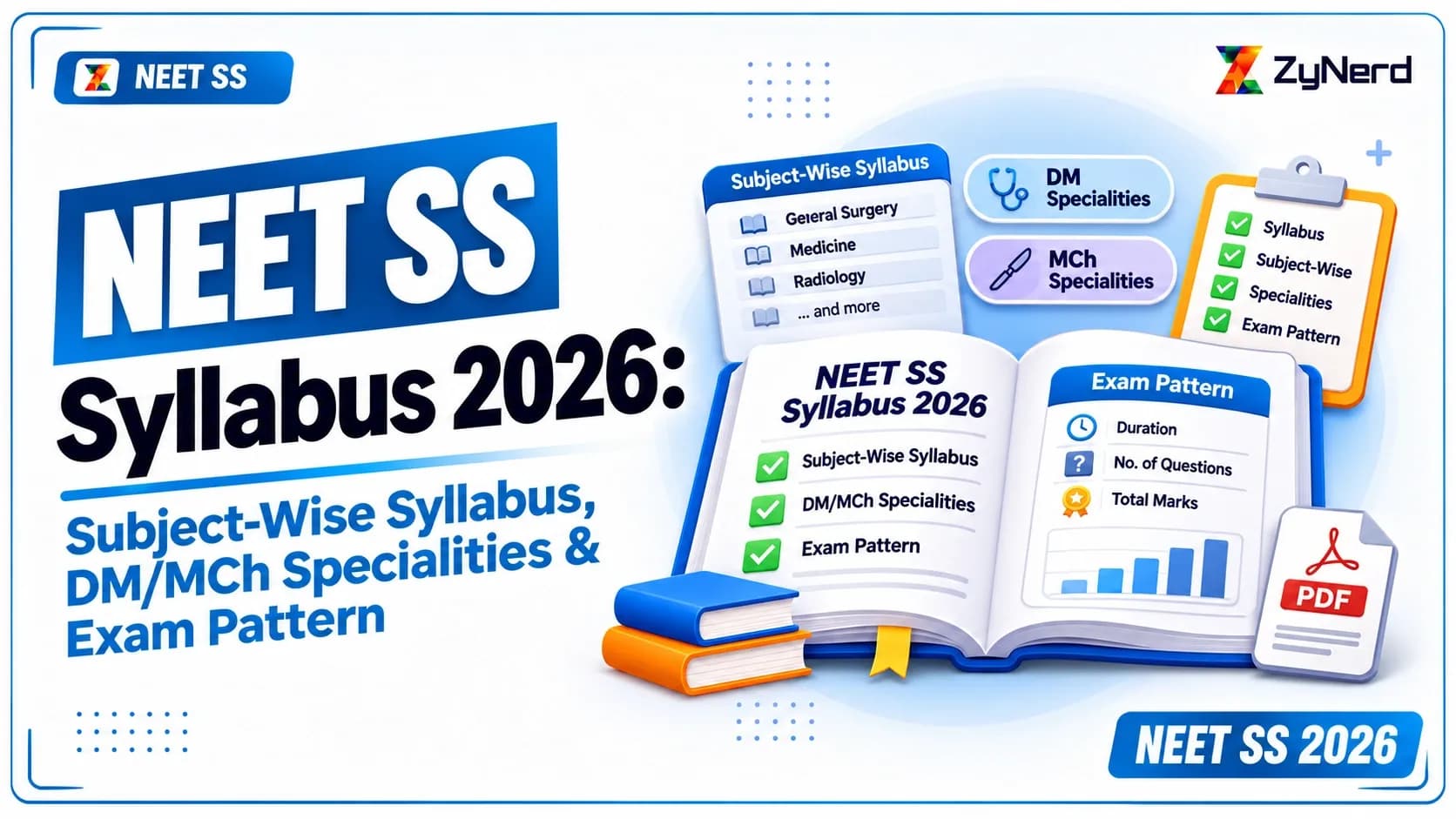
The National Eligibility cum Entrance Test for Super Speciality (NEET SS) is a national-level entrance examination conducted by the National Board of Examinations in Medical Sciences (NBEMS). It is the qualifying-cum-ranking examination for admission to Doctorate of Medicine (DM), Master of Chirurgiae (MCh) and Doctorate of National Board (DrNB) Super Speciality courses across India.
Understanding the NEET SS syllabus 2026 is essential for candidates preparing to pursue advanced medical specialisations. The examination follows a group-based structure, with different question papers covering various medical and surgical feeder specialties.
The NEET SS syllabus is primarily based on the postgraduate exit-level curriculum of the respective feeder broad specialty. Candidates must prepare the general, basic and subspecialty components of their chosen feeder subject. However, the Critical Care Medicine and Medical Oncology groups have separate syllabuses based on their respective super-speciality subjects.
NEET SS Syllabus 2026 Overview
The NEET SS examination is conducted in 15 question paper groups. Each group covers specific super-speciality courses, and candidates must appear for the relevant group based on their postgraduate feeder qualification.
Here is an overview of the NEET SS exam syllabus 2026.
Particulars | Details |
|---|---|
Examination Name | NEET SS 2026 |
Conducting Authority | NBEMS |
Examination Level | National Level |
Examination Mode | Computer-Based Test (CBT) |
Academic Session | 2026-27 |
Courses Offered | DM, MCh and DrNB Super Speciality |
Total Question Paper Groups | 15 |
Total Questions | 150 |
Total Duration | 150 minutes |
Total Sections | 3 Sections (A, B and C) |
Questions per Section | 50 |
Marks for Correct Answer | +4 |
Negative Marking | -1 |
Unattempted Questions | 0 |
Maximum Marks | 600 |
Important points about the NEET SS syllabus:
The examination follows a group-based structure with 15 different question papers.
Thirteen groups have a primary eligible feeder broad specialty. Questions cover its general/basic components and all subspecialty systems at the postgraduate exit level.
The Critical Care Medicine and Medical Oncology groups have separate question papers based exclusively on their respective super-speciality subjects.
Candidates can appear for multiple groups if their postgraduate qualifications are eligible feeder qualifications for those groups.
NEET SS Subject-Wise Syllabus 2026
The NEET SS 2026 examination follows a group-based syllabus. For 13 question paper groups, the syllabus is based on the general/basic components and subspecialty components of the respective primary feeder specialty at the postgraduate exit level.
Question Paper Group | Primary Eligible Feeder Specialty |
|---|---|
Medical Group | MD/DNB General Medicine |
Surgical Group | MS/DNB General Surgery |
Orthopaedics Group | MS/DNB Orthopaedics |
Paediatric Group | MD/DNB Paediatrics |
Obstetrics & Gynaecology Group | MD/MS/DNB Obstetrics & Gynaecology |
Anaesthesia Group | MD/DNB Anaesthesiology |
Radiodiagnosis Group | MD/DNB Radiology |
Respiratory Medicine Group | MD/DNB Respiratory Medicine |
Microbiology Group | MD/DNB Microbiology |
Pathology Group | MD/DNB Pathology |
Psychiatry Group | MD/DNB Psychiatry |
Pharmacology Group | MD/DNB Pharmacology |
ENT Group | MS/DNB ENT |
NEET SS Syllabus for DM and MCh Specialities
The NEET SS examination covers multiple DM, MCh and DrNB Super Speciality courses under different question paper groups. Each group has a common question paper for the super-speciality courses listed under it.
The following table provides the NEET SS subject-wise course mapping, including the super-speciality courses covered under each question paper group.
Question Paper Group | Super Speciality Courses |
|---|---|
Medical Group | 1. Cardiology 2. Clinical Haematology 3. Clinical Immunology & Rheumatology 4. Endocrinology 5. Medical Gastroenterology 6. Hepatology 7. Infectious Diseases 8. Medical Genetics 9. Nephrology 10. Neurology |
Surgical Group | 1. Cardiovascular & Thoracic Surgery 2. Paediatric Cardiothoracic Vascular Surgery 3. Paediatric Surgery 4. Surgical Gastroenterology 5. Hepato Pancreato Biliary Surgery 6. Neurosurgery 7. Plastic & Reconstructive Surgery 8. Urology 9. Vascular Surgery 10. Surgical Oncology 11. Endocrine Surgery 12. Thoracic Surgery |
Orthopaedics Group | 1. Hand Surgery 2. Paediatric Orthopaedics |
Paediatric Group | 1. Neonatology 2. Paediatric Hepatology 3. Paediatric Nephrology 4. Paediatric Oncology 5. Paediatric Neurology 6. Paediatric Cardiology 7. Paediatric Gastroenterology 8. Paediatric Critical Care 9. Paediatric Hemato Oncology |
Obstetrics & Gynaecology Group | 1. Gynaecological Oncology 2. Reproductive Medicine & Surgery |
Anaesthesia Group | 1. Cardiac Anaesthesia 2. Neuroanaesthesia 3. Organ Transplant Anaesthesia & Critical Care 4. Paediatric & Neonatal Anaesthesia |
Radiodiagnosis Group | 1. Neuro Radiology 2. Interventional Radiology |
Respiratory Medicine Group | 1. Pulmonary Medicine |
Microbiology Group | 1. Virology |
Pathology Group | 1. Onco-Pathology |
Psychiatry Group | 1. Geriatric Mental Health 2. Child and Adolescent Psychiatry |
Pharmacology Group | 1. Clinical Pharmacology |
ENT Group | 1. Head & Neck Surgery 2. Head & Neck Oncology |
NEET SS 2026 Exam Pattern
Along with understanding the NEET SS syllabus, candidates must be familiar with the examination pattern and marking scheme.
According to the NBEMS Information Bulletin, NEET SS 2026 is conducted as a computer-based examination with 150 multiple-choice questions.
The examination is divided into three time-bound sections, each containing 50 questions.
Particulars | Details |
|---|---|
Examination Mode | Computer-based Test |
Question Type | Multiple Choice Questions |
Total Questions | 150 |
Total Sections | 3 |
Section A | 50 |
Section B | 50 |
Section C | 50 |
Time per Section | 50 minutes |
Total Duration | 150 minutes |
Maximum Marks | 600 |
Marking Scheme | +4 for correct answers -1 for incorrect answers 0 for unattempted questions |
Important examination instructions:
Candidates cannot proceed to the next section before the allotted time for the current section is completed.
Once the allotted time for a section ends, candidates cannot review its questions or modify their responses.
The next section begins automatically after the previous section's time expires.
Four marks are awarded for every correct answer.
One mark is deducted for every incorrect answer.
No marks are deducted for unanswered questions.
How to Download NEET SS Syllabus PDF?
Candidates can access the official NEET SS syllabus information through the NBEMS website. The examination scheme, subject-wise groups and feeder qualification details are provided in the NEET SS 2026 Information Bulletin.
Follow these steps to download the NEET SS syllabus PDF:
Visit the official NBEMS website: https://natboard.edu.in/
Navigate to the NEET SS examination section.
Select NEET SS 2026 from the available examination years.
Click on the Information Bulletin link.
Open the PDF and navigate to Chapter 5, Scheme of NEET-SS 2026.
Refer to Tables 1 and 2 for the question paper groups and super-speciality courses.
Check Annexures A and B for detailed feeder qualification requirements.
Download and save the PDF for future reference.
Official NEET SS 2026 Information Bulletin:
Click here to download NEET SS 2026 Information Bulletin PDF
The bulletin is the primary reference for candidates preparing for the NEET SS exam.
How to Prepare for NEET SS 2026?
Preparing for NEET SS requires a thorough understanding of the postgraduate feeder specialty syllabus, clinical concepts and super-speciality subjects relevant to the chosen examination group.
Candidates can follow these preparation strategies to cover the NEET SS 2026 syllabus effectively.
1. Understand Your Examination Group
Before starting preparation, identify the super-speciality course you wish to pursue and check its eligible feeder qualifications. Refer to the official NBEMS Information Bulletin to select the correct question paper group.
2. Cover the Complete Feeder Specialty Syllabus
For the 13 primary feeder specialty groups, preparation should cover the complete postgraduate exit-level curriculum of the respective broad specialty.
Do not restrict preparation to the specific DM or MCh course you wish to pursue. Revise the general/basic components as well as the subspecialty systems covered under your feeder subject.
3. Focus on Clinical Concepts
NEET SS preparation requires strong clinical knowledge and the ability to apply concepts to patient management.
Pay attention to clinical case scenarios, diagnostic approaches, investigations, treatment protocols, complications and evidence-based management.
4. Prepare Dedicated Super Speciality Subjects
Candidates appearing for the Critical Care Medicine and Medical Oncology groups should focus on the respective super-speciality curriculum, as their question papers are based exclusively on those subjects.
5. Practise MCQs Regularly
Solve subject-wise MCQs and previous examination questions to strengthen conceptual understanding and improve accuracy.
Analyse incorrect answers, identify weak areas and revise important concepts regularly.
6. Attempt Mock Tests Based on the Latest Exam Pattern
Practise full-length mock examinations with 150 questions and three sections of 50 questions each.
Follow the 50-minute time limit for every section. Since candidates cannot return to a completed section, develop the habit of managing time and reviewing answers within the allotted section duration.
7. Revise Regularly
Create concise revision notes covering important clinical findings, diagnostic criteria, treatment approaches, classifications, staging systems and clinical guidelines.
Regular revision helps improve recall and accuracy during the examination.

Frequently Asked Questions
Here are some answers to questions you might be looking for.

Related Blogs
NEET SS 2026 Exam: Complete Guide to Exam Date, Eligibility, Syllabus, Pattern & Registration
The National Eligibility-cum-Entrance Test for Super Speciality (NEET SS) is a national-level entrance examination conducted by the National Board of Examinations in Medical Sciences (NBEMS).
Nov 20, 2026
NEET SS 2026 Registration: Dates, Application Fee, Eligibility & How to Apply
The National Board of Examinations in Medical Sciences (NBEMS) has commenced the registration process for the National Eligibility-cum-Entrance Test for Super Specialty (NEET SS) 2026.
Nov 2, 2026
NEET PG 2026 Result Statistics: Number of Candidates, Qualified Candidates & Cutoff
The NEET PG 2026 result has been declared by the National Board of Examinations in Medical Sciences (NBEMS) on September 24, 2026. The result includes the candidate's total score and NEET PG 2026 rank. The examination was conducted on August 30, followed by a re-examination in Jaipur on September 5 for candidates affected by a technical disruption.
Sep 30, 2026
NEET PG 2026 Answer Key: Release Date, PDF, Download Steps & Marking Scheme
The NEET PG answer key usually helps candidates verify their responses and estimate their probable score and last year it was released after the official result was declared. This year, the answer key may be published before the results are announced. The National Board of Examinations in Medical Sciences (NBEMS) conducted NEET PG 2026 on August 30, 2026, with a re-examination held for affected candidates at selected Jaipur centres on September 5.
Sep 23, 2026
NEET PG Result 2026 Out @natboard.edu.in: How to Check, Scorecard, Cut-Off, Merit List & More
NEET PG result 2026 tentative release date is September 30, 2026 as per the schedule released by National Board of Examinations in Medical Sciences (NBEMS). The NEET PG 2026 result will be announced on the official website for the candidates who had appeared in the examination.
Sep 15, 2026
NEET PG 2026 Scorecard: Download Link, Release Date, Cutoff, Details & More
The NEET PG scorecard 2026 is the individual result document issued by the National Board of Examinations in Medical Sciences (NBEMS) for candidates who appeared in NEET PG 2026. NBEMS declared the NEET PG 2026 result on September 24, 2026, while individual scorecards can be downloaded from the NBEMS website on or after October 1, 2026.
Oct 1, 2026