


All blogs
Share
Published on 30 April, 2026
INI CET 2026 Syllabus Breakdown: What to Study and How to Prepare
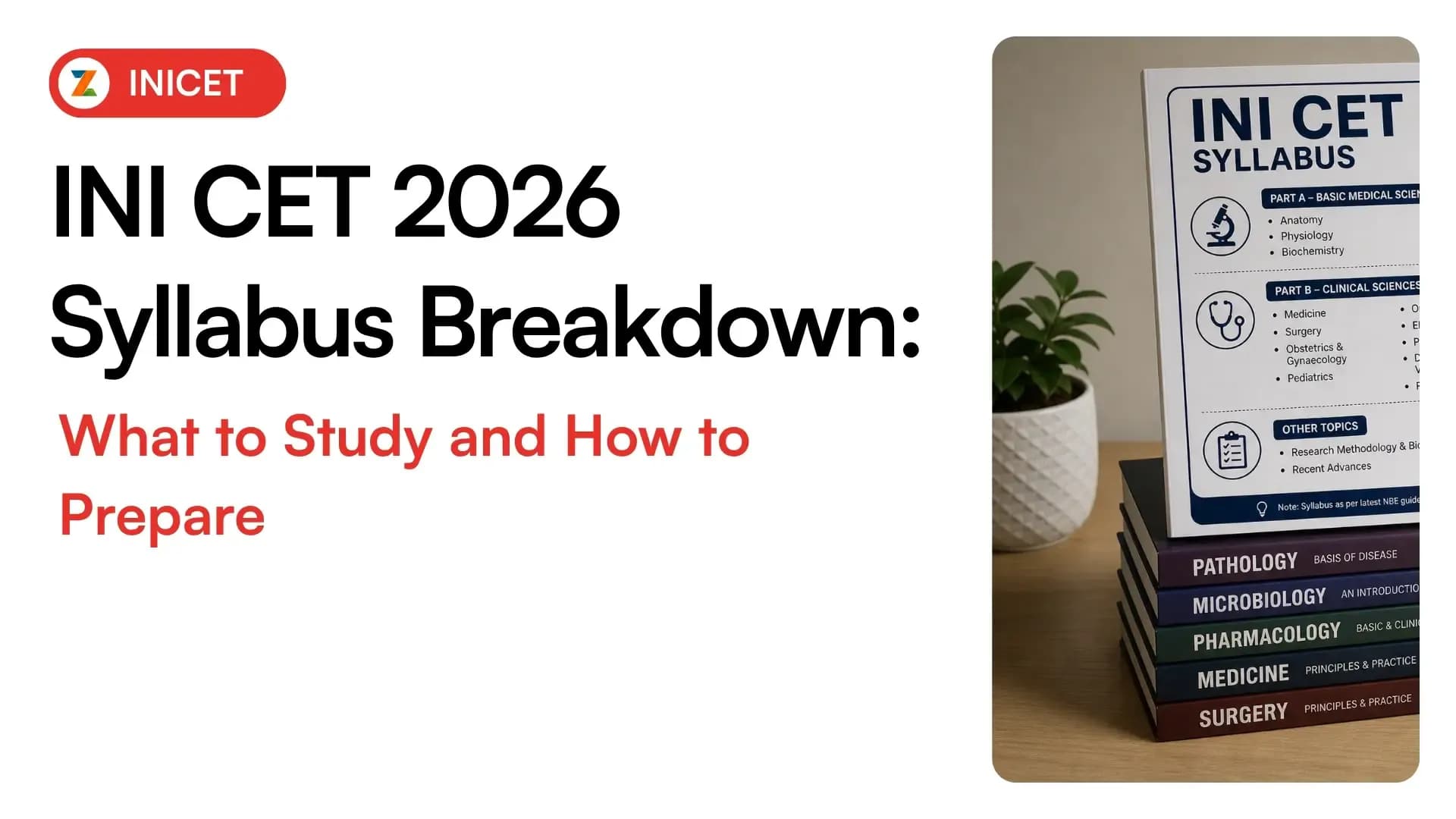
The INI CET July 2026 session is the entrance exam for PG courses like MD, MS, MDS, and the 6-year DM and MCh programs at institutes such as AIIMS, JIPMER, PGIMER, SCTIMST and NIMHANS. It is conducted online by AIIMS and the exam duration is three hours. One common confusion among students is that the official brochure does not list a detailed, topic-wise syllabus. Because of this, most aspirants prepare using the full MBBS syllabus, with more focus on understanding concepts instead of just memorising facts.
INI CET 2026 Syllabus Overview
The INI CET syllabus is quite wide and doesn’t stick to one subject at a time. It basically covers all three phases of MBBS, pre-clinical, para-clinical, and clinical. Questions are often mixed, so you might see concepts from different subjects coming together in a single question. That’s why just reading subjects in isolation doesn’t always work well for this exam.
When it comes to preparation, it helps to think of INI CET as a full MBBS-based exam rather than something limited or selective. Clinical subjects usually feel more important during revision because many questions are built around clinical scenarios, but that doesn’t mean you can ignore the basics. A strong understanding of pre and para subjects still plays a big role in solving those questions.
Subject-wise INI CET Syllabus
INI CET syllabus includes all MBBS subjects from pre-clinical, para-clinical, and clinical phases. Questions are often mixed and based on concepts rather than separate subject-wise blocks.
Pre-clinical Subjects | Para-clinical Subjects | Clinical Subjects |
|---|---|---|
Anatomy | Forensic Medicine & Toxicology | Anaesthesiology |
Biochemistry | Microbiology | Dermatology & Venereology |
Physiology | Pathology | Medicine |
Pharmacology | Obstetrics & Gynaecology | |
Community Medicine | Ophthalmology | |
Orthopaedics | ||
Otorhinolaryngology | ||
Paediatrics | ||
Psychiatry | ||
Surgery |
INI CET Detailed Syllabus 2026
Pre-clinical Subjects
Anatomy | Biochemistry | Physiology |
|---|---|---|
Gross anatomy | Biological cell | General Physiology |
Microanatomy | Biomolecules | Nerve–Muscle |
Embryology and Genetics | Enzymes | Blood |
Neuroanatomy | Metabolic pathways, their regulation and metabolic interrelationships | Respiratory System |
Food assimilation and nutrition | Cardiovascular System | |
Hormones | Gastrointestinal System | |
Molecular Biology | Nutrition | |
pH, Buffer, physiological buffer systems | Environmental Physiology | |
Immunology | Reproduction | |
Environmental biochemistry, cancer and cancer makers | Kidney | |
Neurophysiology | ||
Yoga |
Para-clinical Subjects
Forensic Medicine & Toxicology | Microbiology | Pathology | Pharmacology | Community Medicine |
|---|---|---|---|---|
Forensic Pathology | Introduction to Microbiology | General Pathology | General Pharmacology | Behavioral Sciences |
Clinical Forensic Medicine | Introduction to Bacteriology | Systemic Pathology | Autonomic nervous system & Peripheral nervous system | Health Education |
Medical Jurisprudence | Bacterial Staining and Cultivation | Central nervous system | Environment | |
Forensic Psychiatry | Common Tests for Bacterial identification | Autacoids | Biostatistics | |
Forensic Sciences | Introduction to Parasitology | Cardiovascular system | Epidemiology | |
General Toxicology | Introduction to Virology | Gastrointestinal and respiratory system | Nutrition | |
Clinical Toxicology | Laboratory Diagnosis of Viral Infection | Hormones | Maternal & Child Health | |
Environmental Toxicology | Introduction to Mycology | Chemotherapy | Rehabilitation | |
Analytical Toxicology | Common Laboratory Methods for Diagnosis of Fungal Infections | Epidemiology of communicable diseases & non-communicable diseases | ||
Collection of Transport of Samples | Important national health programmes | |||
Host-Parasite relationship | Occupational health | |||
Bacterial and Viral Genetics | Health administration | |||
Immunity to infection | Health economics | |||
Immunodiagnosis | Geriatrics | |||
Vaccines | Counselling | |||
Sterilisation and disinfection | ||||
Bacteriology of water and air | ||||
Microorganisms associated with gastrointestinal infections. | ||||
Gastrointestinal infections caused by parasites |
Clinical Subjects
Anaesthesiology
Dermatology & Venereology: Ineffective dermatoses, Infective dermatoses, Infestations, Melanin synthesis, Allergic disorders, Drug eruptions, urticaria, erythema multiforme, Steven’s johnson syndrome and toxic epidermal necrolysis, Vesiculo-bullous diseases, Epidermopoisis, Psoriasis, Lichen planus and Pityriasis rosea, Pathogenesis, Classification and clinical features of leprosy, Reactions in leprosy, Diagnosis, treatment and control of leprosy, Syphilis, Gonococcal and Non-gonococcal infections, Chancroid, LGV, Donovanosis, Herpes progenitalis, Syndromic approach to the diagnosis and management of sexually transmitted diseases, HIV infection, Cutaneous manifestations of HIV infection and their management, Hereditary disorder, Dermatological Emergencies
Medicine: General, Clinical Pharmacology, Nutritional and metabolic disorders, Water, electrolyte and acid-base imbalance, Critical care Medicine, Pain management and palliative care, Medical Psychiatry, Poisonings, Specific environmental and occupational hazards, Immune response and Infections, Specific Infections - Epidemiology, clinical features, laboratory diagnosis, treatment, System-Based diseases, Endocrinology and Metabolism
Obstetrics & Gynaecology: Basic Sciences, Obstetrics, Gynaecology, Contraception, Neonatology and Recent Advances
Ophthalmology
Orthopaedics
Otorhinolaryngology: Oral cavity and oropharynx, Ear, Instruments, Operative Procedures, X-ray
Pediatrics: Vital statistics, Growth and development, Nutrition, Immunization, Infectious diseases, Hematology, Respiratory system, Gastro Intestinal Tract, Central Nervous System, Cardiovascular system, Genito-Urinary system, Endocrinology, Neonatology, Pediatrics Emergencies, Fluid-Electrolyte, Genetics, Behavioral Problems, Pediatrics Surgical Problems
Psychiatry: Introduction and Classification of Psychiatric Disorders, Aetiology of Psychiatric Disorders, Schizophrenia, Bipolar Disorders, Depression, Anxiety Neurosis, Phobia and OCD, Hysterical Neurosis (Conversion and Dissociative Disorders), Personality Disorders, Drug and Alcohol Dependence, Psychiatric Disorders of Childhood and Adolescence, Counselling and Psychological Therapies, Psychological Testing
Surgery: Skin, Head and Neck region, Arteries, Veins, Breast, Oesophagus, Stomach and duodenum, Small intestine, Colon and rectum, Appendix, Anus, Peritoneum and intraperitoneal abscesses, Liver, Biliary tract, Pancreas, Acute abdomen, Hernias of the abdominal wall, Urology
How to Cover the INI CET Syllabus Effectively
Preparing for INI CET takes a slightly different approach compared to other exams. It’s not just about finishing subjects, it’s about being able to connect them.
Most students find it easier to begin with the main clinical subjects like Medicine, Surgery, and Obstetrics and Gynaecology. These areas come up frequently and help you get used to thinking in a clinical way. Along with this, Pathology and Pharmacology should also be covered early since they support a lot of concepts in Medicine.
After that, you can go back to the first- and second-year subjects like Anatomy, Physiology, and Biochemistry. Instead of trying to remember every detail, focus on the parts that actually help you understand diseases and treatments. That makes revision quicker and more useful.
Subjects like Microbiology, Community Medicine, and Forensic Medicine are easier to manage if you keep revising them regularly in short cycles. Many questions from these areas are straightforward, so they can help improve your score if you’re clear with the basics.
Revision is where things really come together. Reading once is not enough. You need to go over the same topics multiple times so that recall becomes faster. Practicing MCQs alongside your preparation helps you understand how questions are asked and where you tend to make mistakes.
Closer to the exam, full-length and mixed-subject tests are important. They help you get used to switching between subjects and managing time during the paper.
In the end, the aim is simple: be clear with concepts, revise regularly, and get comfortable applying what you’ve studied.
INI CET 2026 Syllabus Exam Pattern
The INI CET is conducted in online mode, and the total duration of the exam is three hours. The paper consists of 200 questions, divided into four sections. Each section has 50 questions, and you get 45 minutes to complete one section before moving to the next.
Particulars | Details |
|---|---|
Mode of Exam | Online |
Duration | 3 hours |
Total Questions | 200 |
Sections | 4 (50 questions each) |
Time per Section | 45 minutes |
Question Type | MCQs |
Marking Scheme | +1 for correct answer, -⅓ for incorrect answer, 0 for an unanswered question. |
Difference between INI CET Syllabus & NEET PG Syllabus
Both exams are based on the MBBS syllabus, but the question style is different. INI CET usually asks concept-based and clinical questions, while NEET PG has more direct, fact-based questions.
Factors | INI CET Syllabus | NEET PG Syllabus |
|---|---|---|
Syllabus Base | MBBS curriculum | MBBS curriculum |
Question Style | Concept-based, application-oriented | More fact-based, recall-heavy |
Subject Integration | High (mixed questions across subjects) | Moderate |
Clinical Focus | Strong emphasis | Present but less integrated |
Image-based Questions | Frequently asked | Asked but relatively fewer |
Difficulty Level | Generally higher | Moderate to high |
Preparation Approach | Concept clarity + integration | Strong memory + wide coverage |
Revision Strategy | Mixed subject revision | Subject-wise + rapid revision |

Frequently Asked Questions
Here are some answers to questions you might be looking for.

Related Blogs
NEET SS Syllabus 2026: Subject-Wise Syllabus, DM/MCh Specialities & Exam Pattern
The National Eligibility cum Entrance Test for Super Speciality (NEET SS) is a national-level entrance examination conducted by the National Board of Examinations in Medical Sciences (NBEMS).
Nov 11, 2026

Tamil Nadu NEET PG 2026 Counselling Documents Required: Complete Checklist for All Quotas
Candidates preparing for Tamil Nadu NEET PG 2026 counselling should keep all the required certificates and documents ready before completing the counselling application. The Tamil Nadu Selection Committee, Directorate of Medical Education and Research, Chennai, has notified candidates that counselling for PG MD, MS, Diploma and DNB courses for the 2026-27 session will commence shortly.
Oct 13, 2026

Tripura NEET UG Counselling 2026: Registration, Eligibility, Dates, Fees, Seat Matrix & Admission Process
Tripura NEET UG Counselling 2026 is the state-level admission process for candidates seeking MBBS, BDS and other NEET-based undergraduate medical and allied health courses through seats administered by the Tripura Medical Counselling Committee (TRMCC). The counselling is conducted under the Directorate of Medical Education (DME), Government of Tripura.
Aug 17, 2026

NEET PG 2026 Counselling Seat Matrix: PDF, College-Wise, Course-Wise & Category-Wise Seats
The NEET PG counselling 2026 seat matrix is one of the most important documents for candidates preparing their choice-filling strategy. It shows the postgraduate courses and the number of seats available across medical colleges and institutions for the academic year 2026-27.
Oct 1, 2026
NEET PG 2026 Result Statistics: Number of Candidates, Qualified Candidates & Cutoff
The NEET PG 2026 result has been declared by the National Board of Examinations in Medical Sciences (NBEMS) on September 24, 2026. The result includes the candidate's total score and NEET PG 2026 rank. The examination was conducted on August 30, followed by a re-examination in Jaipur on September 5 for candidates affected by a technical disruption.
Sep 30, 2026

NEET PG 2026 Answer Key: Release Date, PDF, Download Steps & Marking Scheme
The NEET PG answer key usually helps candidates verify their responses and estimate their probable score and last year it was released after the official result was declared. This year, the answer key may be published before the results are announced. The National Board of Examinations in Medical Sciences (NBEMS) conducted NEET PG 2026 on August 30, 2026, with a re-examination held for affected candidates at selected Jaipur centres on September 5.
Sep 23, 2026