


All blogs
Share
Published on 6 March, 2026
DNB PDCET 2026 Tie-Breaking Policy Explained: How NBEMS Determines Rank
The DNB PDCET Tie-Breaking Policy plays a crucial role in determining merit rankings when two or more candidates secure the same score in the Diplomate of National Board Post Diploma Centralised Entrance Test (DNB PDCET), conducted by the National Board of Examinations in Medical Sciences (NBEMS). This entrance exam serves as the gateway for admission to Post Diploma DNB broad speciality courses, where even small differences in ranking can significantly impact seat allocation during counselling.
DNB PDCET 2026 Tie-Breaking Policy
The tie-breaking policy is the ordered set of rules the National Board of Examinations in Medical Sciences uses to rank candidates who obtain the same marks in DNB PDCET 2026. When two or more candidates have identical scores, the board applies these rules, one after another in the given order, until the tie is resolved.
When Does the Tie-Breaking Rule Apply in DNB PDCET 2026?
The tie-break rules apply whenever two or more candidates in the same Broad speciality obtain the same marks in the exam. Merit is awarded on a speciality basis, so ties are resolved only among candidates competing for the same Broad speciality.
Official DNB PDCET 2026 Tie-Breaking Criteria
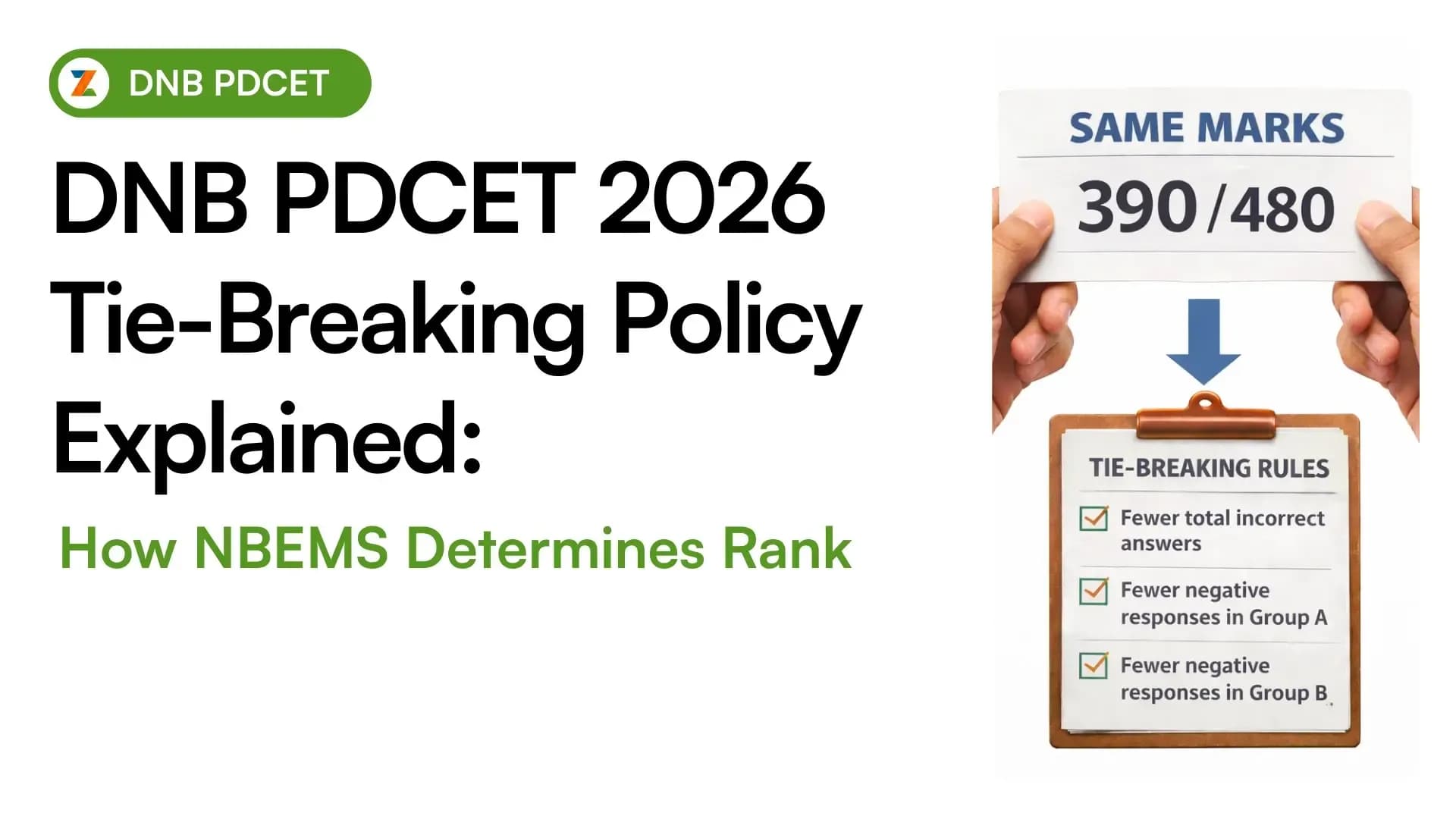
When two or more candidates score the same marks in DNB PDCET 2026, the National Board of Examinations in Medical Sciences resolves the tie using a fixed sequence of criteria. These conditions are applied sequentially until the ranking difference is established.
A. Fewer total incorrect answers
The candidate who has made fewer negative responses across the entire question paper is ranked higher.
B. Fewer negative responses in Group A
If the tie continues, NBEMS compares the number of incorrect answers in Group A of the paper. The candidate with fewer negative responses receives a better rank.
C. Fewer negative responses in Group B
If candidates are still tied, the same comparison is done for Group B questions.
D. Fewer negative responses in Group C
If the tie remains unresolved, the number of negative responses in Group C is considered.
E. Higher MBBS aggregate percentage
If candidates remain tied after the exam-based criteria, the aggregate percentage obtained across all MBBS professional examinations is used for ranking.
For candidates who completed their primary medical qualification outside India, the FMGE percentage is considered instead of the MBBS aggregate.
Applicants must enter their aggregate percentage during the application process. The value is rounded down to two decimal places and later verified during admission.
F. Age of the candidate
If all the above criteria still fail to break the tie, the older candidate (based on date of birth) is given the higher position in the merit list.
How the DNB PDCET 2026 Merit List Is Prepared
The merit list for DNB PDCET 2026 is prepared based on candidates’ scores in the entrance examination for each broad specialty. If two or more candidates obtain the same marks, NBEMS applies the official tie-breaking criteria to determine their final rank in the merit list.
Scores are calculated for each candidate based on answers on the day of the test. Candidates are then ranked in descending order of marks within each Broad speciality.
If candidates have identical marks within the same Broad speciality, the tie-break criteria above are applied in order.
The MBBS aggregate percentage used in criterion E is provided by the candidate during application, rounded to two decimal places, and verified later during admission; incorrect data that affects tie resolution may lead to cancellation.
Example of How the Tie-Breaking Policy Works
Scenario: Rahul and Arjun both scored 175 marks in DNB PDCET 2026 in the General Medicine broad speciality.
Step 1 - Criteria A: Compare total negative responses across the entire paper.
If Rahul has 8 negative responses and Arjun has 10, Rahul gets the higher rank.
If both had the same number of overall negatives, move to Step 2.
Step 2 - Criteria B: Compare negative responses in Group A.
If still tied, check Criteria C, then D, in that order, always moving down the list until a difference is found.
If no difference is found across A-D,
Step 3 - Criteria E: Compare the MBBS aggregate percentages provided in the application.
Here is how rounding is applied, per the bulletin:
Example rounding calculation, shown digit by digit:
Rahul: 623 out of 900. 623 ÷ 900 = 0.692222... Multiply by 100 to get 69.2222... The bulletin requires rounding down to two decimals, so this becomes 69.22.
Arjun: 619 out of 900. 619 ÷ 900 = 0.687777... Multiply by 100 to get 68.7777... Rounded down to two decimals, this becomes 68.77.
Rahul, with 69.22%, would be placed above Arjun with 68.77%. If the MBBS aggregates are identical after rounding, the board uses Criterion F, date of birth, and places the older candidate higher.

Frequently Asked Questions
Here are some answers to questions you might be looking for.

Related Blogs

NEET PG Tie-Breaking Rules 2026: How Merit Is Determined When Candidates Have the Same Score
When two or more candidates obtain the same score in NEET PG, the National Board of Examinations in Medical Sciences (NBEMS) uses specified NEET PG tie-breaking rules to determine their relative merit positions.
Sep 16, 2026

NEET PG 2026 Result Statistics: Number of Candidates, Qualified Candidates & Cutoff
The NEET PG 2026 result has been declared by the National Board of Examinations in Medical Sciences (NBEMS) on September 24, 2026. The result includes the candidate's total score and NEET PG 2026 rank. The examination was conducted on August 30, followed by a re-examination in Jaipur on September 5 for candidates affected by a technical disruption.
Sep 30, 2026

NEET PG 2026 Answer Key: Release Date, PDF, Download Steps & Marking Scheme
The NEET PG answer key usually helps candidates verify their responses and estimate their probable score and last year it was released after the official result was declared. This year, the answer key may be published before the results are announced. The National Board of Examinations in Medical Sciences (NBEMS) conducted NEET PG 2026 on August 30, 2026, with a re-examination held for affected candidates at selected Jaipur centres on September 5.
Sep 23, 2026

NEET PG Result 2026 Out @natboard.edu.in: How to Check, Scorecard, Cut-Off, Merit List & More
NEET PG result 2026 tentative release date is September 30, 2026 as per the schedule released by National Board of Examinations in Medical Sciences (NBEMS). The NEET PG 2026 result will be announced on the official website for the candidates who had appeared in the examination.
Sep 15, 2026
NEET SS Syllabus 2026: Subject-Wise Syllabus, DM/MCh Specialities & Exam Pattern
The National Eligibility cum Entrance Test for Super Speciality (NEET SS) is a national-level entrance examination conducted by the National Board of Examinations in Medical Sciences (NBEMS).
Nov 11, 2026

NEET SS 2026 Registration: Dates, Application Fee, Eligibility & How to Apply
The National Board of Examinations in Medical Sciences (NBEMS) has commenced the registration process for the National Eligibility-cum-Entrance Test for Super Specialty (NEET SS) 2026.
Nov 2, 2026