


All blogs
Share
24 Apr 2026
NEET MDS 2026 Exam Pattern: Complete Guide to Marking Scheme, Questions & Strategy
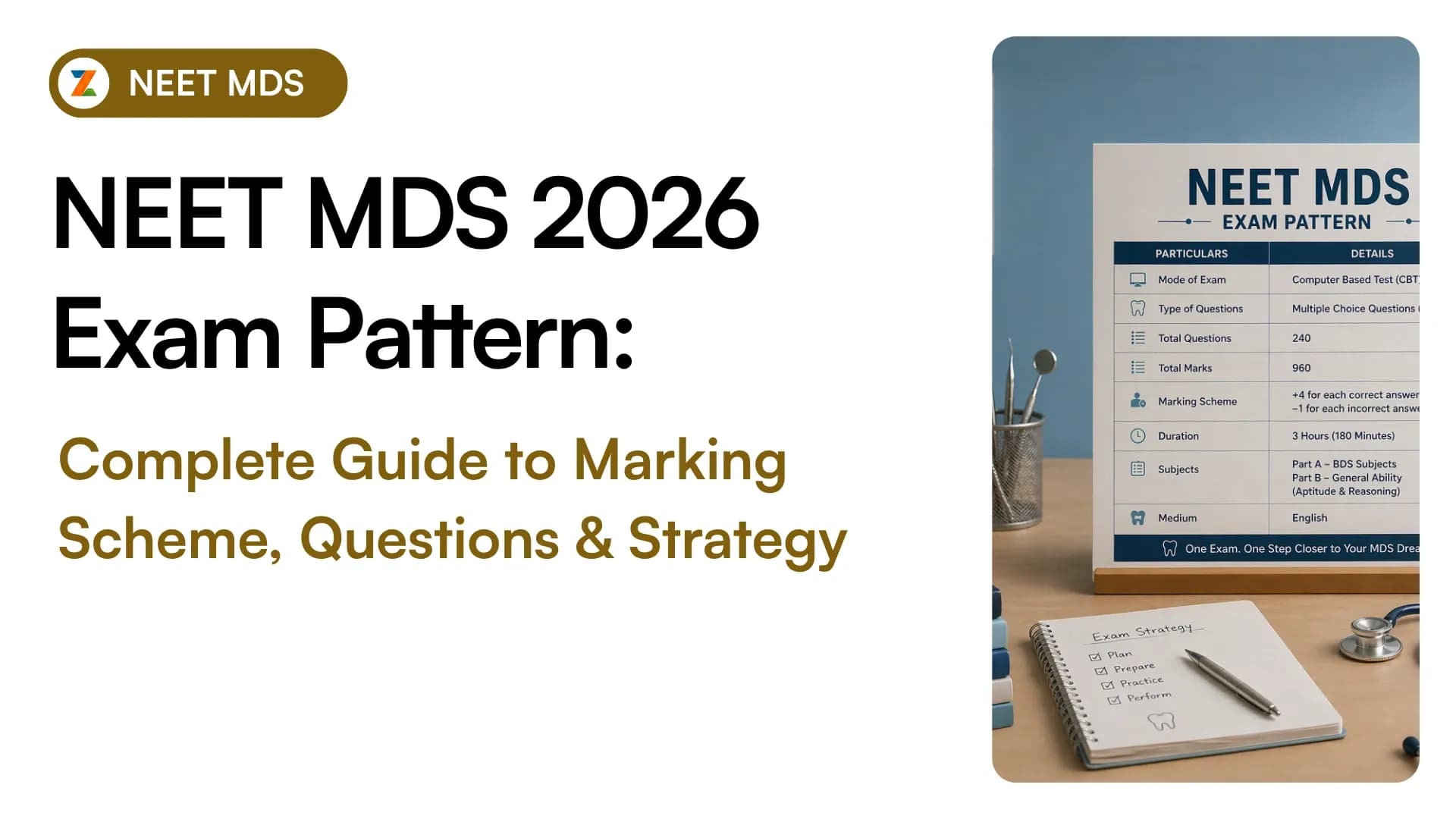
If you’re getting ready for NEET MDS 2026, start by understanding how the exam is actually set. It gives you a clear idea of what to expect and helps you plan your preparation more effectively.
According to the official NBEMS bulletin, the exam will be held in a single session on one day and will be conducted on a computer at a test centre. You’ll be answering 240 multiple-choice questions, and the entire paper will be in English.
The exam is divided into two parts, Part A and Part B, and both sections are time-bound. This means once you complete one part, you won’t be able to go back to it later. That detail alone makes a big difference to how you manage time during the exam.
NEET MDS 2026 Exam Pattern Highlights
This section gives you the basic details of the exam like how it is conducted, how long it lasts, and how many questions you will face. It’s a quick way to understand the overall setup.
Particulars | Details |
|---|---|
Conducting body | National Board of Examinations in Medical Sciences (NBEMS) nbe.edu.in |
Exam mode | Computer-Based Test, single day, single session |
Exam date | 02.05.2026 |
Question type | Multiple-choice questions, 4 options each |
Total questions | 240 MCQs |
Total marks | 960, based on 4 marks per correct answer |
Exam language | English only |
Duration | 3 hours, 2:00 PM to 5:00 PM |
Sections | Part A and Part B, both time-bound |
Marking scheme | +4 for correct, -1 for incorrect, 0 for unattempted |
Admit card date | 29.04.2026 |
NEET MDS Exam Pattern 2026
Before you start preparing seriously, it’s important to know how the exam actually works. It saves you from going in with the wrong expectations and helps you plan your study in a more sensible way.
NEET MDS 2026 is conducted on a computer at a test centre, not as a written paper. You’ll be given three hours to answer 240 multiple-choice questions on the screen.
The paper is split into Part A and Part B, and both have fixed time limits. You have to finish Part A first, and only then will Part B start. Once you move on, you won’t be able to return to the previous section, so you need to be careful with how you use your time.
The syllabus comes from what you’ve studied during BDS. Part A mostly includes the basic subjects like anatomy, physiology, pathology, and medicine. Part B is more focused on dental subjects and clinical areas like prosthodontics, oral surgery, orthodontics, and similar topics.
NEET MDS 2026 Marking Scheme
Understanding the marking scheme is crucial because it directly affects how you attempt the paper, especially when you’re unsure about a question.
Answer | Marks |
|---|---|
Correct Answer | +4 marks |
Incorrect Answer | -1 mark |
Unattempted Question | 0 marks |
An important point is about questions marked for review. If you select an answer and mark it for review, it will still be evaluated based on the same marking rules. So, marking for review does not protect you from negative marking if the answer is incorrect.
NEET MDS Question Distribution
Here you can see how questions are spread across different subjects and sections. It helps you get a rough idea of where more focus is needed.
Subject | No. of Questions |
|---|---|
Part-A | |
General Anatomy including embryology and histology | 14 |
General Human Physiology and Biochemistry | 14 |
Dental Anatomy, Embryology & Oral Histology | 14 |
General Pathology and Microbiology | 14 |
General and Dental Pharmacology and Therapeutics | 14 |
General Medicine | 15 |
General Surgery | 15 |
Part-B | |
Dental Materials | 14 |
Oral Pathology and Oral Microbiology | 14 |
Oral Medicine and Radiology | 14 |
Pedodontics and Preventive Dentistry | 14 |
Orthodontics & Dentofacial Orthopedics | 14 |
Periodontology | 14 |
Prosthodontics and Crown & Bridge | 14 |
Conservative Dentistry and Endodontics | 14 |
Oral and Maxillofacial Surgery | 14 |
Public Health Dentistry | 14 |
Total | 240 |
NEET MDS 2026 Preparation Strategy
Time is one of the biggest challenges in NEET MDS, not because it is too short, but because it is strictly controlled.
Part A has 100 questions to be completed in 75 minutes, and Part B has 140 questions in 105 minutes. That roughly gives you a little under a minute per question. You do not have the luxury to sit and overthink. The exam expects you to read, recall, and decide quickly.
Since the sections are time-bound, you cannot return to Part A once you move to Part B. This is where many students lose marks. Spending too long on a few difficult questions early on can affect the rest of the section. It is always better to move ahead when you feel stuck and come back only if time allows within that same part.
A practical approach during the exam is to go in layers. First, answer the questions you are confident about. Then, in the remaining time, revisit the doubtful ones and try eliminating options to reach the best possible answer.
Preparation should also follow a similar logic. Part A includes more theory-based and medical subjects, so clarity of concepts matters here. Simply memorising facts is usually not enough. Part B leans more towards clinical subjects, so just reading theory is usually not enough. Solving a good number of MCQs helps here because you start getting used to the way questions are asked and how options are framed.
Mock tests make a real difference. They give you a feel of the actual exam, especially the time pressure. With practice, you’ll naturally get better at deciding which questions to answer right away, which ones to leave for later, and when to take a calculated guess.
At the end of the day, it’s not only about how much you’ve studied. What really matters is how you handle those three hours and the choices you make during the exam.
How NEET MDS Questions Are Framed
In NEET MDS, every question is presented in a multiple-choice format with four options. Out of these, you need to pick the single best answer. The wording of questions is important. You will often see phrases like “most appropriate,” “best answer,” or “correct option.” This means the exam is not always about recalling a direct fact. In many cases, more than one option may seem correct at first glance, but only one will fit the question perfectly.
Because of this, the exam tends to check how well you understand concepts rather than how much you have memorised. Clinical thinking, clarity, and the ability to eliminate close options play a big role.
There is also an option to mark questions for review during the exam. This can be useful if you want to revisit a question within the same section. However, if you have selected an answer and left it marked for review, it will still be evaluated. If that answer is incorrect, negative marking will apply.
So while the format looks straightforward, the way questions are designed makes careful reading and clear thinking just as important as knowledge.
NEET MDS 2026 Exam Day Guidelines
On the day of the exam, timings are strictly followed, so reaching the centre early is important. Entry to the test centre usually begins around 12:00 PM and closes at 1:30 PM. After this, no candidate is allowed inside, so it’s not worth taking chances with late arrival.
Once you’re inside, you’ll be allowed to log in to your system around 1:45 PM. A few minutes are given to go through the instructions, and the exam begins at 2:00 PM sharp. The test runs for three hours and ends at 5:00 PM.
Your admit card must be downloaded from the NBEMS website. It will not be sent by post or email. Make sure to carry a printed colour copy of the admit card along with an original government-issued photo ID. Photocopies or digital versions like DigiLocker are not accepted, so it’s better to double-check your documents before leaving home.
Electronic items are not allowed inside the exam hall. This includes mobile phones, smartwatches, or any kind of gadgets. It’s best to avoid carrying unnecessary items altogether.
A simple but useful step is to check your exam centre location a day before the test. The exact address will be mentioned on your admit card. Checking your exam centre a day earlier can make things much easier on the actual day. On the actual day, you’ll already know where to go and won’t be rushing or figuring things out at the last minute.
Keep your admit card and ID ready the night before. Entry is allowed only with the right documents, so having everything in place saves you from unnecessary stress before the exam.
Frequently Asked Questions
Here are some answers to questions you might be looking for.

Related Blogs
NEET PG 2026 Answer Key: Release Date, PDF, Download Steps & Marking Scheme
The NEET PG answer key usually helps candidates verify their responses and estimate their probable score and last year it was released after the official result was declared. This year, the answer key may be published before the results are announced. The National Board of Examinations in Medical Sciences (NBEMS) conducted NEET PG 2026 on August 30, 2026, with a re-examination held for affected candidates at selected Jaipur centres on September 5.
Sep 23, 2026

NEET PG Marks vs Rank 2026: Expected Rank, Previous Year Data, Cutoff & Analysis
The NEET PG marks vs rank 2026 comparison is especially important this year because NEET PG has moved from an 800-mark paper to a 720-mark paper. The 2026 examination had 180 questions instead of 200, while the marking scheme remained +4 for a correct answer and -1 for an incorrect answer.
Sep 25, 2026
NEET PG Result 2026 Out @natboard.edu.in: How to Check, Scorecard, Cut-Off, Merit List & More
NEET PG result 2026 tentative release date is September 30, 2026 as per the schedule released by National Board of Examinations in Medical Sciences (NBEMS). The NEET PG 2026 result will be announced on the official website for the candidates who had appeared in the examination.
Sep 15, 2026
Tripura NEET UG Counselling 2026: Registration, Eligibility, Dates, Fees, Seat Matrix & Admission Process
Tripura NEET UG Counselling 2026 is the state-level admission process for candidates seeking MBBS, BDS and other NEET-based undergraduate medical and allied health courses through seats administered by the Tripura Medical Counselling Committee (TRMCC). The counselling is conducted under the Directorate of Medical Education (DME), Government of Tripura.
Aug 17, 2026

Himachal Pradesh NEET UG Counselling 2026: Registration, Dates, Eligibility, Fees & Seat Allotment
Himachal Pradesh NEET UG Counselling 2026 is the state-level admission process for candidates seeking MBBS and BDS seats in medical and dental colleges across Himachal Pradesh. The counselling is conducted by Atal Medical and Research University (AMRU), Himachal Pradesh, on behalf of the Government of Himachal Pradesh.
Aug 17, 2026

Jharkhand NEET UG Counselling 2026: Dates, Eligibility, Fees, Merit List & Seat Allotment
Jharkhand NEET UG Counselling 2026 is the state-level admission process for candidates seeking admission to MBBS, BDS and BHMS courses through NEET UG 2026. The counselling is conducted by the Jharkhand Combined Entrance Competitive Examination Board (JCECEB) for seats covered under the state counselling process.
Aug 14, 2026