


All blogs
Share
Published on 24 April, 2026
NEET MDS 2026 Eligibility: Rules, Internship, and Registration
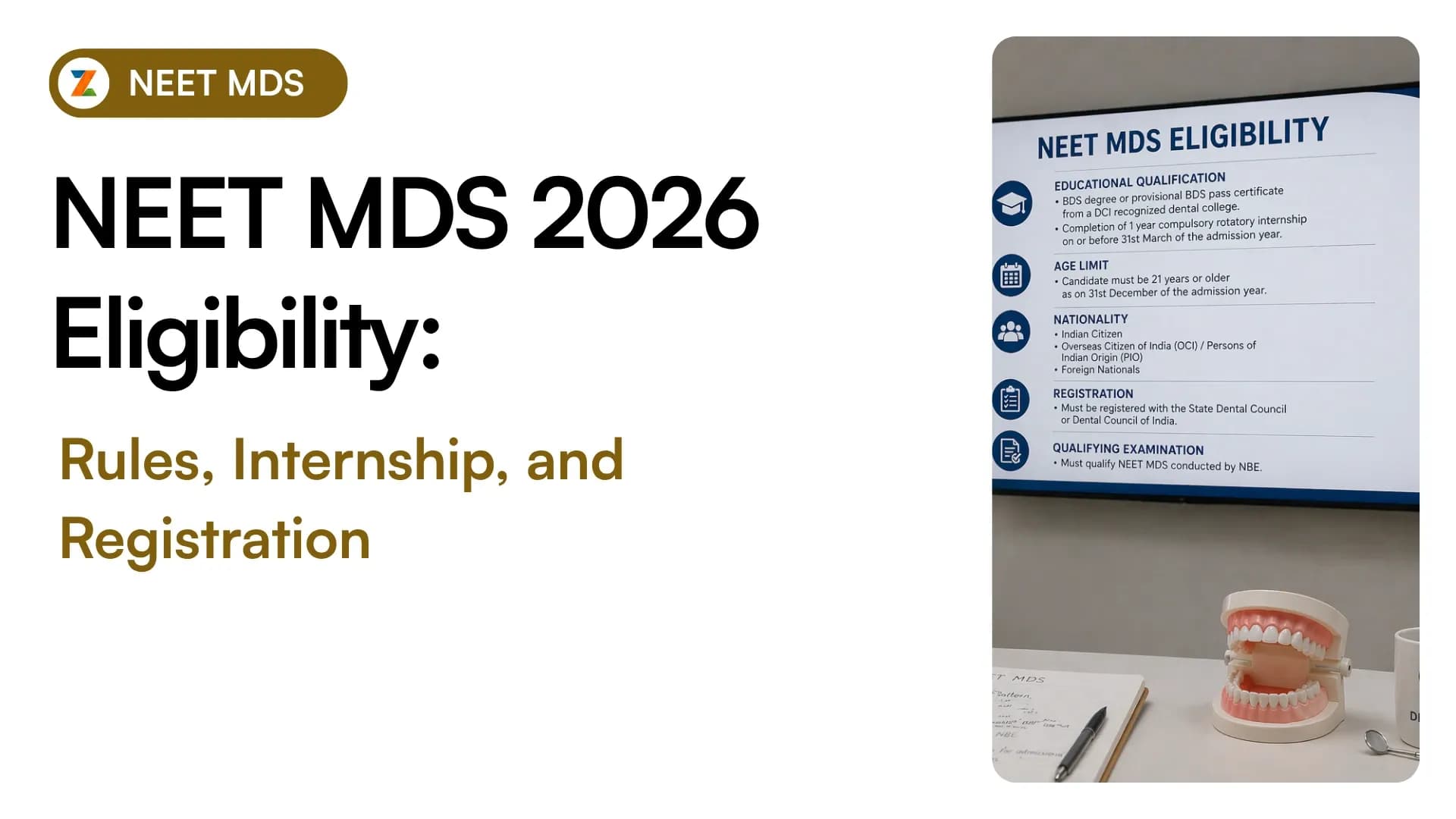
Table of contents
- NEET MDS 2026 Eligibility Highlights
- Eligibility Criteria for NEET MDS 2026
- NEET MDS Educational Qualification Eligibility
- NEET MDS Internship Requirements Eligibility
- NEET MDS Registration Criteria
- NEET MDS Eligibility for Foreign Graduates
- NEET MDS Eligibility for AIQ vs State Quota
- NEET MDS Documents Required for Eligibility Criteria
- Common Mistakes in NEET MDS Eligibility
- Difference between NEET MDS Eligibility & Admission Criteria
Planning for NEET MDS 2026? Before you start preparing seriously, make sure you actually meet the basic requirements. You need a BDS degree from a recognized college, along with registration from your State Dental Council. On top of that, your one-year internship should be completed.
If your internship is still going on, you can still apply. But it has to be finished by 31 May 2026. This part is important. Even if you clear the exam, you won’t be able to take admission unless your internship and registration are done on time.
NEET MDS 2026 Eligibility Highlights
NEET MDS is basically the one exam for MDS admissions in India. Your score is used for All India quota seats, state quota seats, private colleges, and deemed universities. It also covers Armed Forces colleges and the Army Dental Corps. So you don’t need to write multiple exams.
But there are a few exceptions. Institutes like AIIMS New Delhi are not part of this. Also, colleges can’t run their own separate entrance exams anymore. One thing many people miss is that eligibility is checked again later during counselling. So just writing the exam doesn’t mean everything is sorted.
Key Point | Details |
|---|---|
Exam Purpose | Single entrance exam for MDS admissions in India |
Courses Covered | Master of Dental Surgery (MDS) |
Seats Included | All India 50% quota, state quota, private and deemed universities |
Other Admissions | Armed Forces institutions and Army Dental Corps |
Exam Authority | Conducted by NBEMS |
Separate Exams | Not allowed for MDS admissions in India |
Institutes Not Covered | AIIMS New Delhi |
Eligibility Check | Done at application stage and again during counselling |
Basic Requirements | BDS degree, internship completion, Dental Council registration |
Important Note | Clearing the exam alone does not guarantee admission |
Eligibility Criteria for NEET MDS 2026
Most of it comes down to three things: your degree, your internship, and your registration. If any one of these is not in place, it can stop your admission later.
A lot of students focus only on the exam and ignore these basics. That’s where problems usually start during counselling.
Who is eligible:
You have a BDS degree from a recognized college or a recognized foreign dental degree
You’re registered with a State Dental Council (provisional or permanent)
You’ve completed your 12-month internship, or will finish it by 31 May 2026
Who is not eligible:
Your internship is not completed by the deadline
Your BDS or dental degree is not recognized
You don’t have valid Dental Council registration
Your documents don’t match or can’t be verified during counselling
NEET MDS Educational Qualification Eligibility
You need to have a BDS degree from a recognized college or university in India. If you studied abroad, your degree should be recognized here.
Along with that, you should be registered with the State Dental Council. It can be provisional or permanent, both are accepted at different stages.
NEET MDS National Eligibility Criteria
Indian citizens
Indian candidates can apply if they have a BDS degree, have completed internship, and are registered with a State Dental Council.
Overseas Citizens of India (OCI)
OCI candidates are also eligible. They need to follow the same basic rules as Indian candidates like qualification, internship, and registration.
Foreign nationals
Foreign candidates can apply if their dental degree is recognized in India. In some cases, they may also need security clearance and temporary registration from the Dental Council of India.
NEET MDS Age Limit
There’s no specific age limit mentioned for NEET MDS 2026. As long as you meet the main requirements like BDS degree, internship, and registration, age is not really an issue here.
NEET MDS Attempt Limit
There is no fixed attempt limit for NEET MDS. You can take the exam any number of times as long as you meet the basic eligibility conditions like having a BDS degree, completing your internship, and having State Dental Council registration.
If you don’t get a seat in one attempt, you can always try again in the next session. The only thing that matters each time is that you continue to satisfy the eligibility rules.
NEET MDS Internship Requirements Eligibility
If you’ve already finished your BDS and are doing your internship, you can still apply. But your internship must be completed by 31 May 2026.
If it’s still going on, you’ll need a letter from your college saying you’ll finish it on time. Without that, things can get stuck later during verification. Also, don’t take the form lightly. The internship dates you enter are taken seriously. During counselling, they’ll check those against your actual certificate. There’s no real flexibility here. The one-year internship is compulsory. Only a few older batches had exceptions, and those don’t apply to current students. If your internship goes beyond the deadline, you won’t be eligible this year.
NEET MDS Registration Criteria
You also need to be registered with a State Dental Council. This can be provisional or permanent, but you should have one. Most students go with provisional registration during internship and switch to permanent later. That’s normal. Just make sure everything is valid by the time counselling starts.
One thing to double-check is your details. Your name, registration number, all of that should match your academic records. Small mismatches can slow things down during verification. For foreign nationals, it works a bit differently. They are given temporary registration by the Dental Council of India for the duration of the course, if they meet the conditions. At the end of the day, you’ll have to show proof of registration during counselling. If it’s not sorted, admission can get delayed or even cancelled.
NEET MDS Eligibility for Foreign Graduates
If you’ve done your dental degree outside India, it should be recognized by the Dental Council of India. Some candidates may also need security clearance from the Ministry of Home Affairs. If that applies to you, it has to be done before applying, not later.
Instead of regular state registration, foreign nationals can get temporary registration from DCI for the duration of the MDS course. But this isn’t automatic. You should already be registered with the dental authority in your own country, and your degree should be valid there. In some cases, you may also need a no-objection certificate from your country to study in India.
NEET MDS Eligibility for AIQ vs State Quota
AIQ Eligibility
For the 50% All India Quota seats, the same general eligibility rules apply. Candidates who completed BDS from Jammu & Kashmir can also take part in AIQ counselling. They’re also eligible for Armed Forces institutions and the Army Dental Corps.
State Quota Eligibility
State quota is where things can change a bit. Each state has its own rules, especially for domicile and reservation. MCC handles counselling for the 50% AIQ seats. For state quota seats, the respective state authorities take care of the process. So it’s always a good idea to check the specific rules of the state you’re applying to.
NEET MDS Documents Required for Eligibility Criteria
These are the documents they’ll ask for during counselling. Better to keep everything ready instead of worrying later.
BDS degree (or equivalent if you studied abroad)
State Dental Council registration
Provisional or permanent registration proof
Internship completion certificate
If internship is still going on, a note from your college saying you’ll finish it by 31 May 2026
For foreign nationals:
Proof your degree is recognized in India
MHA clearance, if applicable
Common Mistakes in NEET MDS Eligibility
A lot of people lose out over small things, not big ones.
Assuming a good rank means you’re set
Forgetting that eligibility is checked again later
Internship not done on time
No proper registration at the time of admission
Messing up internship dates in the form
Not checking state vs AIQ rules properly
Missing documents during counselling
Ignoring rules for foreign degrees
Difference between NEET MDS Eligibility & Admission Criteria
Eligibility simply decides whether you can sit for the exam. Admission depends on what happens after that, mainly your rank, choices, and document check during counselling.
Basis | Eligibility | Admission |
|---|---|---|
What it decides | Whether you can apply | Whether you get a seat |
When it matters | Before the exam | After results |
Based on | Degree, internship, registration | Rank, choices, seats |
Who handles it | Exam authority | Counselling Authority |
Documents | Basic details | Full checking happens here |
End result | You write the exam | You either get a seat or not |
Frequently Asked Questions
Here are some answers to questions you might be looking for.
Related Blogs
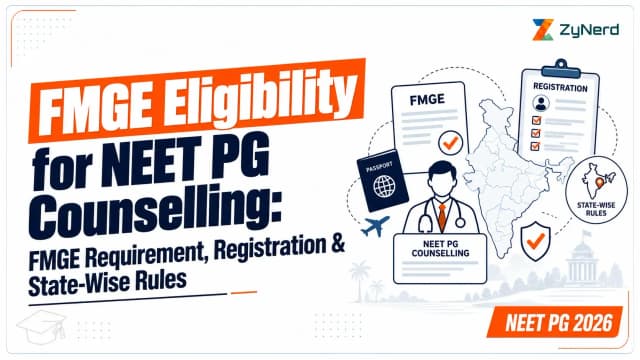
FMGE Eligibility for NEET PG Counselling: FMGE Requirement, Registration & State-Wise Rules
Foreign medical graduates can pursue MD/MS and other NEET PG-linked postgraduate courses in India, but they must satisfy both the NEET PG eligibility requirements and the applicable FMGE, medical registration and internship requirements.
Sep 7, 2026
NEET SS 2026 Registration: Dates, Application Fee, Eligibility & How to Apply
The National Board of Examinations in Medical Sciences (NBEMS) has commenced the registration process for the National Eligibility-cum-Entrance Test for Super Specialty (NEET SS) 2026.
Nov 2, 2026
KEA NEET PG Counselling 2026: Registration, Offline Document Verification, Eligibility, Fees & Seat Allotment Rules
Karnataka NEET PG counselling is the state-level counselling process for admission to postgraduate medical courses in Karnataka. The Karnataka Examinations Authority (KEA) conducts centralized counselling for eligible NEET PG candidates for seats in government medical colleges, government quota seats in private and minority medical colleges, and private seats in eligible private institutions and few seats in deemed universities as well.
Aug 27, 2026
Himachal Pradesh NEET UG Counselling 2026: Registration, Dates, Eligibility, Fees & Seat Allotment
Himachal Pradesh NEET UG Counselling 2026 is the state-level admission process for candidates seeking MBBS and BDS seats in medical and dental colleges across Himachal Pradesh. The counselling is conducted by Atal Medical and Research University (AMRU), Himachal Pradesh, on behalf of the Government of Himachal Pradesh.
Aug 17, 2026
Tripura NEET UG Counselling 2026: Registration, Eligibility, Dates, Fees, Seat Matrix & Admission Process
Tripura NEET UG Counselling 2026 is the state-level admission process for candidates seeking MBBS, BDS and other NEET-based undergraduate medical and allied health courses through seats administered by the Tripura Medical Counselling Committee (TRMCC). The counselling is conducted under the Directorate of Medical Education (DME), Government of Tripura.
Aug 17, 2026
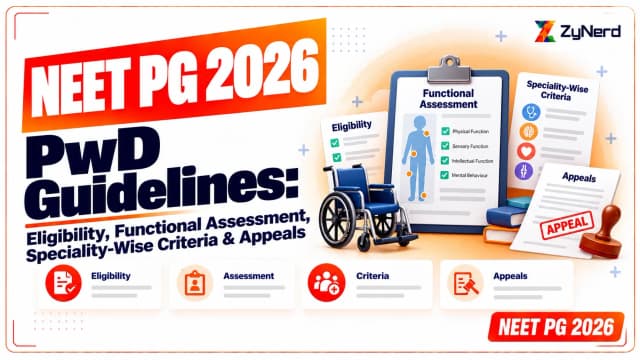
NEET PG 2026 PwD Guidelines: Eligibility, Functional Assessment, Speciality-Wise Criteria & Appeals
The National Medical Commission (NMC) has released new guidelines for NEET PG 2026 PwD candidates. The guidelines explain how PwBD candidates will be assessed for eligibility during counselling and admission.
Oct 9, 2026