


All blogs
Share
Published on 30 October, 2025
NEET Seat Matrix and Cutoff Explained: How to Read, Compare, and Plan Smarter with ZyNerd
Table of contents
- What is the NEET Seat Matrix?
- How Is the Seat Matrix Updated Each Round?
- How To Read Seat Matrix On ZyNerd
- What Are NEET Cutoffs and Why They Matter?
- Understanding How Cutoffs Change Each Round
- Connecting Seat Matrix and Cutoff Data: The Smarter Way to Predict Your Chances
- Avoiding the Most Common Counselling Mistakes
- Why Students Trust ZyNerd for Smarter Decisions
- Conclusion
Getting into a top medical college through NEET counselling means understanding two key things: the seat matrix and the cutoff. The seat matrix tells you exactly how many seats exist in each college, quota and category. Cutoffs show how competitive each college was in past rounds. By combining these, students can make smarter choices. This guide is used to explain both concepts for NEET UG and NEET PG, how they change each round and how ZyNerd’s counselling platform helps you track them easily.
What is the NEET Seat Matrix?
The seat matrix is the breakdown of total seats by college, course and reservation category for a particular counselling. In NEET UG, for example, it lists how many MBBS/ BDS seats each college has under each quota and each category. NEET counselling has multiple quotas: typically 15% All India Quota seats filled through MCC nationwide counselling, and 85% State Quota seats filled by each state’s own counselling. Both appear in seat matrices but are filled separately.
Certain institutions, for example, central universities like AIIMS, JIPMER, BHU, AMU, DU and ESIC/AFMS have their own special seat quotas. Deemed universities’ seats are generally filled through MCC counselling and are often shown as 100% in AIQ/central counselling matrices. State universities’ seat matrices include 85% state quota seats and sometimes a few seats under AIQ.
For NEET PG, MCC (and state bodies) release PG seat matrices listing MD/MS/PG Diploma seats by college and category. For example, the MCC publishes a college-wise matrix for each counselling, which includes government vs private vs DNB seats.
How Is the Seat Matrix Updated Each Round?
At the start of counselling, official bodies release an initial seat matrix (per round). After each counselling round, seats get allotted and some are vacated (due to resignations or upgrades), so the remaining seats change. The counselling authorities (MCC for AIQ and each state authority) then publish a revised seat matrix for the next round. In practice, this means you can’t just rely on the first matrix, you must check updates before round 2, 3, mop-up and stray vacancy.
To keep up, ZyNerd’s portal keeps track of these changes. The platform provides real-time updates on Allotments, Closing Ranks (Cut Offs), along with fees, stipend and bond for all the institutes. In other words, after every seat allotment, ZyNerd’s Seat Matrix page is refreshed with the latest available seats with each round’s new vacancies being updated. This saves you from manually hunting down new PDF updates.
How To Read Seat Matrix On ZyNerd
Log in to ZyNerd using your phone number and OTP. Go to Insights → Seat Matrix to explore real-time seat availability, round-wise trends and cutoff details for your counselling.
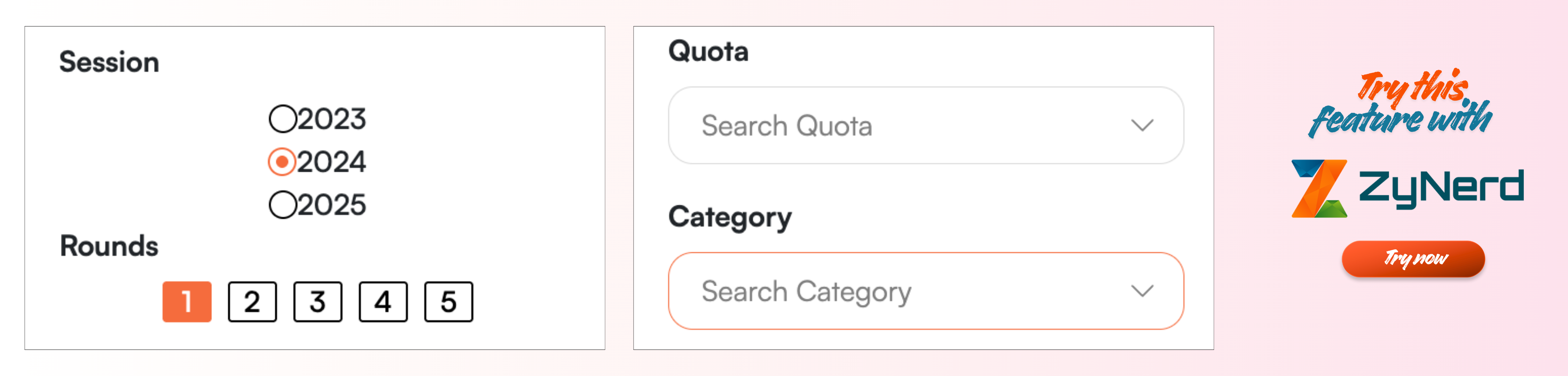
Session Wise
The table shows the counselling year (for example, 2023, 2024).
Use the dropdown filter labelled Year.
By selecting different years, you can compare the Closing Rank and Seats of different years. This helps you see whether a college is becoming more or less competitive over time.
Round Wise
On the table, you’ll see a column for “Round” which shows which allotment round the particular data refers to.
Use the filter labelled “Round” to switch between Rounds 1-5.
When you compare the same college & category across Round 1 vs Round 2, you’ll see changes in “Seats” and sometimes “Closing Rank”.
If you notice the closing rank for Round 2 is lower than Round 1, it confirms that the cutoff slipped due to fewer vacant seats.
Quota Wise
Select your quota in the filter:
Quota | Description / Eligibility |
|---|---|
AIQ | All India Quota (All qualified candidates eligible - including J&K) |
AMU | Aligarh Muslim University's Institutional Quota (AMU MBBS eligible) |
BHU | Banaras Hindu University's Institutional Quota (BHU MBBS eligible) |
DU | Delhi University's Institutional Quota (DU MBBS Eligible) |
IP | Delhi - IP University's Institutional Quota (IP Univ MBBS Eligible) |
JM | Jain Minority (1 institute) - SKBS - Vadodara |
MM | Muslim Minority (2 institutes) - Yenepoya, Mangalore & Hamard, Delhi |
MNG | Deemed universities (All qualified candidates are eligible) |
NRI | NRI Quota under Deemed Universities |
DNB Post MBBS | DNB Post MBBS offered by NBE (All qualified candidates eligible) |
NBE Diploma | NBE Diplomas offered by NBE (All qualified candidates are eligible) |
Then compare closing ranks/seats for that quota separately from the state quota. This avoids the common mistake of comparing your rank against state quota cutoffs when you’re applying via AIQ.
Category Wise
The table will have columns for category (for example: Open/General, OBC, SC, ST, EWS, PwD).
Use the filter for “Category” to select your specific category.
Overall View
Look at the colleges listed in the table after applying filters, for each institute you’ll see “Courses” offered, “Seats”, “Fees”, “Stipend”, “Bond Years”, “Bond Penalty” and “Beds”.
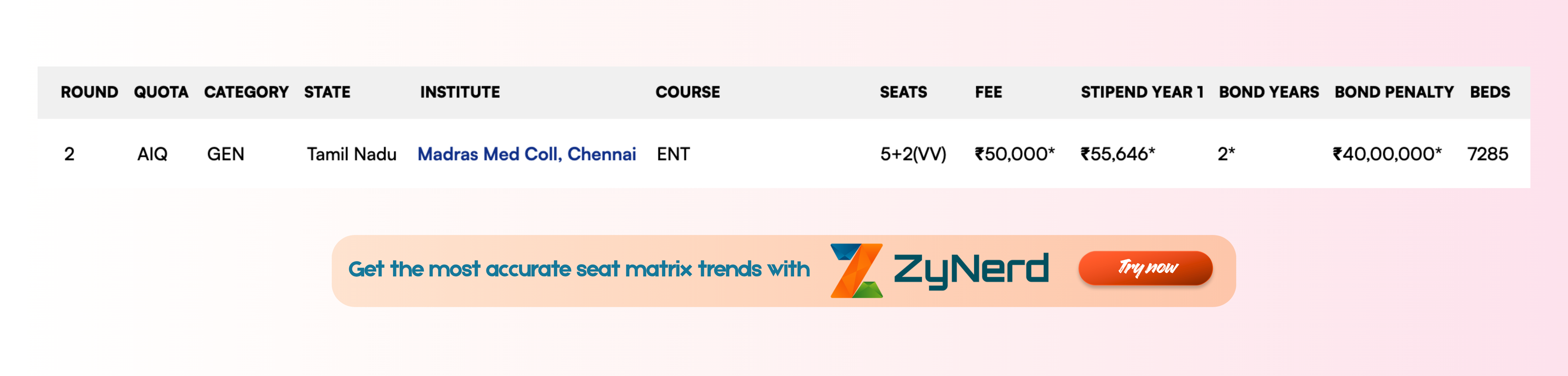
In 2024, Madras Medical College offered 5+2(VV) seats for the ENT Course under the General Category. VV stands for Virtual Vacancies, referring to the seats held by candidates who have opted for upgradation. In Round 2, the institute had 5 empty seats in addition to 2 seats held by candidates who had opted to upgrade.
What Are NEET Cutoffs and Why They Matter?
A cutoff (closing rank) is essentially the last rank (or score) at which a seat was filled in a college/category in a given round. It’s the minimum you need to secure that seat. Cutoffs are critical because they tell you how competitive a college is.
Cutoffs also differ by category: reserved-category cutoffs are typically lower due to reservation policies. Similarly, AIQ cutoffs are usually a bit higher than state-quota cutoffs. Importantly, cutoffs change every year and every round. They depend on factors like overall exam difficulty, number of applicants and total seat matrix. Within a counselling session, round 1 cutoffs are usually highest because top-ranking students fill the most desirable seats first, while subsequent rounds’ cutoffs often slip due to the availability of vacant seats.
Understanding How Cutoffs Change Each Round
Round-wise Pattern
Round 1: Usually has the lowest closing rank, that is, higher scores holding candidates get in.
Round 2: Cutoffs are slightly relaxed as some students either upgrade or vacate seats.
Mop-up & Stray Vacancy Rounds: These rounds can show higher cutoffs since they deal with remaining or surrendered seats.
Opening and Closing Ranks
Opening Rank: The first candidate with the highest score who got a seat in the college for a round.
Closing Rank: The last candidate admitted in the round.
Together, they show the range of ranks that secured seats in that college.
For example, your rank is 10,000. Note which colleges had a closing rank of around 15,000 or lower. Those are “target” or “safety” options.
Then switch to “Round 2” and compare the closing rank. If the closing rank dropped to, say, 25,000 in Round 2, that means that college became easier to get might be because some seats got vacated.
Use the Seat count column to check how many seats were available in your category.
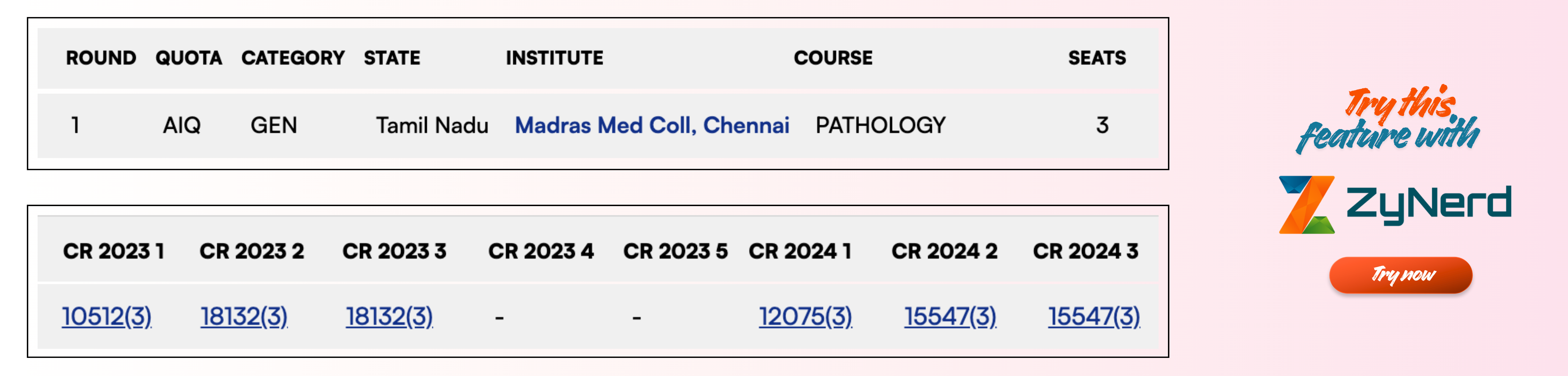
For example, in 2023, for the General category under AIQ, Madras Medical College offered a total of 3 seats for Pathology. In Round 1 of 2023, all three seats were allotted to candidates, with the last allotment going to the candidate with rank 10512. In Round 2, one of the 3 candidates vacated their seat, allowing a candidate with rank 18132 to take their place.
Closing Rank 2023 Round 1
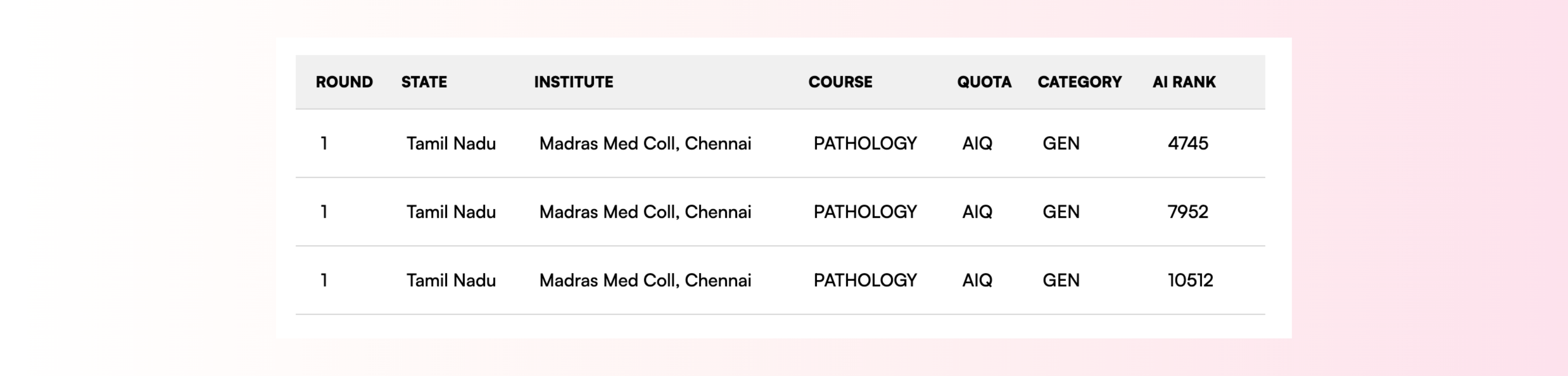
Closing Rank 2023 Round 2
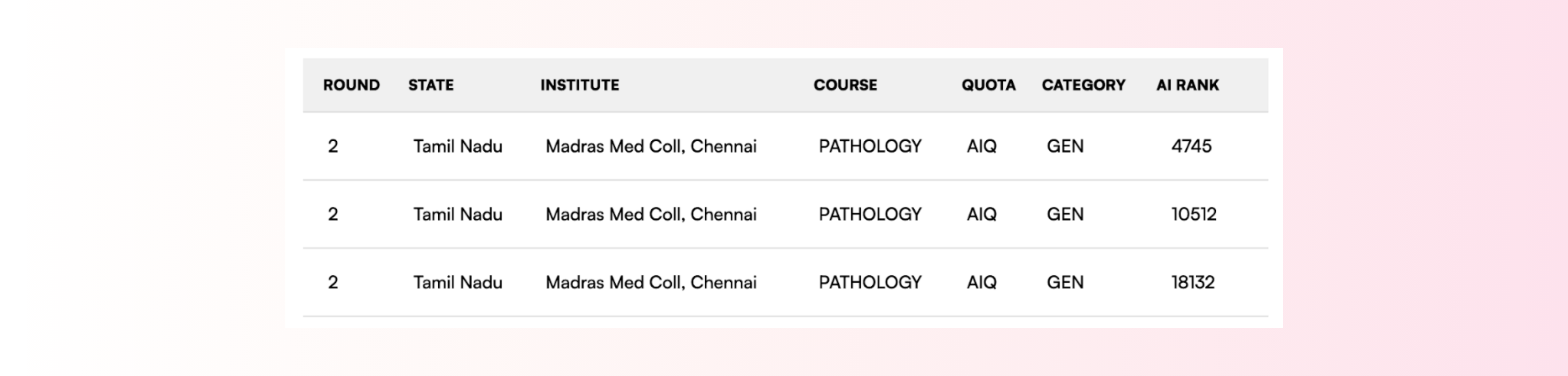
Round-wise Closing Ranks
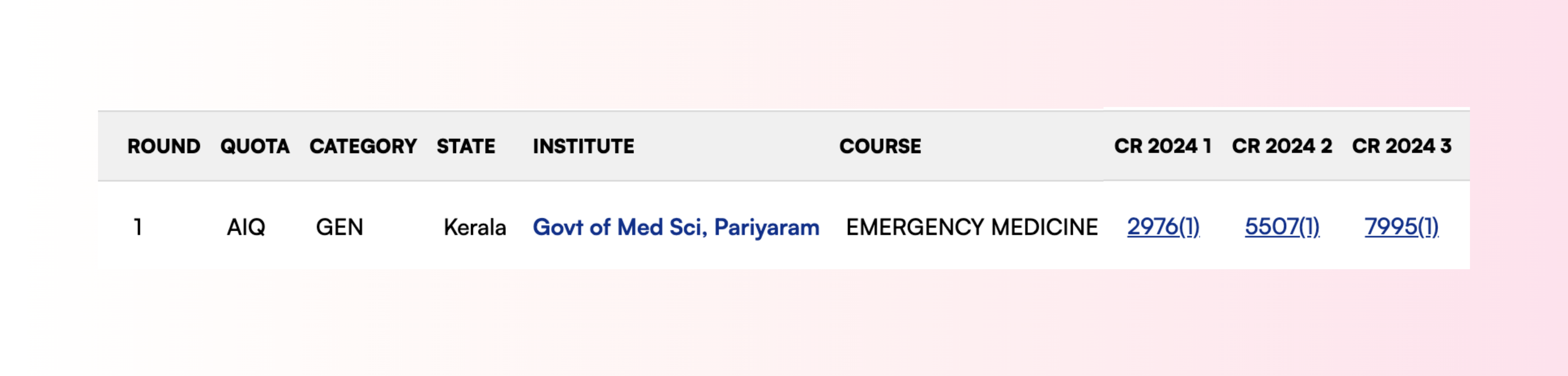
This shows the closing ranks for the institute in 2024 across 3 rounds. In Round 1, the last admitted student had a rank of 2976, meaning only higher-ranked candidates were allotted seats. By Round 2, the closing rank moved to 5507, showing that the seat became available to lower ranks because some earlier candidates opted for upgradation or vacated seats. In Round 3, the cutoff slipped further to 7995, which usually happens when leftover seats remain and competition reduces.
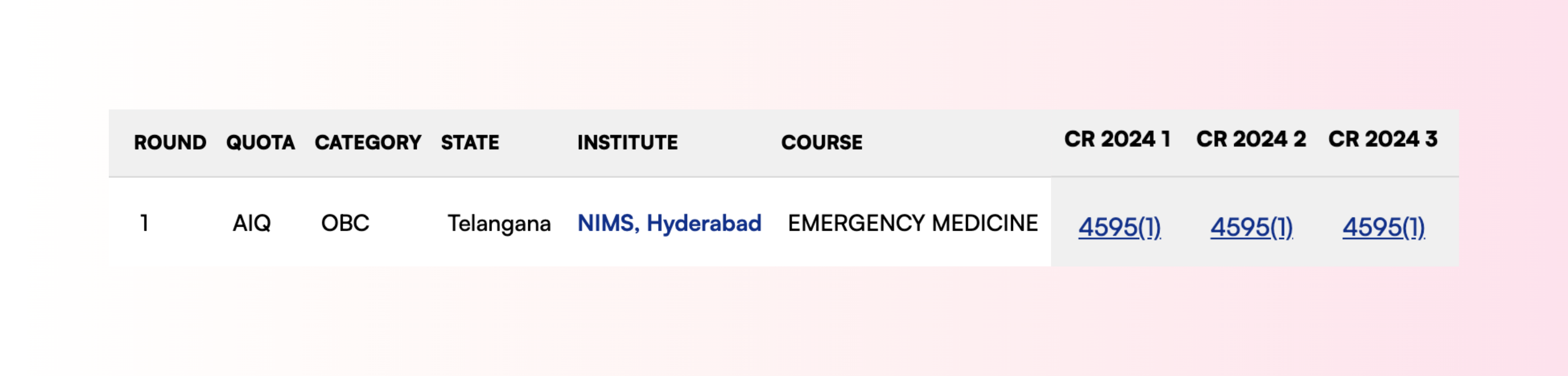
Here, the closing rank stayed the same (4595) across all three rounds. This indicates that no new allotments were made in later rounds; the same candidates either retained their seats or no vacancies opened up for that category or quota. The institute might be highly preferred, so every seat was filled and confirmed early. Sometimes, eligibility or category limits prevent further allotments in later rounds.
Connecting Seat Matrix and Cutoff Data: The Smarter Way to Predict Your Chances
When you look at how many seats were available and how far the cutoff stretched in each round, you can instantly see which colleges became more open in later rounds, which stayed highly competitive, and where your rank might realistically fit this year.
The seat matrix shows the total number of seats offered by each institute and category in a particular round. The cutoff is the closing rank, the rank of the last student who secured a seat that round. When the seat count or distribution changes, the cutoff usually moves with it.
In 2024, Christian Medical College, Vellore had 2 seats for DNB Palliative Medicine, and 2 candidates with ranks 13607 and 19538 were allotted in Round 1. Both vacated their seats in Round 2, and candidates with ranks 20365 and 24339 were allotted. In Round 3, the candidate with rank 20365 gave up their seat, and the candidate with the rank 22121 filled in.
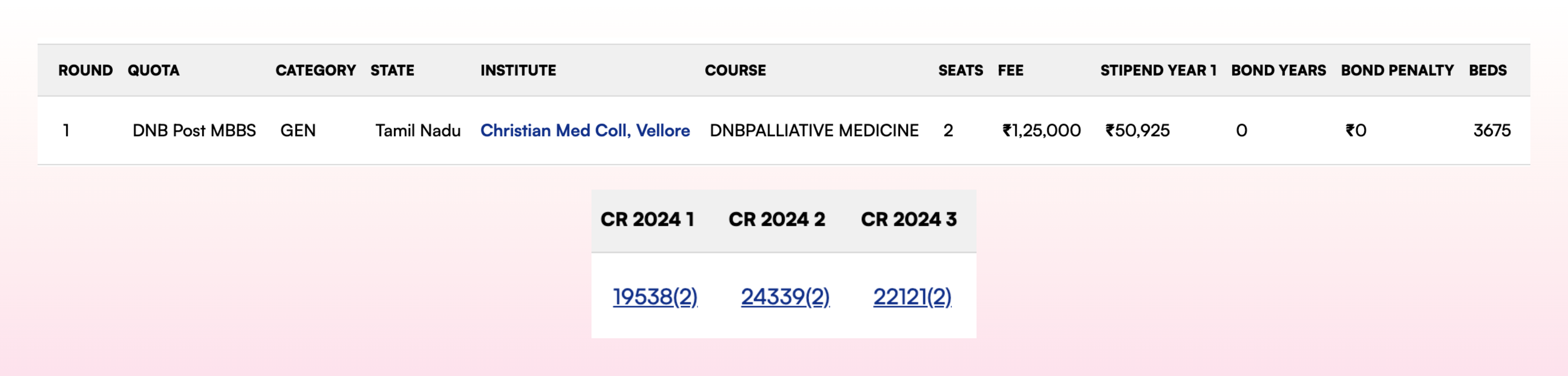
In the 2024 DNB Post-MBBS counselling, let’s take Christian Medical College, Vellore (Tamil Nadu) for the DNB Palliative Medicine course.
From the seat matrix view, you can see:
Seats
Fee
Stipend
Bond
Beds
Closing Round of 3 rounds
Avoiding the Most Common Counselling Mistakes
Mixing up quotas
Confusing AIQ vs State quotas is common. Generally, 15% AIQ vs 85% state quota, with exceptions, central institutes and many deemed universities are handled separately under central counselling, and states have domicile rules.
Ignoring category cutoffs
Reserved-category cutoffs are usually lower than general-category cutoffs, but the gap varies widely by college, state and year, always check category-wise closing ranks.
Relying on one-year data
Cutoffs shift yearly. Don’t pick based solely on last year if new seats were added or more students took the exam this year. Watch for seat additions or new colleges, as these can lower cutoffs by increasing the total number of seats.
Not updating after each round
Some students stick to a choice list without revising after Round 1 results. New vacancies mean new opportunities as cutoffs can drop; failing to revise can mean missing good seats in subsequent rounds.
Submitting too few choices
Fear of losing a certain college may lead students to list too few options. Always fill in all reasonable colleges based on matrix and cutoffs so you have backups.
Why Students Trust ZyNerd for Smarter Decisions
ZyNerd is designed to tackle these challenges in one place. It consolidates seat matrices, cutoff histories, allotment maps, and more, so you don’t juggle PDFs and spreadsheets. Most importantly, seat matrix, allotments, and cutoffs are updated on the portal within hours of being released by MCC or the respective counselling authorities. ZyNerd offers:
Up-to-date Seat Matrix: After each round, ZyNerd’s Seat Matrix refreshes with the latest available seats by college/quota/category. You can filter by counselling session (UG/PG, AIQ/State, round, etc.) to see the exact breakdown. This replaces manual checking of MCC or state sites.
Closing Ranks: ZyNerd provides closing rank charts for every college, category and round (AIQ and state) across multiple years. You can immediately see trends to set realistic goals.

Allotment Mapping: Beyond just cutoffs, ZyNerd maps how seats get filled each round. This means you can see exactly which seats were taken each round.
Personalized Filters: The portal lets you filter colleges by state, quota, course, and even by your own rank range. It then shows you only relevant options with their opening/closing ranks and available seats.
Alerts and Support: ZyNerd also sends reminders for deadlines and key updates, so you don’t miss changes in the seat matrix or cutoffs. The data is curated from official sources, ensuring accuracy.
Conclusion
Understanding the NEET seat matrix and cutoff trends is key to doing well in counselling. The seat matrix shows which seats are available, and the cutoffs show what rank is needed. When you look at both together, you can see where your rank fits and plan your choices wisely. With ZyNerd, you get all this data in one place, making it easier to track updates and improve your chances of getting the best seat for your NEET UG or PG rank.

Frequently Asked Questions
Here are some answers to questions you might be looking for.

Related Blogs

NEET PG 2026 Counselling Seat Matrix: PDF, College-Wise, Course-Wise & Category-Wise Seats
The NEET PG counselling 2026 seat matrix is one of the most important documents for candidates preparing their choice-filling strategy. It shows the postgraduate courses and the number of seats available across medical colleges and institutions for the academic year 2026-27.
Oct 1, 2026

Tripura NEET UG Counselling 2026: Registration, Eligibility, Dates, Fees, Seat Matrix & Admission Process
Tripura NEET UG Counselling 2026 is the state-level admission process for candidates seeking MBBS, BDS and other NEET-based undergraduate medical and allied health courses through seats administered by the Tripura Medical Counselling Committee (TRMCC). The counselling is conducted under the Directorate of Medical Education (DME), Government of Tripura.
Aug 17, 2026

Karnataka NEET PG Counselling for Non-Karnataka Candidates: Private, Management & Government Seat Eligibility
Karnataka is one of the most preferred destinations for NEET PG aspirants from across India, particularly because its counselling includes seats in government colleges, private medical colleges, minority institutions and private universities. For Karnataka NEET PG counselling for non Karnataka candidates, however, the most important point is that eligibility depends on the type of seat being sought.
Sep 2, 2026

NEET PG 2026 Round 1 Seat Allotment Result, Download Link, Reporting and Free Exit Rules
The NEET PG Round 1 seat allotment result 2026 is an important milestone for candidates seeking admission to MD, MS, DNB and other eligible postgraduate medical programmes through MCC counselling.
Oct 23, 2026

Can You Hold a NEET PG Seat in One State While Participating in Another State's Counselling?
Many NEET PG candidates participate in both All India Quota and state counselling because the same NEET PG rank can open opportunities across different counselling systems. This often creates a practical question: can I hold a NEET PG seat in one state and still participate in counselling conducted by another state?
Sep 15, 2026

Kerala NEET PG Counselling: Why Is Competition High? Category-Wise Cutoff Trends & Analysis
Kerala is one of the states where NEET PG counselling requires candidates to look beyond their NEET PG rank. The competition is shaped by the combination of limited seats, popular postgraduate branches, government college preference, category-wise reservations and the way seats move across counselling rounds.
Sep 7, 2026