


All blogs
Share
Published on 19 February, 2026
NEET 2026 Tie-breaking Policy by NTA Explained for NEET UG Rank Determination
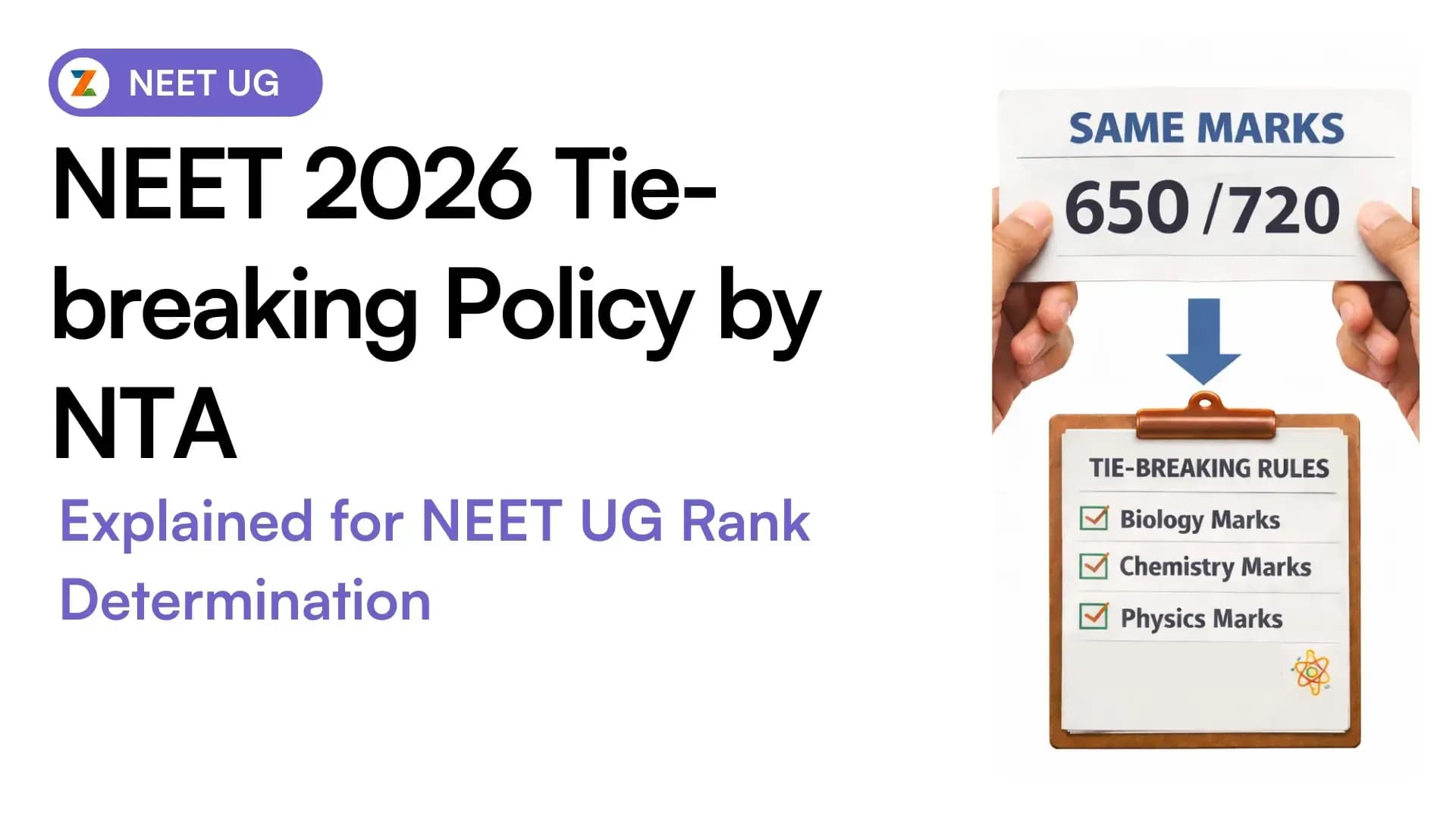
The NEET UG tie-breaking policy, managed by the National Testing Agency (NTA), is a set of rules designed to determine when two or more candidates secure identical total marks or percentile scores in the exam. This becomes particularly relevant given the massive scale of NEET UG, with lakhs of aspirants competing for limited medical and dental seats, where even small differences can significantly impact All India Rank, college allotments, and admission chances. This approach ensures transparent, merit-based differentiation in the highly competitive merit list preparation process.
NEET UG Tie-breaking Rule
When two or more students score the same total in NEET UG, it can get tricky to decide who ranks higher, after all, every mark counts toward grabbing a good medical seat. To handle this fairly, the NTA follows a clear step-by-step tie-breaking process that starts with the subjects most important for medicine.
First, they look at who got more marks in Biology (that's Botany + Zoology combined), the one with the higher Biology score moves ahead. If those are still equal, they check Chemistry next, giving preference to the higher scorer there. If it's still a tie, Physics marks decide it. If even that doesn't break the tie, they dig into accuracy: they compare the ratio of wrong answers to correct ones across the whole exam, favouring whoever made fewer mistakes overall.
Some rules even go deeper into subject-wise error rates if needed. And if, after all these checks, the scores are somehow still identical, the NTA goes for a final random draw but it's done transparently under the watch of an independent expert committee, so everything stays fair and above board. This way, the ranking feels more merit-based rather than left to chance or random things like age or roll numbers.
When Does the NEET Tie-Breaking Rule Come Into Effect
The tie-breaking rules only kick in when two or more students end up with the exact same total score (or percentile) in NEET UG and with so many lakhs of aspirants appearing every year, especially in the higher score brackets, these ties happen more often than you'd think.
This process is super important because it's what shapes the final All India Rank (AIR) and the merit lists that MCC and state counselling bodies use. That ranked position decides everything, whether you get your dream college, a preferred branch like MBBS or BDS, or even if you secure a seat at all during the high-stakes counselling rounds. A difference of just one spot in the rank list can change your entire future path in medicine!
Detailed explanation of the tie-breaking rule
This section explains the step-by-step criteria used to resolve ties when two or more candidates secure the same NEET UG score.
The candidate who scores higher marks or percentile in Biology (Botany and Zoology combined) will be given a higher rank.
If the tie still continues, the candidate with higher marks or percentile in Chemistry will be ranked higher.
If the tie remains unresolved, higher marks or a percentile in Physics will be considered next.
If the candidates are still tied, the one with a lower ratio of incorrect answers to total attempted answers across all subjects will be preferred.
If the tie persists, the candidate with a lower ratio of incorrect to attempted answers in Biology (Botany and Zoology) will be ranked higher.
If needed, the same comparison will then be applied to Chemistry, giving preference to the candidate with a lower incorrect-to-attempted answer ratio.
If the tie is still not broken, the incorrect-to-attempted answer ratio in Physics will be evaluated.
If all the above criteria fail to resolve the tie, the final ranking will be determined through a random selection process conducted under the supervision of an independent expert committee.
NEET UG Tie-breaking Scenario-Based Explanation
Scenario 1 – Biology marks make all the difference
Rahul and Priya both nailed 700 marks out of 720, same total, same percentile, neck and neck. But when the NTA checks the first tie-breaker, Rahul pulls ahead because he scored 230 in Biology while Priya got 228. Since Biology (Botany + Zoology combined) is the most important subject for medical admissions, Rahul gets a higher rank. Just those 2 extra marks in Bio were enough to decide who goes first in the merit list.
Scenario 2 – When subject scores are identical, they look at who was more accurate
Now imagine Sam and Kiran both have exactly 700 marks and the exact same breakup: same in Biology, same in Chemistry, same in Physics no difference at all in any subject. At this point the NTA shifts to accuracy. They calculate the number (or proportion) of wrong answers across the whole paper. Suppose Sam had only 15 incorrect answers while Kiran had 17 Sam ranks higher because he was more precise overall. If the total wrong answers were also the same, they go subject-wise (Biology first, then Chemistry, then Physics) to see who made fewer mistakes in the priority subjects. And only if every single one of these checks still ends in a dead heat does the NTA finally do a random draw under the supervision of an independent expert committee to settle it fairly.
Official Resources for NEET UG Tie-breaking Policy
You can find the official NEET UG tie-breaking policy and complete ranking criteria in the NEET UG Information Bulletin released by the National Testing Agency (NTA). Candidates are advised to refer to the latest information bulletin on the official NTA website for the most accurate and updated guidelines.

Frequently Asked Questions
Here are some answers to questions you might be looking for.

Related Blogs

Tripura NEET UG Counselling 2026: Registration, Eligibility, Dates, Fees, Seat Matrix & Admission Process
Tripura NEET UG Counselling 2026 is the state-level admission process for candidates seeking MBBS, BDS and other NEET-based undergraduate medical and allied health courses through seats administered by the Tripura Medical Counselling Committee (TRMCC). The counselling is conducted under the Directorate of Medical Education (DME), Government of Tripura.
Aug 17, 2026

NEET PG Marks vs Rank 2026: Expected Rank, Previous Year Data, Cutoff & Analysis
The NEET PG marks vs rank 2026 comparison is especially important this year because NEET PG has moved from an 800-mark paper to a 720-mark paper. The 2026 examination had 180 questions instead of 200, while the marking scheme remained +4 for a correct answer and -1 for an incorrect answer.
Sep 25, 2026

NEET PG 2026 Rank: How AIR Is Calculated
The NEET PG rank is one of the most important details candidates receive after the result. But how does NBEMS decide your All India Rank (AIR)? Is it based only on marks, or does percentile also affect the rank?
Sep 24, 2026

NEET PG Tie-Breaking Rules 2026: How Merit Is Determined When Candidates Have the Same Score
When two or more candidates obtain the same score in NEET PG, the National Board of Examinations in Medical Sciences (NBEMS) uses specified NEET PG tie-breaking rules to determine their relative merit positions.
Sep 16, 2026
NEET PG 2026 Result Statistics: Number of Candidates, Qualified Candidates & Cutoff
The NEET PG 2026 result has been declared by the National Board of Examinations in Medical Sciences (NBEMS) on September 24, 2026. The result includes the candidate's total score and NEET PG 2026 rank. The examination was conducted on August 30, followed by a re-examination in Jaipur on September 5 for candidates affected by a technical disruption.
Sep 30, 2026

NEET PG 2026 Round 1 Seat Allotment Result, Download Link, Reporting and Free Exit Rules
The NEET PG Round 1 seat allotment result 2026 is an important milestone for candidates seeking admission to MD, MS, DNB and other eligible postgraduate medical programmes through MCC counselling.
Oct 23, 2026