


All blogs
Share
10 Sept 2026
Rural Service & Institutional Preference in NEET PG Counselling: Eligibility, Quota & State-Wise Rules

Rural service and institutional preference are two important concepts that can affect eligibility, merit calculation and seat allocation in NEET PG state counselling. However, neither works through one uniform national rule. Individual states frame their own policies for government service candidates, rural or difficult-area service, institutional preference and related incentives.
For example, Assam gives eligible doctors an incentive in NEET PG merit for service in notified remote and difficult areas, while Kerala provides a separate service reservation and additional marks for rural and difficult rural service. Punjab treats certain PCMS doctors with completed service as institutional preference candidates. Chandigarh and Manipur have specifically defined institutional preference categories in their PG admission policies.
What Is Rural Service in NEET PG?
NEET PG rural service generally refers to medical service rendered by eligible doctors in rural, remote, difficult or otherwise notified underserved areas. States may link this service to postgraduate admission through one or more mechanisms:
a separate service or in-service quota;
additional marks or incentive weightage in NEET PG merit;
preference within a service category;
eligibility for a specified pool of seats; or
post-admission service obligations or bonds.
Therefore, the term NEET PG rural service quota should not be understood as a single nationwide quota applicable to all candidates.
A particularly important distinction is between rural service as an admission incentive and a rural-service bond after PG admission. A state may give additional marks for past rural service, require government doctors to meet a minimum service period for a service quota, or impose a service obligation after admission. These are separate policy mechanisms and should not be treated as interchangeable.
At the national level, the issue of compulsory rural posting for doctors seeking PG admission has historically been left substantially to state governments. Government policy has also recognized incentives for doctors serving in remote and difficult areas.
Rural Service Duration/Requirements
If you want to claim a NEET PG rural service quota or rural-service incentive, you must meet the service conditions prescribed by the concerned state. These may include:
Minimum service period: The required duration varies by state. For example, Assam required at least five years of continuous service for eligibility and at least one year for incentive in remote and difficult areas.
Who can claim it: Usually government or in-service doctors, although some states recognize NHM or other specified public-sector service.
When service must be completed: States may prescribe a cut-off date by which the required service must be completed to claim the benefit.
Eligible workplaces: Only hospitals, PHCs, CHCs or other facilities officially recognized or notified by the state may count. A private hospital in a rural location does not automatically qualify.
Government service: Whether government employment is mandatory depends on the state's rules and the category being claimed.
Internship: Internship generally does not count as rural service unless the state's rules specifically recognize it.
Service certificate: Candidates may need appointment and posting orders, joining records, service certificates, rural/difficult-area certificates and NOC, where applicable.
Post-PG obligation: A separate government or rural-service bond may apply after PG. This is different from the service required to claim the admission benefit.
If service is incomplete: Candidates may lose the rural-service incentive or become ineligible for the relevant service category if they have not completed the required period by the prescribed cut-off.
Since rural service eligibility NEET PG rules differ by state, candidates should always check the latest prospectus, government notification and counselling notice before claiming the benefit.
What Is Institutional Preference?
NEET PG institutional preference means giving preference in PG admission to candidates who completed their MBBS from a specified medical college, university or group of institutions.
For example, a state may identify a particular group of State Quota seats as an Institutional Preference Pool and make those seats available to candidates who completed MBBS from the concerned medical college.
Institutional preference is different from residence-based or domicile-based reservation.
The Court's ruling is important for candidates because being a resident of a state is not, by itself, equivalent to being an institutional-preference candidate.
Institutional Preference Eligibility
Institutional preference medical colleges generally give eligible candidates a preference based on their previous academic or service connection with a specified institution, university or government medical system.
In most cases, candidates must have completed their MBBS from the medical college or university identified in the applicable counselling rules. However, eligibility is not always limited to graduates of the same college. Some admission policies may also include candidates who completed MBBS from a recognized group of institutions or doctors who satisfy specified government-service conditions.
Candidates should verify the following before claiming institutional preference:
Whether their MBBS institution is included in the notified institutional-preference category.
Whether the preference applies to the entire university, a particular medical college or a defined group of institutions.
Whether the category is available only for State Quota seats or also for other seat pools.
Whether in-service doctors can qualify through prescribed government-service experience.
Whether a minimum service period, probation completion or No Objection Certificate is required.
Whether the candidate must submit an institutional certificate, MBBS marksheet or service document in a prescribed format.
Whether unfilled institutional-preference seats are converted to another category.
Institutional preference should not be confused with domicile or residence-based eligibility. A candidate's state residence alone does not establish institutional preference. The relevant connection is usually the institution from which the candidate completed MBBS, although some state policies may extend eligibility to specific service categories.
The exact percentage of seats, qualifying institutions, service conditions and documentation requirements vary according to the applicable counselling rules. Therefore, candidates should rely on the current year's official prospectus, seat matrix and admission notification before selecting the institutional-preference category.
Rural Service vs Institutional Preference
This section explains the key differences between NEET PG rural service benefits and institutional preference, including eligibility, qualifying criteria, and how each affects seat allocation. It also highlights why these two categories should not be treated as interchangeable.
Feature | Rural Service | Institutional Preference |
|---|---|---|
Basis | Past government/public service in notified rural, remote or difficult areas | MBBS completed from specified institution/university |
Candidate type | Usually government/in-service candidates, depending on state rules | Usually institutional graduates; some states may extend eligibility to specified service categories |
Purpose | Encourage doctors to serve underserved areas | Maintain institutional continuity and provide limited preference to graduates of the institution |
Effect on merit | May give additional marks or affect service-category merit | Usually provides access to a defined institutional-preference seat pool |
Relevant authority | State government/health department/counselling authority | State government, university and counselling authority |
Documents Required For Rural Service & Institutional Preference
Documents for NEET PG rural service quota or institutional preference vary by state, but candidates may be asked to provide:
For rural or service eligibility
NEET PG scorecard/rank letter
MBBS degree or provisional degree certificate
Permanent registration certificate
Appointment letter
Joining report
Posting order
Relieving or transfer records, where applicable
Service certificate specifying the period of service
Certificate identifying the posting as rural, remote or difficult, where required
Competent-authority certificate in the prescribed format
No Objection Certificate, where prescribed
Proof of completion of probation, where required
For institutional preference
Candidates may need:
NEET PG scorecard/rank letter
MBBS degree certificate
MBBS final professional marksheet
College or university completion certificate
Institutional certificate confirming MBBS from the concerned institution
Registration certificate
Category certificate, if applicable
PwD/EWS/SC/ST/OBC certificate, wherever applicable
Any affidavit or declaration prescribed by the counselling authority
_11zon.webp)
Frequently Asked Questions
Here are some answers to questions you might be looking for.

Related Blogs

NEET PG Service & In-Service Candidates: Eligibility, Quota, Reservation & State-Wise Rules
Doctors already working in government health services may get an opportunity to pursue postgraduate medical education through a NEET PG in-service quota or NEET PG service quota, depending on the rules of the state.
Sep 7, 2026
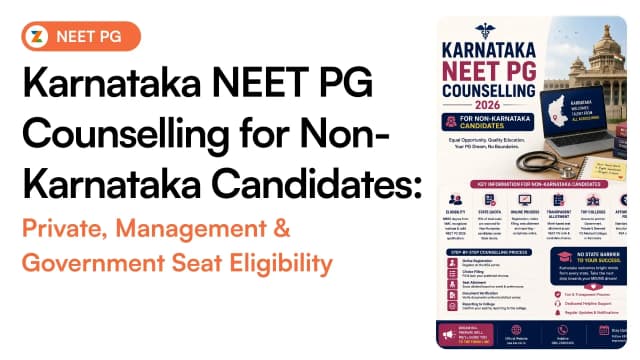
Karnataka NEET PG Counselling for Non-Karnataka Candidates: Private, Management & Government Seat Eligibility
Karnataka is one of the most preferred destinations for NEET PG aspirants from across India, particularly because its counselling includes seats in government colleges, private medical colleges, minority institutions and private universities. For Karnataka NEET PG counselling for non Karnataka candidates, however, the most important point is that eligibility depends on the type of seat being sought.
Sep 2, 2026
AP & Telangana NEET PG Local & Non-Local Quota: Eligibility, Domicile & Counselling Rules
For NEET PG aspirants targeting Andhra Pradesh or Telangana, qualifying NEET PG is only the first step. Eligibility for state counselling depends on the seat type, local-candidate status, study history and the documents used to establish that status.
Sep 2, 2026

Minority Seats in NEET PG Counselling: Linguistic & Religious Minority Eligibility, Colleges & Admission Rules
Minority seats in NEET PG counselling are available in certain medical colleges that have recognised religious or linguistic minority status. These seats are not governed by one uniform national minority-quota rule. The eligibility, documentation, seat distribution and counselling process can differ depending on the state, institution and type of seat.
Sep 10, 2026

NEC Seats in NEET PG Counselling: Meaning, Eligibility, Application Process & Admission Rules
NEC seats in NEET PG counselling are special seats reserved under the North Eastern Council (NEC) quota for candidates belonging to North Eastern States other than Assam. These seats are part of the Assam State Quota framework and are governed by the Medical Colleges of Assam (Regulation of Admission into Post Graduate Degree and Diploma Courses) Rules, 2021, as amended from time to time. The Directorate of Medical Education (DME), Assam conducts the State Quota counselling process.
Sep 7, 2026
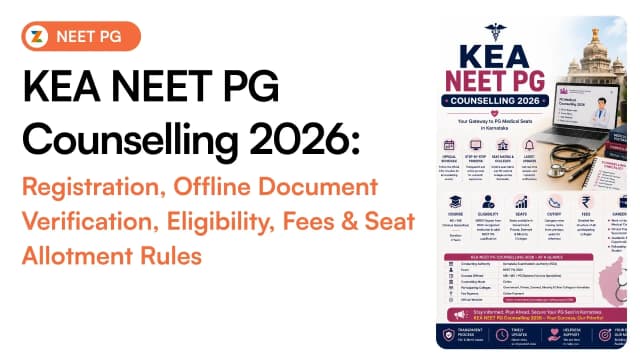
KEA NEET PG Counselling 2026: Registration, Offline Document Verification, Eligibility, Fees & Seat Allotment Rules
Karnataka NEET PG counselling is the state-level counselling process for admission to postgraduate medical courses in Karnataka. The Karnataka Examinations Authority (KEA) conducts centralized counselling for eligible NEET PG candidates for seats in government medical colleges, government quota seats in private and minority medical colleges, and private seats in eligible private institutions and few seats in deemed universities as well.
Aug 27, 2026