


All blogs
Share
02 Sept 2026
Can You Register for NEET PG Counselling in Multiple States? Re-Registration & Participation Rules
NEET PG counselling is divided into MCC counselling and state counselling, and each has its own registration process, eligibility conditions and participation rules. This often leads candidates to ask, “Can I apply for NEET PG counselling in multiple states?”
The answer is generally yes. A NEET PG qualified candidate can register for counselling conducted by multiple states, provided they meet the eligibility requirements of each state. However, registering in several states does not mean that a candidate can hold or join multiple PG seats simultaneously.
The most important distinction is between registration, participation, seat allotment and joining. Rules can also change from one state to another, particularly for domicile eligibility, state quota seats, resignation and stray vacancy rounds.
The latest completed MCC PG counselling cycle available officially is the NEET PG 2025 counselling cycle. MCC's 2025 bulletin states that MCC conducts counselling for AIQ, Deemed Universities, Central Universities/Institutes and DNB, while state counselling authorities conduct their respective state counselling.
Can You Register for NEET PG Counselling in Multiple States?
Yes, in general, you can register for NEET PG counselling in multiple states.
There is no single nationwide registration portal that covers all state quota counselling. Each state counselling authority has its own registration portal and eligibility criteria.
For example, a candidate may be eligible to register for:
Karnataka NEET PG state counselling
Maharashtra NEET PG state counselling
Rajasthan NEET PG state counselling
Uttar Pradesh NEET PG state counselling
The candidate must complete the NEET PG state counselling registration separately wherever they are eligible.
However, the fact that you can register in multiple states does not mean you automatically qualify for the government state quota in all of them. State quota eligibility may depend on factors such as domicile, place of MBBS study, local status, government service, category and other conditions prescribed by that state.
For instance, the official Telangana PG prospectus has prescribed local/non-local eligibility conditions for Competent Authority Quota seats, demonstrating why candidates must check the individual state's eligibility rules before registering.
So, NEET PG multiple state registration is possible, but state-wise eligibility is separate.
MCC vs State Counselling Registration
One of the biggest counselling mistakes is assuming that registering with MCC also registers you for state counselling.
It does not.
MCC Counselling
MCC conducts counselling for specified categories of PG seats, including:
50% All India Quota seats
Deemed University seats
Central Universities/Institutes
DNB seats covered under MCC counselling
The MCC bulletin separately identifies these counselling categories and states that MCC conducts their allotment process.
State Counselling
State counselling authorities conduct counselling for seats under their respective state systems. Candidates must visit the concerned state's official counselling portal and complete the required registration, document verification and choice-filling process.
Therefore:
NEET PG registration with MCC ≠ registration for state counselling.
A candidate interested in both MCC and state quota opportunities generally has to complete both processes separately.
Is Separate Registration Required for Each State?
Yes.
When you register for multiple NEET PG counselling, each state generally treats its counselling process as a separate application.
For example, registering for State A does not automatically create an application for State B.
A candidate must usually:
Register on the state's official counselling portal.
Pay the applicable registration or counselling fee.
Submit the required documents.
Complete state-specific verification, where applicable.
Fill and lock choices during the relevant round.
This also means that a candidate should keep track of different registration deadlines, document requirements and payment rules.
The dates can overlap, so missing one state's registration deadline cannot generally be corrected simply because you registered elsewhere.
Re-Registration Rules
NEET PG re-registration can mean two different things, and candidates should not confuse them.
1. Re-registration for another state
Suppose you register for Karnataka counselling and later decide to apply for Maharashtra counselling. This is not technically a re-registration within Karnataka. It is a new registration with another state counselling authority.
Each state has its own application process.
2. Re-registration in a later counselling round
This depends on the rules of the particular counselling authority.
For MCC's 2025 counselling, the registration rules varied by round. Candidates who registered in Round 1 and were not allotted a seat did not need to register again for Round 2. Candidates who had not registered in Round 1 could register freshly in Round 2.
For Round 3, MCC required fresh registration in specified circumstances, while candidates already registered and not allotted seats in earlier rounds did not necessarily have to register again.
This means NEET PG re-registration is round-specific, not a universal rule.
Always check the notification for the particular round.
Can You Participate in Counselling Simultaneously?
Yes, but with an important limitation.
You can generally have active registrations in multiple eligible state counselling processes at the same time. Therefore, can I participate in multiple state counselling? The practical answer is yes, subject to the rules of those counselling authorities.
For example, a candidate could remain registered in:
MCC + State A + State B and monitor allotments from each process.
The problem begins when a candidate is allotted or joins a seat and wants to continue participating elsewhere.
MCC's counselling system specifically coordinates candidate data with participating states. After Round 3, MCC shares joined-candidate data with the states, while states also share their joined-candidate data with MCC. Joined candidates can subsequently be filtered out of rounds for which they are no longer eligible.
So, simultaneous registration is different from simultaneous seat holding.
Can You Hold a Seat in One State and Participate Elsewhere?
This is where candidates need to be especially careful.
Being allotted a seat and actually joining the seat are not always treated in the same way.
Round 1
Some counselling systems provide an exit or upgrade option after Round 1.
Under MCC's 2025 rules, a candidate allotted a Round 1 seat could use the free-exit option and participate in Round 2. A candidate who wanted to retain the Round 1 seat while seeking upgradation had to report and provide the required willingness for upgradation. In 2026, reporting may not be required for candidates who wish to retain their allotted seat while participating in upgradation. However, this should be treated as provisional until MCC publishes the official 2026 information bulletin with the updated rules.
Later rounds
The consequences become stricter in later rounds.
Under the MCC 2025 scheme, a candidate upgraded in Round 2 had to leave the Round 1 seat and join the Round 2 seat. The earlier seat could not be retained.
In Round 3, once a candidate joined the upgraded seat, the candidate could not upgrade or resign from that Round 3 seat under the MCC rules.
State counselling can have its own rules on resignation and participation. Some states may also make candidates ineligible for later rounds once they have joined a seat.
Therefore, do not assume:
“I will join this college now and leave whenever another state gives me a better seat.”
That may result in forfeiture, cancellation or loss of eligibility for subsequent rounds.
Fees & Security Deposits
Registering for multiple NEET PG counselling processes can also mean paying fees to multiple authorities.
Each state can prescribe its own:
Registration fee
Security deposit
Tuition fee payment requirement
Counselling fee
Refund conditions
The MCC fee structure is separate from state counselling fees.
For example, in MCC's 2025 PG counselling, the AIQ registration fee was ₹1,000 for UR/EWS candidates and ₹500 for reserved candidates, along with refundable security deposits of ₹25,000 and ₹10,000 respectively. Deemed University counselling had a higher fee and security deposit.
MCC also specified situations in which the refundable security deposit could be forfeited, including failure to join an allotted seat in Round 2 or later rounds, or cancellation of admission due to certain reasons.
State counselling authorities may have completely different fee amounts and refund policies.
Therefore, before you register for multiple NEET PG counselling, calculate not only the registration cost but also the amount that may remain blocked as a security deposit.
Important State-Specific Restrictions
The biggest limitation on NEET PG counselling multiple states is not registration itself. It is eligibility and round-wise participation.
Domicile and state quota eligibility
Some states restrict government quota eligibility based on domicile, MBBS education or local status.
For example, Telangana's rules have prescribed local/non-local criteria for Competent Authority Quota admissions.
Other-state candidates
Some states may permit candidates from outside the state for particular categories or seats while restricting them from specific state quota seats.
This is why candidates must distinguish between:
Can I register? And For which seats am I eligible?
These are not necessarily the same question.
Stray vacancy restrictions
Stray rounds are usually much stricter.
For example, the official Uttar Pradesh NEET PG 2025 brochure states that candidates who had taken admission to a PG course in a medical or dental college in India through AIQ or another state quota counselling were not eligible for the UP NEET PG stray vacancy round.
This illustrates an important point: participation rules can become more restrictive as counselling progresses.
State-specific resignation rules
A state may also specify:
Whether resignation is permitted
The last date for resignation
Whether fees are refundable
Whether a resigned candidate can participate in the next round
Whether a joined candidate becomes ineligible for later rounds
These provisions must be checked in the relevant state's official counselling notification.
Practical Strategy for Candidates
Registering for multiple states can be useful, particularly for candidates who want to maximise their options. But it should be done strategically.
Start by making a list of states where you are actually eligible, instead of registering everywhere.
Then compare:
State eligibility
Seat availability
Fees
Stipend
Bond conditions
Counselling schedule
Resignation rules
Stray-round eligibility
Most importantly, maintain a counselling calendar. State registration windows, choice filling and reporting dates can overlap.
When you receive an allotment, immediately check:
Can I retain this seat? Can I upgrade? Can I resign? Will I remain eligible for another counselling? Will my security deposit be forfeited?
This is particularly important from Round 2 onward because the exit and upgrade rules can become much stricter. MCC's 2025 scheme, for example, required candidates upgraded to a Round 2 seat to relieve from their earlier seat and join the new one.
A simple example
Suppose you register for:
MCC + Karnataka + Maharashtra + Rajasthan
You are not holding four seats. You are simply participating in four separate counselling processes.
If you receive a seat in Karnataka and later want to pursue Maharashtra, whether you can continue depends on whether you have merely been allotted the seat, reported to it, joined it, or resigned from it, as well as the rules applicable to that particular round.
So the safest approach is to treat every allotment as a decision point, not simply as a temporary seat.
_11zon.webp)
Frequently Asked Questions
Here are some answers to questions you might be looking for.

Related Blogs

NEC Seats in NEET PG Counselling: Meaning, Eligibility, Application Process & Admission Rules
NEC seats in NEET PG counselling are special seats reserved under the North Eastern Council (NEC) quota for candidates belonging to North Eastern States other than Assam. These seats are part of the Assam State Quota framework and are governed by the Medical Colleges of Assam (Regulation of Admission into Post Graduate Degree and Diploma Courses) Rules, 2021, as amended from time to time. The Directorate of Medical Education (DME), Assam conducts the State Quota counselling process.
Sep 7, 2026

Rural Service & Institutional Preference in NEET PG Counselling: Eligibility, Quota & State-Wise Rules
Rural service and institutional preference are two important concepts that can affect eligibility, merit calculation and seat allocation in NEET PG state counselling. However, neither works through one uniform national rule. Individual states frame their own policies for government service candidates, rural or difficult-area service, institutional preference and related incentives.
Sep 10, 2026

NEET PG Counselling Security Deposit, Forfeiture & Auto-Forfeiture Rules: Quota-Wise Amounts & Conditions
The NEET PG security deposit is an important part of counselling registration because it is refundable only when the candidate complies with the applicable counselling rules. The amount varies depending on whether the candidate is participating in AIQ or Deemed University counselling and, for AIQ, according to the applicable category.
Sep 16, 2026
KEA NEET PG Counselling 2026: Registration, Offline Document Verification, Eligibility, Fees & Seat Allotment Rules
Karnataka NEET PG counselling is the state-level counselling process for admission to postgraduate medical courses in Karnataka. The Karnataka Examinations Authority (KEA) conducts centralized counselling for eligible NEET PG candidates for seats in government medical colleges, government quota seats in private and minority medical colleges, and private seats in eligible private institutions and few seats in deemed universities as well.
Aug 27, 2026
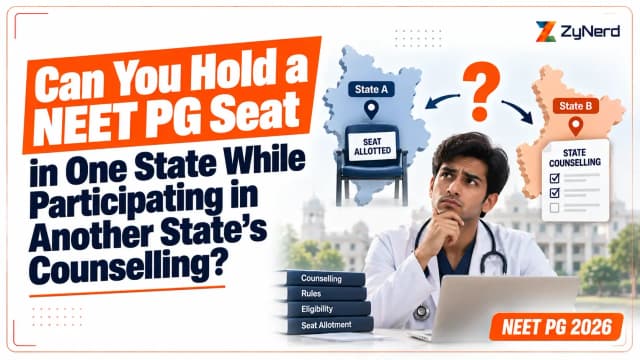
Can You Hold a NEET PG Seat in One State While Participating in Another State's Counselling?
Many NEET PG candidates participate in both All India Quota and state counselling because the same NEET PG rank can open opportunities across different counselling systems. This often creates a practical question: can I hold a NEET PG seat in one state and still participate in counselling conducted by another state?
Sep 15, 2026

Minority Seats in NEET PG Counselling: Linguistic & Religious Minority Eligibility, Colleges & Admission Rules
Minority seats in NEET PG counselling are available in certain medical colleges that have recognised religious or linguistic minority status. These seats are not governed by one uniform national minority-quota rule. The eligibility, documentation, seat distribution and counselling process can differ depending on the state, institution and type of seat.
Sep 10, 2026