


All blogs
Share
Published on 1 May, 2026
INI CET Exam Pattern 2026 Explained: Questions, Marking Scheme, and Time Management
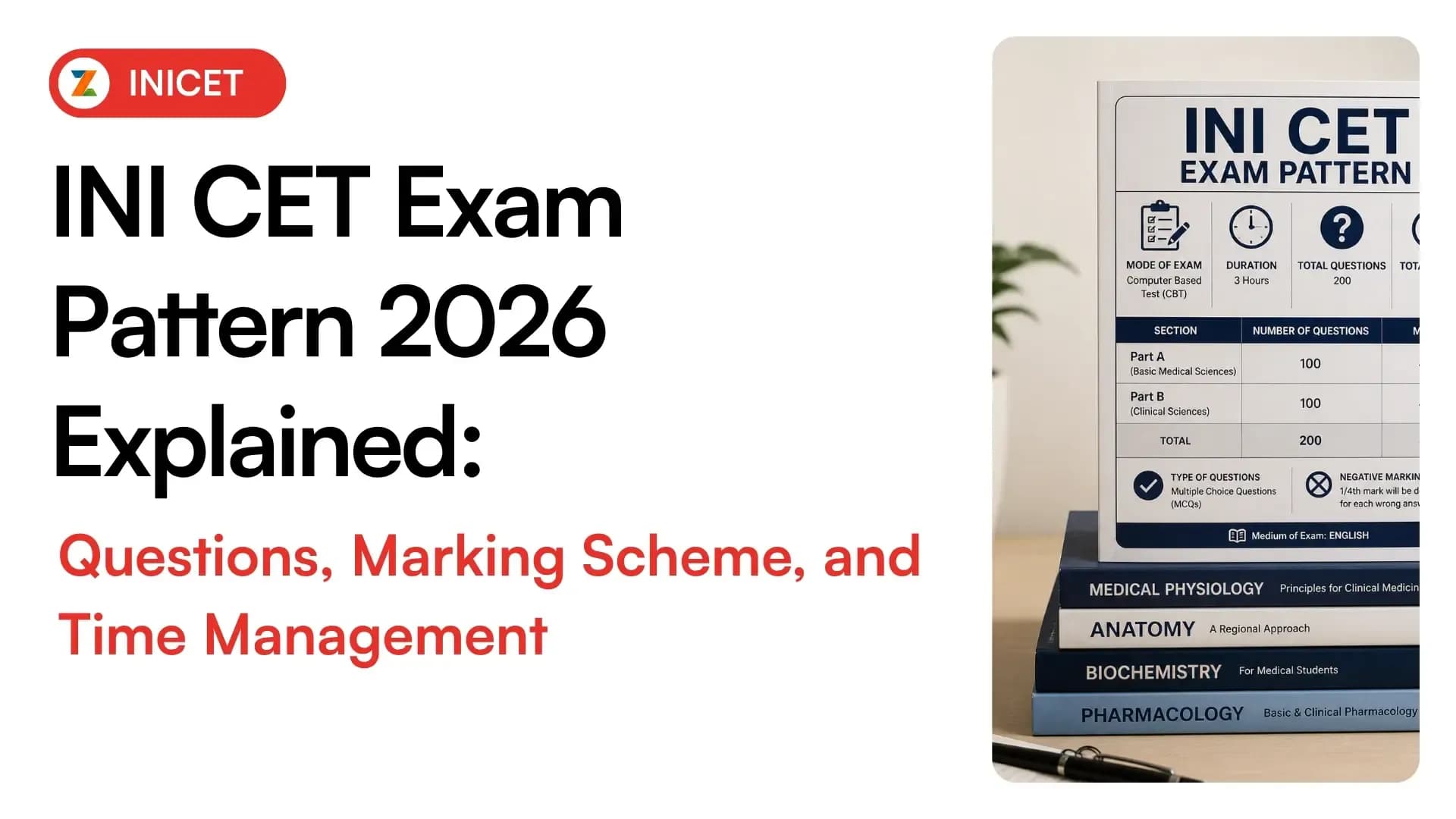
INI CET is the exam for admission to postgraduate courses in institutes like AIIMS, JIPMER, NIMHANS, PGIMER, and SCTIMST. For the 2026 session, it is conducted online and includes 200 questions to be completed in 3 hours. All questions are objective. Each correct answer gives one mark, and each wrong answer leads to a deduction of one-third mark.
Understanding this basic structure early makes a difference. It helps you plan how to attempt the paper, manage time in each section, and avoid losing marks due to negative marking.
INI CET Exam Pattern 2026 Overview
According to the AIIMS prospectus, INI CET is conducted in computer-based mode and the total duration is 3 hours. The paper consists of 200 objective-type questions. These include both single correct and multiple correct answer formats. Each correct answer gives one mark, and each wrong answer cuts one-third mark. Questions you leave unanswered do not affect your score.
The paper is split into 4 sections, and each section has 50 questions. Each section is allotted 45 minutes. The sections run one after the other, and once the time for a section ends, it gets submitted automatically. You cannot go back and attempt or review questions from the previous section after that.
INI CET Detailed Exam Pattern 2026 Overview
Gives a clear idea of how the paper is arranged, including sections, questions, and time. Helps you know what to expect on exam day.
Particulars | Details |
|---|---|
Exam Mode | Computer-Based Test (CBT) |
Duration | 3 hours (180 minutes) |
Total questions | 200 |
Type of questions | MCQs |
Correct answer | +1 mark |
Incorrect answer | -1/3 mark |
Unanswered / marked for review | 0 mark |
Paper breakup | 4 parts, 50 questions each, 45 minutes per part |
INI CET Exam Pattern 2026 Marking Scheme
Shows how marks are given for correct answers and cut for wrong ones. Makes it easier to understand how your score is calculated.
Answer | Marks |
|---|---|
Correct answer | +1 |
Wrong answer | -1/3 |
Unanswered | 0 |
Marked for review | 0, unless answered later within the active section time |
How to Handle the Paper and Prepare Effectively
The structure of INI CET forces you to think in short, controlled phases rather than one long stretch. Each section has 45 minutes, and once that time is over, it’s gone. Because of this, the goal is not to attempt everything, but to use that 45 minutes well.
At the start of a section, it helps to move quickly through the paper and pick out questions that feel straightforward. These are usually direct concepts, familiar clinical scenarios, or things you’ve revised recently. Getting these done early builds momentum and secures marks without pressure.
After that, shift to questions where you can eliminate one or two options. Even if you are not fully sure, partial clarity can still help you reach the correct answer. This is where most students gain an edge, not by knowing everything, but by making better decisions.
Questions that feel completely unfamiliar or too time-consuming should not be forced immediately. Leaving them for later prevents unnecessary loss of time. If there is time left at the end of the section, you can come back and take a second look with a calmer approach.
Accuracy matters more than the number of attempts. Because of negative marking, random guessing often reduces your score instead of improving it. A balanced attempt with controlled risk works better than trying to answer every question.
Focus more on revising what you’ve already studied instead of constantly adding new topics. Without revision, it becomes hard to recall things in the exam. Going through your notes regularly and solving mixed questions helps improve both speed and accuracy.
It also helps to practice tests in the same format as the exam. Solving questions in 45-minute sections trains you to manage time better and stay calm under pressure.
With practice, you should get used to switching between subjects, dealing with questions you’re unsure about, and keeping a steady pace throughout the paper. That combination is what the exam actually tests.
Important Rules to Keep in Mind
These are basic exam-day rules that are often ignored but can directly affect your attempt. Knowing them in advance helps avoid last-minute issues and unnecessary stress.
Admit card must be downloaded online before the exam. Entry to the exam hall is not allowed without a printed admit card.
Reach the exam centre as per the reporting time mentioned. Late entry is usually not permitted.
The exam runs in 4 fixed sections. Once a section ends, it is submitted automatically and cannot be accessed again.
Only the active section will be visible on the screen. Other sections remain locked until their turn.
In case two candidates get the same score, ranking is decided based on fewer negative marks first. If still tied, the candidate with more percentage in qualifying examination degree is given preference.
PwBD candidates who are eligible can use a scribe or get compensatory time as per the official rules. This extra time is usually given at a fixed rate per hour of the exam.
Follow all exam hall instructions carefully. Any violation can lead to disqualification.
Mistakes to Avoid in INI CET Exam Pattern
Small errors in approach can make a big difference in a paper like this. Avoiding these can help you use your preparation more effectively.
Spending too long on one question and then rushing through the rest of the section
Treating it like a continuous 3-hour paper instead of handling it in 45-minute sections
Trying to attempt every question without thinking about negative marking
Relying on fixed subject weightage instead of preparing all subjects together
Skipping timed practice and going straight to full-length tests
Changing answers again and again without a clear reason
Leaving revision and focusing only on new topics close to the exam
Not practicing mixed questions, which makes switching between subjects harder during the paper

Frequently Asked Questions
Here are some answers to questions you might be looking for.

Related Blogs

NEET PG 2026 Answer Key: Release Date, PDF, Download Steps & Marking Scheme
The NEET PG answer key usually helps candidates verify their responses and estimate their probable score and last year it was released after the official result was declared. This year, the answer key may be published before the results are announced. The National Board of Examinations in Medical Sciences (NBEMS) conducted NEET PG 2026 on August 30, 2026, with a re-examination held for affected candidates at selected Jaipur centres on September 5.
Sep 23, 2026

NEET PG Marks vs Rank 2026: Expected Rank, Previous Year Data, Cutoff & Analysis
The NEET PG marks vs rank 2026 comparison is especially important this year because NEET PG has moved from an 800-mark paper to a 720-mark paper. The 2026 examination had 180 questions instead of 200, while the marking scheme remained +4 for a correct answer and -1 for an incorrect answer.
Sep 25, 2026
NEET SS Syllabus 2026: Subject-Wise Syllabus, DM/MCh Specialities & Exam Pattern
The National Eligibility cum Entrance Test for Super Speciality (NEET SS) is a national-level entrance examination conducted by the National Board of Examinations in Medical Sciences (NBEMS).
Nov 11, 2026
Tripura NEET UG Counselling 2026: Registration, Eligibility, Dates, Fees, Seat Matrix & Admission Process
Tripura NEET UG Counselling 2026 is the state-level admission process for candidates seeking MBBS, BDS and other NEET-based undergraduate medical and allied health courses through seats administered by the Tripura Medical Counselling Committee (TRMCC). The counselling is conducted under the Directorate of Medical Education (DME), Government of Tripura.
Aug 17, 2026

NEET PG 2026 Round 1 Seat Allotment Result, Download Link, Reporting and Free Exit Rules
The NEET PG Round 1 seat allotment result 2026 is an important milestone for candidates seeking admission to MD, MS, DNB and other eligible postgraduate medical programmes through MCC counselling.
Oct 23, 2026

Tamil Nadu NEET PG 2026 Counselling Documents Required: Complete Checklist for All Quotas
Candidates preparing for Tamil Nadu NEET PG 2026 counselling should keep all the required certificates and documents ready before completing the counselling application. The Tamil Nadu Selection Committee, Directorate of Medical Education and Research, Chennai, has notified candidates that counselling for PG MD, MS, Diploma and DNB courses for the 2026-27 session will commence shortly.
Oct 13, 2026